A star has died, but the instrument is still covered in stars. That is the small disturbance inside Gérard de Nerval's black-sun image. In the opening quatrain of “El Desdichado,” the speaker's sole star is dead; his lute, meanwhile, carries the black sun of melancholy. Light has gone out in one place and become impossible in another. Before deciding what the sun means, a translator has to decide what is happening to the lute.[1]
The French places the objects together:
Ma seule étoile est morte, — et mon luth constellé
Porte le Soleil noir de la Mélancolie.[1]
A literal gloss would be: my only star is dead, and my star-studded lute bears the black sun of melancholy. The oddness belongs to the original. The sun is dark, yet it has enough presence to be carried. The instrument remains ornamented with the very thing the speaker has lost.
The sonnet first appeared in Le Mousquetaire on 10 December 1853 and entered Les Filles du feu in 1854. Its wording changed between those publications. The French quotations here follow the later text as printed in the 1856 edition reproduced by Wikisource; the University of Wuppertal's Lyriktheorie archive supplies the earlier newspaper version.[1][2] That distinction matters because some apparent translation choices begin as differences between French texts.
Two freely accessible English renderings make the choices unusually visible: Peter Shor's version, dated May 2021, and novelist Adam Roberts's version, published with his commentary in April 2025. These are two individual experiments, each with its own priorities, rather than a survey of Nerval in English.[3][4]
Start with the voice. The French opening, “Je suis,” introduces a succession of identities: the dark one, the widower, the unconsoled. Each definite article makes its condition sound like a title. The next line supplies an actual title, the prince of Aquitaine, attached to a tower that has been abolie. An English tower can be ruined, demolished or, more strangely, abolished. “Ruined” offers something we can picture; “abolished” makes the loss sound like the cancellation of an entire order of existence. These are possible English effects, not interchangeable descriptions.[1]
The sentence seems certain about who is speaking until line nine reverses its opening. “Je suis” becomes “Suis-je”: I am becomes am I? The speaker tries divine and historical names without settling among them. Even a reader who cannot identify every allusion can hear the change from announcement to interrogation. A translation can preserve that movement without solving the identity puzzle for us.[1]
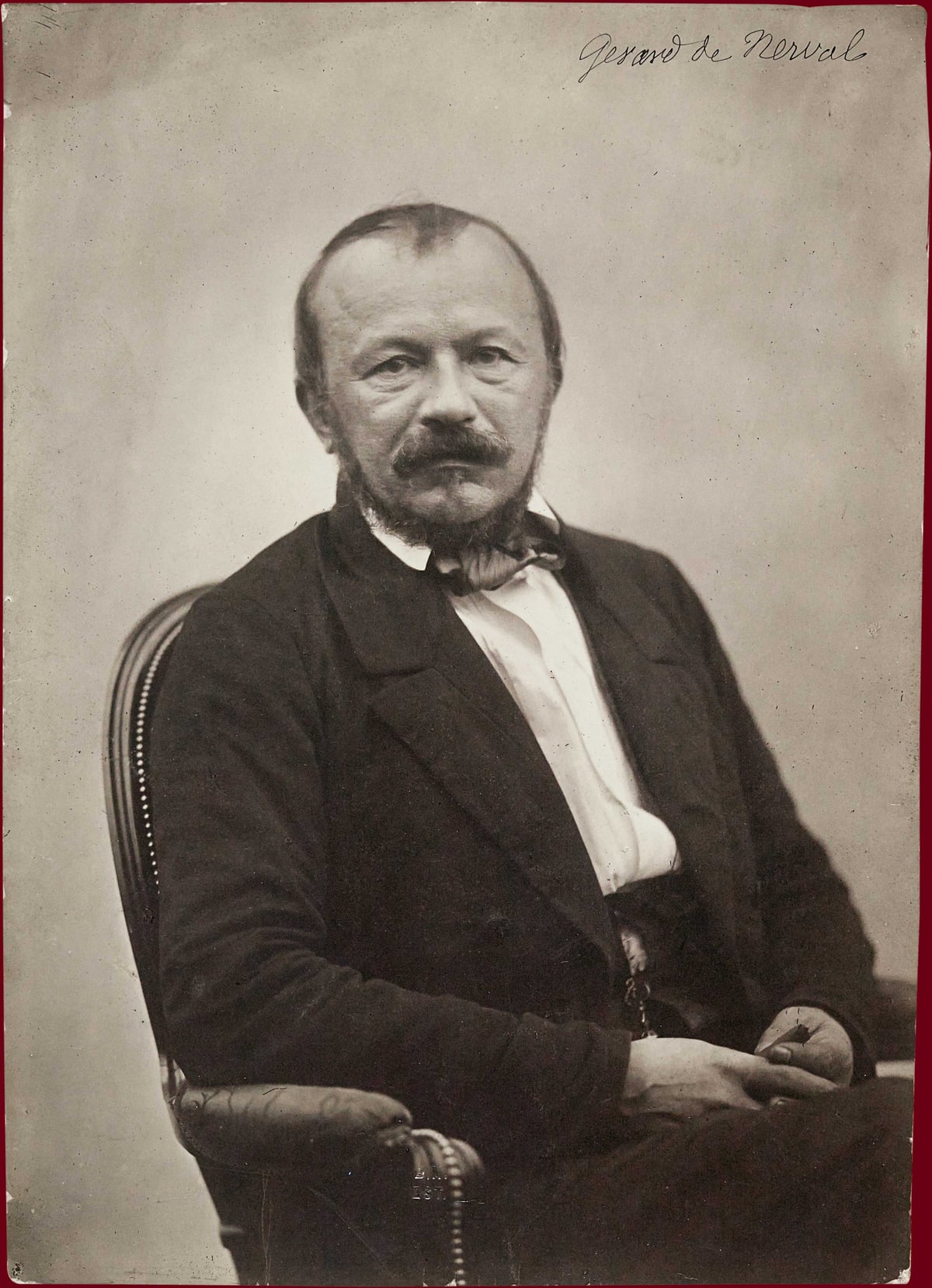
The archival photograph accompanying this essay supplies a different kind of identification. The BnF dates Adrien Tournachon's portrait of Nerval to 1855 and records the material print. It gives us a particular sitter, photographer and object.[5] The sonnet's speaker remains harder to pin down. Reading the portrait as a key to every mask in the poem would close questions that the verse keeps asking.
On the lute, one adjective concentrates the difficulty. Constellé brings stars into the instrument's surface and echoes étoile, the dead star earlier in the line. Its literal visual information also creates a relationship: the private loss and the musical object belong to the same sky. That relationship survives even if we cannot say whose death the star represents.[1]
Shor renders this area with “rare design” and describes it as emblazoned on the lute. His phrasing makes the instrument easy to imagine as a decorated object. To my ear, it also loosens the immediate verbal connection between the dead star and the stars on the lute: the second stellar image has become a design whose content arrives with the black sun.[3]
Roberts takes a more interpretive route with “star-sign.” The phrase suggests an astrological identity. A reader encounters an instrument marked by a governing sign, whereas the French adjective can leave us looking at a surface scattered with stars. Roberts's choice gives the image a particular direction; the less interpretive English “star-studded” would keep its visual relationship more readily available.[1][4]
Neither choice is a trivial change of decoration. If the lute displays an emblem, the poet seems to bear a badge. If it has a star-sign, his music seems subject to a destiny. If it is scattered with stars, the lost light persists as a pattern on the thing he plays. These are readings invited by the wording. The French does not force us to choose a single explanation.
A quieter repetition helps hold the strange images together. The speaker who calls himself inconsolé addresses someone who has consolé him. The first word announces a condition; the second remembers an act that once interrupted it. His request, Rends-moi, asks for restoration: an Italian place and sea, a flower, a trellis where rose and vine meet. The poem can be mysterious about the addressee while remaining exact about the grammar of wanting something back.[1]
The ending moves from things seen to sounds made. After claiming to have crossed Acheron twice in victory, the speaker describes playing on Orpheus's lyre. The last line brings together soupirs and cris: sighs and cries, belonging respectively to the saint and the fairy. “Cries” leaves room for several kinds of utterance. “Screams” makes their violence harder to miss. “Songs” would make them more comfortably musical.[1]
Shor chooses “the fairy's scream.” The sharpness keeps a disturbance audible beside the saint's softer breath. Roberts ends with “hymns” and explicitly acknowledges that departure in his accompanying note: he hears a hymnal quality in the sonnet. His explanation makes the choice available for judgment. The ending becomes more devotional and harmonious, even as the contrast between its two voices narrows.[3][4]
Here the earlier French text offers a useful check on our ears. The 1853 newspaper version has the speaker crossing Acheron vivant, alive, where the later text says vainqueur, victorious. Its penultimate line pairs modulation with singing; the later version instead specifies tour à tour, in turn.[1][2] Surviving becomes winning, and an act of singing becomes an alternation. Those differences precede the English translator.
For me, that alternation prevents victory from sounding final. The speaker can perform both voices without reducing them to one mood. His instrument holds the saint's sigh and the fairy's cry just as the earlier lute holds stars after the death of his star. Making the music does not require the contradictions to disappear.
Read the two English versions with those small hinges in mind: the star repeated or displaced, the declaration turned into a question, the cry softened or sharpened. A translation gives the poem an audible shape. Comparing shapes lets us hear where an apparently clear English phrase has settled something that Nerval left vibrating.
Sources
- Gérard de Nerval, “El Desdichado,” Les Chimères, Michel Lévy Frères, 1856, p. 291, Wikisource — French text used for quotations and line references; literal English glosses in this essay are the author's.
- University of Wuppertal, Lyriktheorie, “1853 Gérard de Nerval: El Desdichado” — newspaper text, first-publication details and the 1854 collection reference.
- Peter Shor, “My translation of El Desdichado,” May 2021, MIT faculty website — English rendering and accompanying French text.
- Adam Roberts, “Nerval, ‘El Desdichado’ (1854),” 29 April 2025 — English rendering and the translator's explanation of his final-word choice.
- Bibliothèque nationale de France, The Nadars, a photographic legend, “Gérard de Nerval” — Adrien Tournachon's 1855 portrait, photographic process, collection reference and image provenance.