Miss Mapp can work out a surprising amount from a sponge. When Captain Puffin puts one on his window sill, she knows how far he has advanced through his morning routine. A shopping basket is almost as eloquent. Its contents, its shape, even the liquid leaking through it can disclose what a neighbour intends to serve for tea. In the opening chapter of E. F. Benson's Miss Mapp, watching the street is skilled work.[1]
The pleasure of Elizabeth Mapp is that she really is observant. Benson gives her a quick intelligence before showing what she does with it. She notices arrangements, reconstructs motives and anticipates opportunities. But her best view has a blind spot: she struggles to imagine that anything happening within sight might have nothing to do with her standing in Tilling. Information becomes a claim on other people's lives.
This essay discusses events near the novel's ending.
The window confers no office
Benson introduces Mapp at a bow window projecting from her garden room. The street runs downhill in front of her; her house lies to one side, the church to the other. She can monitor her gardener's punctuality, inspect the movements of servants and watch neighbours emerge for their morning shopping. A fig tree conceals her at another window. Visibility is unevenly distributed, and she has the better side of the arrangement.[1]
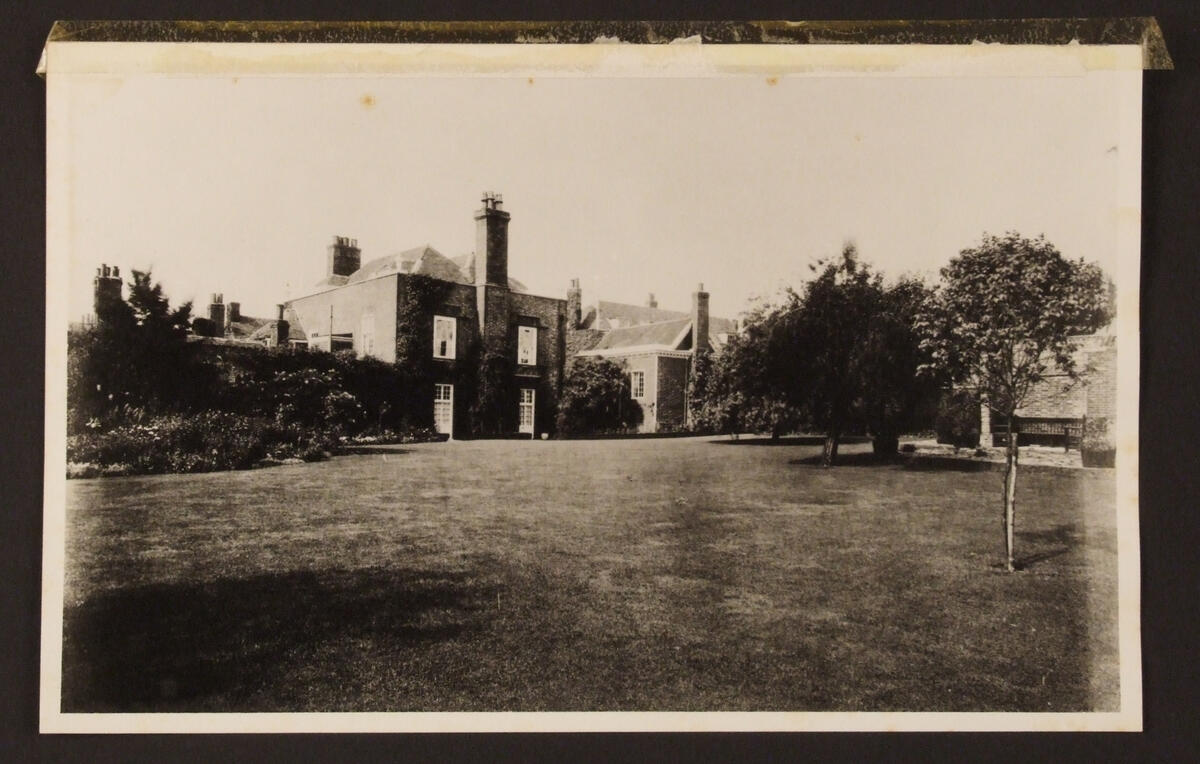
The architecture comes from a real place. Lamb House in Rye, previously occupied by Henry James and later by Benson, became Mallards in the Mapp and Lucia novels; Rye supplied the model for Tilling. The National Trust's archival photograph records the garden front and the separate Garden Room, before that room's destruction in a bombing raid in 1940. The photograph preserves the physical setting from which Benson developed his fictional vantage point.[2][4]
What matters is how she inhabits it. The church's history holds little interest because a guidebook could supply it. Her gardener's lunch break is another matter. When she intercepts a child carrying a basket, suspected theft turns out to be a strawberry net sent for repair. She then checks that the net comes back. Innocence ends this particular accusation without disturbing the habit that produced it.[1]
Benson makes that habit wonderfully explicit when she considers the late-night lights in two neighbours' houses: “Miss Mapp knew better than that, but she had not made up her mind exactly what it was that she knew.” The sentence gives certainty a head start on knowledge. Its first clause supplies the satisfaction of superiority; its second quietly removes the evidence.[1]
Yet she is not simply wrong about everything. Remembering that Mrs. Plaistow has avoided hard chocolates helps her infer a visit to the dentist. Ice and red currants suggest a dessert. Benson lets us enjoy the detective work, then shows suspicion adding ingredients of its own. The fruit must be inferior; the dessert must be an attempt to copy Mapp's supposedly ancestral recipe. Observation has slipped into a story about an affront.[1]
A gracious voice can leave you stranded
Mapp's power becomes clearest when she stops looking and goes to the telephone. Isabel Poppit invites her to tea and bridge that afternoon. Mapp concludes that she is a replacement for somebody more desirable. The late invitation wounds her, but the wound immediately becomes a calculation: the hosts need eight players for two tables.[1]
A refusal might inconvenience them; an acceptance would settle the matter. Mapp finds a more satisfying reply: “I'll try to look in if I can.” If Isabel recruits someone else, Mapp can arrive and make nine. If no substitute is found, she can stay away and leave seven. Her apparent flexibility prevents her hostess from making a reliable plan.[1]
This is a small masterpiece of character revealed through logistics. Mapp does not need to issue an order. She makes her own behaviour uncertain and leaves someone else responsible for accommodating it. The gracious voice matters because it preserves her claim to be doing a favour. Her aggression has become difficult to challenge without appearing ungrateful.
It also reveals her dependence. She wants the bridge and the good tea. She wants a chance to criticise the pudding. She cannot comfortably abandon the people she despises, because their gatherings provide the occasions on which she can count. The invitation lets us see both sides of her manoeuvre: a woman making herself indispensable because she fears she has become optional.
That fear also shapes her contempt for the wealthy Poppits. She regards herself as a defender of Tilling's established families while accepting their hospitality freely and refusing to reciprocate to Mrs. Poppit. Benson specifies the convenient stopping point of her resistance: it does not extend to missing a meal. Her social principles repeatedly leave room for her appetites.[1]
Other people have windows too
The novel eventually reverses the flow of information. Near the end of chapter XI, Mapp wants to know about a bridge game from which she was excluded. Mrs. Plaistow, usually called Diva, possesses the answer and can choose when to give it. Mapp must flatter her, find an opening and finally ask directly. The observer has become a petitioner.[1]
Diva's compressed answer supplies the players and almost nothing else. She then disappears into her house. Earlier, Mapp kept Isabel suspended over an invitation; now somebody else controls the duration of her uncertainty. No grand punishment is necessary. Tilling can hurt her simply by enjoying itself elsewhere.
Chapter XII makes the limit even more exact. Mapp can hear the visiting Contessa talking inside Major Flint's house while his servant denies that he is at home. Her senses are working perfectly. What they cannot obtain is admission. Being able to prove that a gathering exists does not make her welcome at it.[1]
Benson allows this exclusion to sting without turning Mapp into a misunderstood innocent. On Christmas evening she waits in vain for the Major to accept her offer of company. Her loneliness is real, but her thoughts about his ailing friend Captain Puffin are also opportunistic: a permanent reduction in that friendship would improve her own prospects. Wanting companionship does not prevent her from treating other attachments as obstacles.[1]
This mixture keeps the character alive. We can recognise the hurt of being left out while recoiling from her proposed remedies. The comedy does not require us to choose between pitying her and seeing through her.
The room itself has acquired an afterlife. In her study of Lamb House, Ailsa Boyd argues that literary representations can preserve architecture after its physical destruction. She also traces how control of Mallards becomes entwined with social leadership across Benson's later novels. The house is more than background: possessing a desirable position encourages its occupant to imagine a corresponding authority over the town.[3]
In Miss Mapp, that imagined authority is already unstable. A window can reveal a party, a telephone can unsettle a hostess, and an insinuation can spoil someone's afternoon. None can compel affection. Mapp's great comic predicament is that she understands so much about where people go, and so little about why they might prefer to go without her.
Sources
- E. F. Benson, Miss Mapp, Project Gutenberg full text — preface and chapters I, XI and XII; all quotations and fictional incidents discussed here.
- National Trust, “The history of Lamb House” — James and Benson's residence, Rye as Tilling, Mallards and the Garden Room's destruction.
- Ailsa Boyd, “A conscious memento”: The Literary Afterlives of Henry James's Lamb House, Interiors (2019), author's accepted manuscript — architectural memory and the Mapp and Lucia novels, especially PDF pages 17–19.
- National Trust Collections, “The garden front and the Garden Room from the South, Lamb House, Rye, East Sussex,” NT 204219 — archival photograph; date unrecorded; image credit National Trust / Charles Thomas.