The snake is dead before the most important thing happens. Henry Lawson’s bushwoman has broken its back, crushed its head and thrown it into the fire. Her son Tommy stands watching it burn. Then he looks up. The shift is tiny: from the defeated animal to his mother’s wet eyes. It changes what he thinks he can do for her.[1]
“The Drover’s Wife,” Lawson’s 1892 story, spends a night with a woman guarding her children while her husband is away moving sheep. Its ending is often easy to remember as an embrace after danger. Read the gestures in order, though, and the embrace becomes more demanding. Tommy has wanted to prove himself useful by striking something. His final promise concerns the person who must keep working when the excitement is over.[1][3]
This essay discusses the story’s ending.
A stick is easier than attention
At the first alarm, Tommy wants his mother to stand back while he deals with the snake. The disproportion is comic: his stick is bigger than he is. When he swings, he injures the dog’s nose. Later, tucked up with the other children on the kitchen table, he keeps his club under the bedclothes, where it torments his brother. His equipment for protecting the family makes somebody else uncomfortable.[1]
These incidents make his courage both appealing and troublesome. He is eager, attached to his mother and genuinely ready to help. But he keeps imagining help as a chance to enter the fight. She has to protect him from the danger and from his enthusiasm for it.
When the snake finally emerges, the pattern returns. Tommy wakes, grabs his stick and tries to climb down. His mother pushes him back with a “grip of iron.” She finishes the killing while keeping him out of it. The force that looks harsh from the child’s side is doing the work of care.[1]
Lawson has already said that she loves her children but scarcely has time to show it. That observation acquires a physical form here. One hand must interrupt her son’s adventure while she deals with an animal that could kill him. Affection has to become restraint before it can become an embrace.
The hand changes its work
After the blows, Lawson slows the scene. The woman feeds the fire. Mother, boy and dog watch. She rests a hand on Alligator’s head, and his fierceness subsides. The younger children settle back to sleep. The repeated actions of combat give way to touch, stillness and looking.[1]
This pause matters because killing the snake has solved only the immediate emergency. Throughout the vigil, the narrative has opened into the woman’s memories: fire, flood, sick cattle, childbirth and a child’s death. The reader has spent the night learning how much one household asks of her. Tommy has slept through most of that narrated history. We should not assume that he suddenly knows everything we know. What he sees now is enough to interrupt his excitement: his mother is crying.[1]
He puts his arms around her neck and says:
“Mother, I won’t never go drovin’; blarst me if I do!”[1]
The roughness of the language survives his change of attention. Earlier, his swearing drew corrections; now the oath gives tenderness the force of a declaration. Lawson does not supply Tommy with an adult vocabulary of obligation. He lets the boy make a commitment in the voice we have already heard.
Its subject is striking. Tommy does not promise to kill the next snake. He names the work that takes his father away. I read this as his first attempt to connect his mother’s distress with a pattern of absence, rather than with an enemy he can hit. Staying becomes something he can imagine doing for her.
That interpretation needs a limit. The story calls the father a “good enough husband” and explains that drought ruined his attempt to settle. Droving is a way to earn, and he intends to move his family to town. Tommy’s vow expresses love without solving the problem of how a family might live together and still make a living.[1]
Daylight makes no guarantee
There is a family history behind this attention to the person left at home. Heritage NSW identifies Lawson’s mother, Louisa, and his childhood experiences as sources for the story. Its account also follows Louisa into publishing and advocacy for women’s employment. That context helps us resist treating the fictional wife’s endurance as the whole imaginable life of a bush woman.[2]
The story’s later readers have also questioned whose experience its sympathy contains. In the State Library of New South Wales magazine Openbook, Susan Hunt describes Leah Purcell’s play, novel and film as reinterpretations from an Indigenous perspective. Lawson’s own narrative records Indigenous assistance at childbirth while using racist language to describe it. His capacity to recognise one woman’s burden coexists with limits in how he represents other people.[1][3]
The final embrace gains force when we keep those limits, and the family’s practical difficulties, in view. A feeling of recognition is an opening. It cannot certify the future. Lawson gives us no grown-up Tommy, no completed record of a promise kept.
He gives us two people sitting together as “sickly daylight” enters the bush. The adjective leaves the morning frail. Outside, the conditions that exhausted her continue; inside, the hands that restrained the child can briefly hold him close.[1]
Tommy began by asking for room to swing his stick. He ends by closing the distance between himself and his mother. The snake has stopped moving. At last, he has noticed who cannot afford to stop.
Sources
- Henry Lawson, “The Drover’s Wife,” in While the Billy Boils, Project Gutenberg full text — the opening encounter, overnight recollections and final six paragraphs; all quotations and fictional incidents discussed here.
- Heritage NSW, “Louisa Lawson,” Blue Plaques — the story’s connection to Lawson’s mother and childhood, and Louisa’s work in publishing and women’s employment.
- Susan Hunt, “Do we still have time for Henry Lawson?”, Openbook, Spring 2022, pp. 74–77, State Library of New South Wales — the story’s 1892 date, Purcell’s reinterpretations and Lawson’s literary reputation.
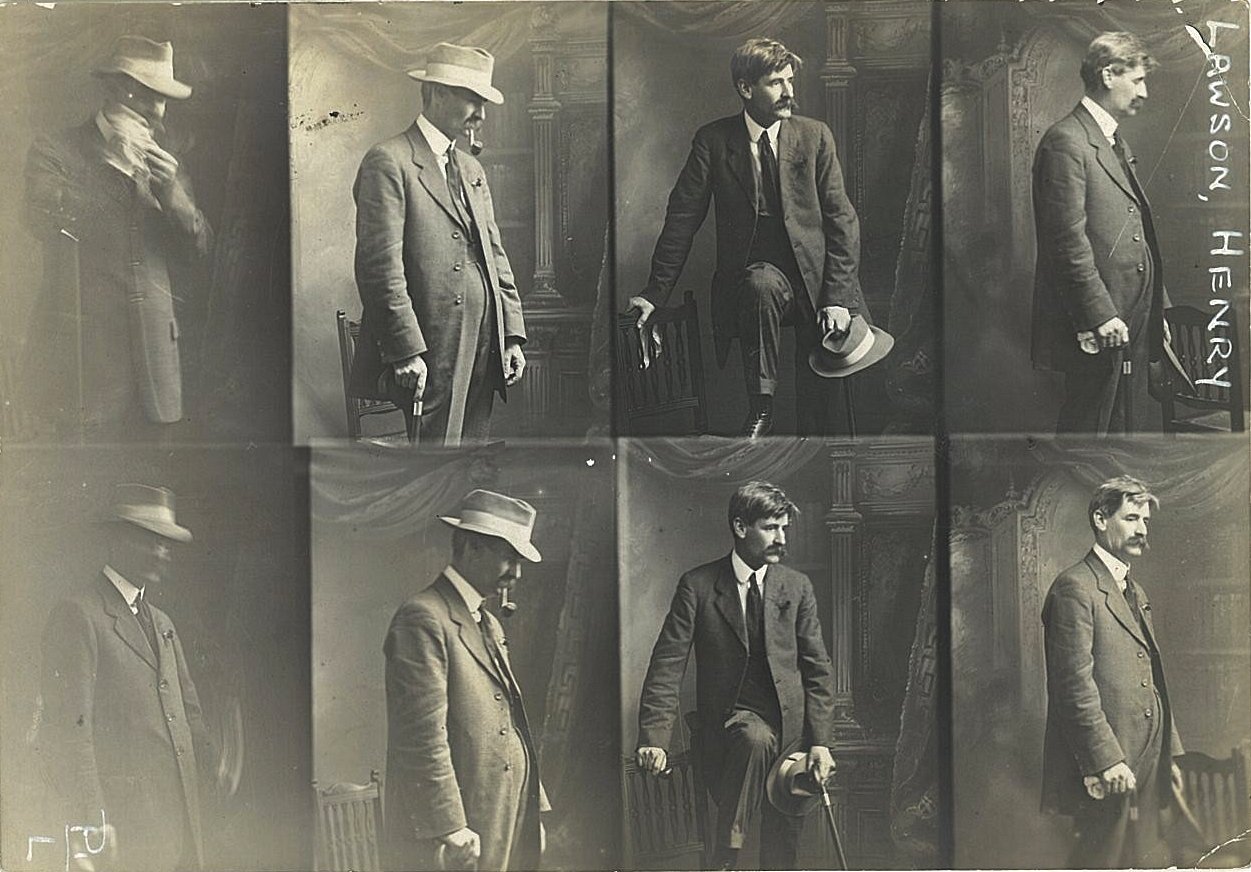
- State Library of New South Wales collection, “Henry Lawson, 1915 — photographer William Johnson,” Wikimedia Commons file record — provenance and original archival photograph.