The rain is getting into Cullerne Minster. Water stands on the floor, wet coats contribute their own atmosphere, and the rector is explaining how magnificent everything is. Above the visitors, a thin crack runs down the wall beneath a tower window. Edward Westray, the young architect sent to supervise repairs, notices it. So does the reader. The interesting question is how long anyone can keep talking around it.[1]
John Meade Falkner's The Nebuly Coat, published in 1903, rewards that sort of attention. Its aristocratic mystery grows inside a small town where buildings, reputations, and household finances all need propping up. A useful way into the novel is to follow Westray's inspections while listening for the difference between what people notice and what they feel able to say. The suspense begins in that gap.[1][2]
This guide discusses the prologue and first five chapters, leaving the later revelations and ending undisclosed.
Begin with the warning that stays in the office
Read the short prologue carefully. Before Westray reaches Cullerne, his employer, Sir George Farquhar, tells him that the central tower has an old structural problem. Underpinning would be desirable, but “there is no money.” Farquhar has therefore kept the matter quiet. He also warns his assistant about preservationists likely to criticize the firm's work. The assignment arrives already entangled with cost and reputation.[1]
This conversation gives us an advantage over the people who welcome Westray in chapter I. When Canon Parkyn praises the strength of the tower's supporting arches, we know the professional assessment has been less comfortable. Westray sees the fissure and remembers the maxim “The arch never sleeps.” In his imagination, the arches acquire voices, protesting against the weight placed upon them.[1]
Falkner lets a practical observation become an eerie refrain without requiring us to decide that anything supernatural has happened. The phrase means something to an architect; its repetition also makes the building seem wakeful while its guardians reassure themselves. Stone has become the most insistent speaker in a very talkative scene.
Then Westray reassures the organist that the arches may last their lifetimes. He remembers his instructions. The young man who can see the danger participates in making it sound less pressing.[1]
Keep that hesitation in mind. Westray is a conscientious observer, but his arrival does not give the novel an independent instrument for measuring everyone else. He has an employer, a position to maintain, and limited freedom to act. His competence helps us understand the building; his caution makes us examine the person doing the understanding.
Listen to who gets introduced
The first church visit is also an excellent comedy of rank. Parkyn introduces the organist, doctor, and churchwarden with little verbal adjustments that announce his own importance. The churchwarden's involvement in trade requires an indulgent qualification. The other men respond with gestures that distance them from the rector's performance.[1]
Meanwhile, the clerk remembers something useful: years earlier, bell-ringing had been stopped after a mason saw the tower moving and dust falling from its cracks. This recollection contains more evidence about structural danger than the rector's confidence does. Yet the information emerges through an old story, complete with remembered festivities and a superstition about an interrupted peal.[1]
Try to hear both parts. The superstition does not erase the observation. Nor does the speaker's lower standing make the observation less consequential. Falkner makes the reader extract evidence from the social circumstances in which it survives.
Mr Sharnall, the organist, provides a different challenge. He is wonderfully sharp about other people's pretensions, but his judgments carry the heat of his own disappointments. In chapter II, he complains about the neglected organ as though describing his own body. When he takes Westray through the dark streets, familiarity makes him a useful guide; fear makes him imagine a threatening figure in an empty recess.[1]
Later that evening, he tells Westray about Martin Joliffe, who spent years pursuing a claim to the Blandamer inheritance. Sharnall gives us the story through its household consequences: Martin's absences, debts, and repeated returns to a sister whose savings he consumed. We learn what the pursuit cost before we can judge whether its premise was sound.[1]
On a first reading, resist sorting these voices into dependable informants and disposable eccentrics. Sharnall's resentment can sharpen his eye and distort it. The clerk can preserve a precise memory inside a rambling account. Their manner matters, but it does not settle the truth of everything they say.
Stay for the argument about the painting
By chapter V, Westray has settled into Miss Joliffe's lodging house. He appreciates her cooking and cleanliness, takes care to spare her unnecessary trips upstairs, and decides to remain. He also wants the room adjusted to his taste. Among the offending objects is a large flower painting he would like replaced by a plan of the church.[1]
Before he makes that request, the narrative lets us spend time with his landlady. She is trying to meet the costs of her brother Martin's final illness. A London firm has offered fifty pounds for the painting, a possible answer to her debts. But her mother painted it, her father treasured it, and she remembers being lifted up as a child to touch the caterpillar depicted in one corner. Selling it would disturb a connection she cannot price.[1]
This change of viewpoint is essential. Westray sees an ugly object taking up useful space. We have just seen an object carrying the memory of a father's arms. His aesthetic judgment may be perfectly defensible; it cannot account for all that the painting does in the room.
Miss Joliffe, in turn, treats the dealers' offer as confirmation of artistic excellence. Westray knows the firm is reputable, and the letter unsettles him. Neither character yet understands why someone should be so interested in this particular picture. A domestic disagreement quietly becomes a mystery.[1]
Falkner establishes her attachment before Westray challenges the painting's worth; their disagreement then makes the dealers' interest newly puzzling. The painting has already acquired a significance beyond its possible use as a clue. Whatever we eventually learn about it, we have encountered the life that gives it value. Westray's wish to hang a church plan in its place becomes a small, revealing image of his predicament: his professional way of seeing requires room that someone else's history occupies.
Let the details take their time
An early reviewer noticed the relationship between atmosphere and suspense. Reviewing it on 14 November 1903, The Spectator praised Falkner's restraint while arguing that the minster's glass, bells, and music contributed to the drama. The review is preserved by the John Meade Falkner Society; save the full text until after the novel, because it reveals major developments.[2]
The Apollo Library edition of 2016, introduced by A. N. Wilson, offers another route to the book, while Project Gutenberg supplies a freely accessible text. For a first encounter, begin with Falkner's prologue and leave introductions until afterwards if you prefer to discover the mystery unaided.[1][3]
You need little specialist knowledge to begin. The title refers to the Blandamer coat of arms, whose silver and green bars have cloudlike outlines. Falkner introduces it through the stained-glass window that attracts Westray's eye in chapter I. Its meaning accumulates as people speak about it; you can let the heraldic vocabulary arrive with the story.[1]
What deserves patience is the movement between inspecting and listening. A crack calls for technical judgment. A recollection requires attention to the person remembering. A painting asks why someone has kept it. Follow those different acts of reading, and Cullerne's apparently leisurely conversations acquire a persistent unease. Westray has come to repair a building. The opening chapters keep showing him how much he must learn about its inhabitants before he can understand what needs saving.
Sources
- John Meade Falkner, The Nebuly Coat (1903) — Project Gutenberg text; prologue and chapters I–V provide the scenes and quotations discussed here.
- The Spectator, review of The Nebuly Coat, 14 November 1903 — transcription preserved by the John Meade Falkner Society; contemporary reception of the novel's atmosphere and restraint. Contains major spoilers.
- Bloomsbury, The Nebuly Coat, Apollo Library edition, 1 December 2016 — publication details and introduction credited to A. N. Wilson.
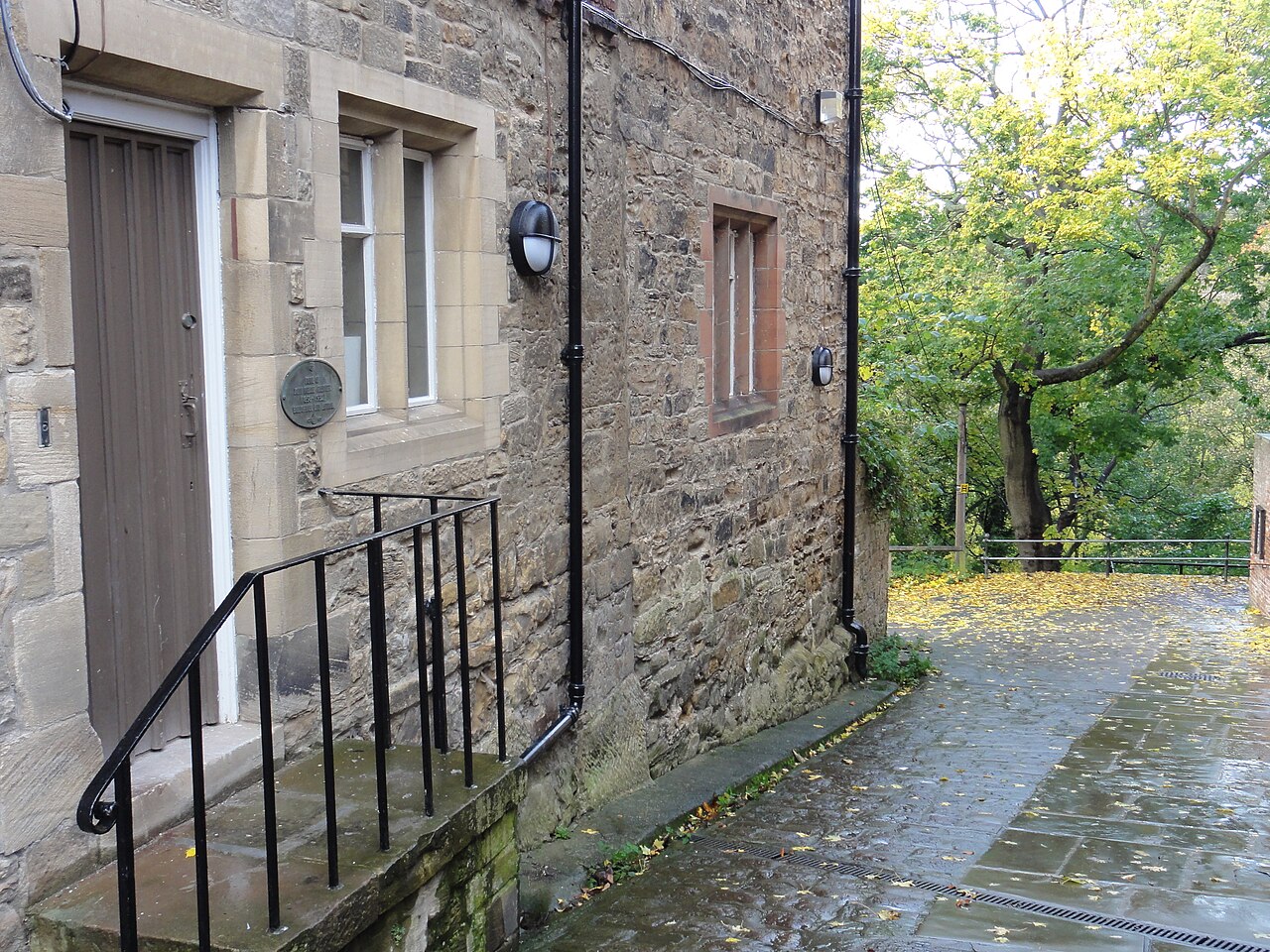
- Ian Forsyth, “Falkner house,” 27 October 2012 — original photograph and CC0 provenance record, Wikimedia Commons.
- Open Plaques, “John Meade Falkner black plaque,” record 11733 — identification of the photographed home and its location at Windy Gap, off Palace Green, Durham.