Some classics grow older by looking finished. The Left Hand of Darkness has lasted by refusing that comfort. Ursula K. Le Guin's novel arrived in 1969 with an audacious social experiment: on the icebound planet Gethen, people are ambisexual and do not live within a permanent division into male and female. An envoy from Earth, Genly Ai, must learn to meet them without treating his own categories as natural law.[1][5]
The experiment won the 1969 Nebula and the 1970 Hugo for best novel, helping to establish the book as a landmark of science fiction.[3][4] It also carried conspicuous limits. Genly calls every Gethenian “he.” The political plot keeps its most fully drawn Gethenians in public roles, while domestic work and child-rearing—precisely the activities that might test the premise—remain largely outside its frame.[9]
That contradiction became part of the book's afterlife. Feminist readers challenged the masculine default; Le Guin defended some choices, reconsidered others, and later returned to Gethen with a different narrator and a different field of vision. The novel did not become durable because every objection could be answered. It became durable because praise, criticism, archival evidence, and self-correction now sit beside one another. Its reception is a record of a mind—and a literary culture—learning to read its own blind spots.
The thought experiment begins with a compromised witness
The cleanest way to misread The Left Hand of Darkness is to treat Gethen as a successful diagram of genderlessness. Le Guin does not give readers a neutral tour. She gives them Genly, a professional observer whose habits of observation repeatedly fail.
His report announces that “Truth is a matter of the imagination,” then breaks its apparent authority apart.[1] Diplomatic narrative alternates with myths, field reports, an investigator's notes, Estraven's journal, and stories whose status cannot be reduced to either fact or ornament. The form asks readers to assemble a world from voices that do not share one method of knowing. An editor who rejected the manuscript in June 1968 complained that these interim legends made the novel “dry and airless” and ultimately unreadable.[2] What looked extraneous from a plot-first perspective became central to the published book's anthropology: a culture is not the same thing as one visitor's report about it.
Genly's gendered language belongs to that unstable authority. Early in the novel, he catches himself “forcing him into those categories so irrelevant to his nature and so essential to my own.”[9] The sentence is both diagnosis and warning. Genly knows that he is sorting Gethenians into male and female, yet self-awareness does not instantly cure the habit. His alliance with Estraven develops through the slow recognition that the person he coded as feminine, evasive, or untrustworthy has been the more lucid political reader.
This design gives the masculine pronoun a plausible dramatic function: the narrator is not Gethenian, and his language keeps exposing the pressure of his home culture. But dramatic function is not an all-purpose acquittal. The word “he” acts on readers even when the novel wants it to reveal Genly's limitation. It makes masculine personhood effortless to imagine and every other possibility an intellectual correction. The book can stage a biased witness and still reproduce some of his bias at the level of the page.
That double effect is why the novel generated argument rather than a stable lesson. Its finest formal decision and its most visible limitation occupy the same pronoun.
The prizes made a landmark before they made a consensus
The publication sequence is almost too neat. A publisher turned the manuscript down on June 21, 1968, objecting to its density and interrupted action.[2] Ace published it in 1969.[1] The Science Fiction Writers of America selected it as that year's Nebula winner for best novel, and the following August the World Science Fiction Convention awarded it the 1970 Hugo over a field that included Kurt Vonnegut's Slaughterhouse-Five.[3][4]
Awards do not prove an interpretation, but they change the scale on which interpretation happens. The double win identified Le Guin's experiment as central rather than marginal to the genre. It also encouraged a triumphant shorthand: a great novel had imagined a world beyond gender, and science fiction had recognized the achievement.
The actual book is less settled. Gethen is not a utopia awaiting Genly's approval. Karhide and Orgoreyn organize power differently, yet both can be suspicious, nationalistic, and lethal. The absence of permanent sexual difference coexists with a history that has apparently never produced war, but rivalry, bureaucracy, exile, imprisonment, and fear remain. Even Genly's mission—to bring the planet into the Ekumen—cannot be separated cleanly from the question of who gets to name contact as progress.[5]
The myths and reports rejected as nuisances prevent the gender premise from becoming a single-answer puzzle. A tale about two brothers, a report on sexual physiology, and a Handdara practice of answering questions by dramatizing uncertainty do not merely decorate the plot. They make Gethen exceed the envoy's vocabulary. The awards recognized a breakthrough, but the novel's form kept the breakthrough from hardening into doctrine.
Feminist criticism found the Earth inside Winter
The strongest feminist objections did not deny the scale of Le Guin's invention. They asked why a society without fixed sex still reached readers through the generic “he.” Where were childcare, household labor, and other work culturally marked feminine? Why did the novel's fullest action remain concentrated in political and public life while that work stayed offstage?[9]
Those questions expose an important boundary in speculative fiction. Changing one biological condition does not automatically remake every narrative convention used to imagine a society. A writer can abolish fixed sex in the premise while retaining masculine universality in grammar, point of view, and the distribution of significant action. Gethen estranges gender for the reader, but the novel's omissions reveal what its own moment still treated as background.
Le Guin's response became unusually important because she did not present her first explanation as final. Her 1976 essay “Is Gender Necessary?” discussed the experiment and defended several of its choices. The Ursula K. Le Guin Foundation's bibliography distinguishes that original piece from “Is Gender Necessary? Redux” in the collection's revised edition, published after Le Guin had reconsidered parts of her argument.[6]
The publication history matters as much as any individual retraction. The name “Redux” presents reconsideration as a second, dated encounter with the earlier defense, not as a timeless statement that erases it. Library of America's collected Hainish volume now places that revised essay in the same book as The Left Hand of Darkness, the 1969 version of “Winter's King,” and the later “Coming of Age in Karhide.”[5][6] Reception has entered the edition's architecture. The classic arrives with evidence that its author changed her mind.
The manuscript shows that revision preceded the debate
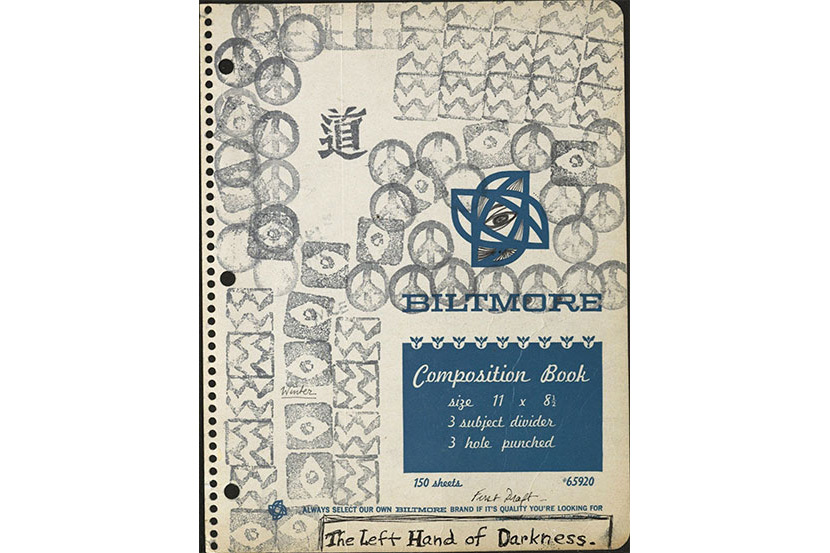
The archive makes this history more complicated still. The handwritten manuscript survives in three notebooks in the Ursula K. Le Guin Papers at the University of Oregon. Sean Joyce-Farley, writing about the collection for Library of America, compares an early draft of Genly's encounter with his Gethenian landlady to the published scene.[9]
In the draft, Genly tries to decide whether the landlady's apparent femininity indicates defective sexuality. In the finished novel, the same encounter becomes a jolt to his assumptions: the person he reads as feminine has not borne children but has sired four. The change does not remove Genly's stereotyping. It redirects the scene so that his classification, rather than the Gethenian's body, becomes the object under examination.[9]
This is a small revision with a large implication. It prevents two convenient stories. One would say Le Guin conceived a perfectly liberated Gethen that later critics failed to appreciate. The other would say criticism alone taught her to see the novel's gender problem. The notebook shows the work of recognition already happening inside composition, while the later essays show that it did not finish there.
The cover image belongs to this dossier for that reason. It is neither a polished author portrait nor a generic frozen landscape. It is the first physical container of a world still being made: stamped squares, peace signs, a spiral worked over in ink, and an eye looking back from the center.[9] The manuscript's material state rebukes the idea that a classic descends intact. Gethen emerged through crossings-out, substitutions, and a writer discovering what her own sentences had assumed.
Returning to Gethen changed who could speak from inside it
Le Guin eventually returned to Gethen after what she called twenty-five or thirty years. In her foreword to The Birthday of the World, she says the new story let her listen to an openhearted Gethenian narrator, ask questions the novel's urgent plot had left unanswered, and finally enter a kemmerhouse.[7] The later story does not update Genly's report. It changes the camera.
Sov Thade Tage em Ereb narrates from inside Rer, “the oldest city in the world.” The official excerpt begins with the city's roofed streets, annual thaw, layered political memory, and local way of counting time before Sov turns toward the experience of coming of age.[8] Even this opening changes the scale: an inhabitant speaks from within Gethenian history rather than arriving with an envoy's assignment, and Le Guin describes the full story as an opportunity to explore the sexual life her earlier plot had hurried past.[7][8]
That return is not a correction sheet. It cannot make the 1969 book retrospectively free of masculine default, and it should not be used to dismiss the readers who encountered that default in the first place. Its value lies in showing that an invented world need not remain trapped inside the first angle from which it was narrated. Le Guin could preserve Gethen's underlying premise while discovering that Genly's estrangement was only one possible doorway.
The later story also clarifies the original novel's deepest craft principle. The Left Hand of Darkness is not finally about possessing the right category for Estraven. It is about learning that intimacy does not require complete translation. On the ice, Genly's political mission narrows into dependence on one person he had persistently misread. Recognition arrives not when difference disappears, but when his need to force that difference into a familiar hierarchy begins to loosen.
A living classic keeps the argument attached
There are two easy verdicts available now. One celebrates The Left Hand of Darkness as if it cleanly predicted contemporary understandings of nonbinary or gender-fluid life. The other sees the universal “he” and the missing domestic sphere, then demotes the novel to an obsolete experiment. Both make the book smaller.
The first erases historical difference and the force of feminist criticism. Gethenians are not a direct representation of any single human identity, and Genly's vocabulary does not become neutral simply because the plot exposes his bias. The second verdict mistakes limitation for emptiness. A novel can fail to imagine beyond every convention of 1969 and still reorganize what readers and writers believe fiction can ask.
The more useful afterlife keeps achievement and objection in contact. Read the prize record beside the rejection letter. Read Genly's self-diagnosis beside the masculine grammar he cannot escape. Read the published scene beside the notebook draft, the 1976 defense beside the later commentary, and the envoy's report beside Sov's life from within Gethen.[2][5][6][8][9]
That arrangement does not rescue the novel from criticism. It rescues criticism from becoming a closing argument. The Left Hand of Darkness kept its future open because Le Guin allowed the evidence of change to remain attached: not a flawless prophecy, but a work capable of showing where imagination broke through, where inheritance held it back, and why another telling was still necessary.
Sources
- Ursula K. Le Guin Foundation, “The Left Hand of Darkness” — official work page, 1969 publication note, excerpts, editions, and later reception links.
- Ursula K. Le Guin Foundation, “A Rejection Letter” — the June 21, 1968 editorial rejection of the manuscript.
- Science Fiction and Fantasy Writers Association, “The Left Hand of Darkness” — official record of the 1969 Nebula Award for Best Novel.
- The Hugo Award, “1970 Hugo Awards” — official Best Novel result and finalist slate.
- Library of America, Ursula K. Le Guin: Hainish Novels & Stories, Volume One — edition context and contents including the novel, “Coming of Age in Karhide,” and “Is Gender Necessary? Redux.”
- Ursula K. Le Guin Foundation, The Language of the Night — official publication history and contents distinguishing “Is Gender Necessary?” in the original edition from “Is Gender Necessary? Redux” in the revised edition.
- Ursula K. Le Guin Foundation, “Foreword: The Birthday of the World” — Le Guin's account of returning to Gethen and the later story's point of departure.
- Ursula K. Le Guin Foundation, “The Birthday of the World Excerpts” — official excerpt from “Coming of Age in Karhide.”
- Sean Joyce-Farley, “Are You There Ursula? It's Me, Sean,” Library of America (August 17, 2020) — research in the handwritten manuscript, comparison of draft and published passages, and source page for the notebook image.