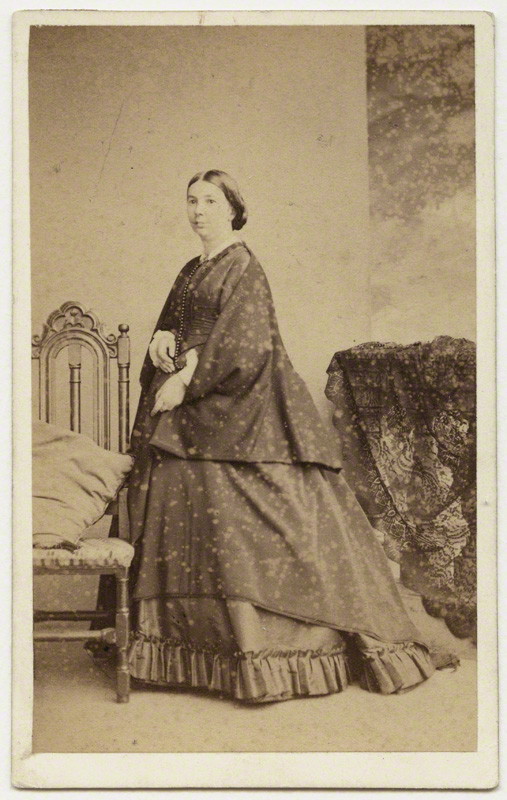
The first sentence of Miss Marjoribanks has barely announced a death when another voice slips into it. Fifteen-year-old Lucilla regrets that she could not soothe her mother's last moments, “as she herself said.” The tag is tiny, but it opens a hairline crack between the heroine's account and the narrator's. Lucilla may be grieving; she is also already phrasing the grief, arranging herself inside a familiar scene of filial devotion.[1]
That crack never closes. Lucilla's great declared purpose is to be “a comfort to dear papa,” a phrase she repeats until everyone in Carlingford can repeat it for her. Meanwhile, she takes charge of her father's table, redraws his drawing room, builds a Thursday-evening salon, manages romances, and eventually organizes a parliamentary campaign. Margaret Oliphant's narrator keeps translating these operations into the mock-heroic vocabulary of kingdoms, campaigns, sacrifice, and Providence. The joke is not simply that an ambitious woman pretends to be dutiful. It is stranger and more generous: Lucilla's language of innocence becomes so effective that the narration starts conducting business in it too.
Published in 1866 as part of Oliphant's Chronicles of Carlingford, the novel survives in a digitized first-edition volume and a modern critical afterlife.[5][6] Q. D. Leavis placed Lucilla between Austen's Emma and Eliot's Dorothea Brooke, a comparison that identifies her scale: she is a provincial organizer with the confidence of a reformer.[6] But the pleasure of reading her begins at sentence level, where it is often impossible to decide whether the narrator is exposing Lucilla's self-importance or ceremonially installing it.
The first sentence adds a chaperone
Chapter I teaches the reader how to hear two registers at once. Lucilla has learned from novels what a bereaved daughter should feel and how that feeling should look. On the train home, she rehearses the pale face, private tears, brave breakfast smile, and self-sacrifice that the occasion seems to require. The narrator dryly observes that her feelings are “sufficiently real in their way.”[1]
“In their way” matters. Oliphant does not force a clean choice between sincerity and performance. Lucilla's emotion is real, but it arrives already shaped for an audience; the performance is calculated, but calculation does not make every feeling counterfeit. Even the narrator's corrections preserve this double status. Lucilla is not unmasked and dismissed. She is accompanied by a voice that keeps one eyebrow raised while following her wherever she intends to go.
That is why “as she herself said” becomes more than a distancing formula. It assigns a phrase to Lucilla, then places that phrase inside the narrator's prose, where it can circulate later without another attribution. The heroine supplies the public language of her own story. The narrator supplies tone, timing, and an amused witness.
“Comfort” is an action verb
By Chapter IV, nineteen-year-old Lucilla has returned from her education to keep her promise. The narrator immediately clarifies that home feels warm not from tenderness but because she is “coming into her kingdom,” a domain where she expects her will to be law. Before her father comes downstairs, she has already “harmonised the rooms,” as she herself expresses it, by moving chairs and covering tables with her possessions.[1]
The narrator's attribution of “harmonised” does two jobs. It keeps an inflated verb for rearranging furniture visibly Lucilla's, inviting laughter. It also names the result precisely: an impersonal room becomes recognizably Lucilla's. Her euphemism does not conceal an empty gesture. It makes occupation sound like care.
At breakfast the next morning, the pattern becomes almost perfect. Lucilla sits in her father's usual place because, she explains with “ingenuous sweetness,” moving the urn would have been inconvenient. Dr Marjoribanks accepts the side chair before he grasps the consequence. The narrator announces that he has “abdicated” and that the reins of state have been withdrawn from his hands.[1] Lucilla describes a minor logistical necessity; the narrator describes a bloodless transfer of power. Both versions are true.
This is the novel's central verbal machine. “Comfort” turns desire into duty. “Harmony” turns possession into improvement. An apparently impersonal “one has to” removes the wanting subject from the sentence. Lucilla rarely needs to issue a naked command because she can present the finished arrangement as the natural answer to everyone's needs.
The mock epic does not cancel the work
Melissa Schaub identifies the novel's crowns, reigns, and sovereigns as a sustained mock-epic irony, part of a broader refusal to make history or politics resolve into a pure ideal.[2] That account helps explain why the grand language never settles into either praise or ridicule. A “throne” is an absurd name for a sofa—until one notices how reliably people approach Lucilla there, disclose problems, and accept decisions.
Her Thursday evenings offer the clearest test. Lucilla recruits Barbara Lake's contralto, pairs voices, calibrates invitations, uses her father's dinners to overcome husbands' objections to the gatherings, and turns a private drawing room into a town institution. The narrator calls the first evening a victory built on sacrifice, sending heroic prose to perform drawing-room logistics.[1] Yet the social fact remains: without Lucilla's labor, the singers do not meet that audience and Carlingford does not acquire that shared room.
The mock epic therefore measures a mismatch between the narrow offices officially available to Lucilla and the breadth of what she can accomplish through them. It also keeps her benevolence under inspection. She helps, but she likes being indispensable; she improves other people's prospects, but she expects the improvement to confirm her authorship. The tone holds both facts without converting the novel into a verdict on whether she is secretly emancipated or merely conventional.
Hope Rogers offers a useful further complication: Lucilla's relative “flatness”—her unusual freedom from self-doubt and divided motive—can be the source of her agency rather than evidence that she has none.[4] The repeated phrases support that reading. “Comfort to papa” is not necessarily a lie she tells while privately confessing something else. It is a stable account of herself that lets her move straight from perception to arrangement. Other characters hesitate over what they want; Lucilla gives wanting an institutional name and begins.
One pronoun supplies a public
Lucilla's smallest imperial instrument may be a pronoun. Erik Gray draws attention to her capitalized, antecedentless “They,” which can mean a particular set of men or men as a class. The word makes its subjects both indistinct and important: interchangeable enough to manage, consequential enough to require a standing theory.[3]
In Chapter XXVI, after a newly arrived general looks disappointed to find Lucilla rather than a prettier young woman, the narration notes that prettiness is “all They think about, as Miss Marjoribanks herself said.” Moments later Lucilla explains that “one has always to do one's duty to society.”[1] The sequence is comic because personal irritation expands so quickly into sociology and public service. “They” reduces the general to a specimen; “one” raises Lucilla's response into a rule; “society” names the beneficiary.
But the grammar is not merely camouflage. Lucilla really does think in systems. Singers, suitors, dinners, votes, and drawing-room chairs become positions to be filled and forces to be balanced. Her abstractions can flatten other people, yet they also let a woman denied formal office imagine a public on which she can act. The narrator's mock-political idiom is ready to meet her there.
Ten years make the joke answerable
At the start of Chapter XXXVI, the narrator pauses and declares that one “fytte” of Lucilla's history is finished. The mock chronicle surveys her sacrifices, failed interventions, and ungrateful beneficiaries in language that is extravagantly solemn. Then Chapter XXXVII jumps forward: Lucilla has in fact spent ten years at the head of Grange Lane society and as a comfort to her father.[1]
The time jump gives the running joke a cost. Curtains fade. The marriage proposals Lucilla expected do not materialize. A social institution that depends on one hostess proves hard to preserve. Her slogans have served her, but they have also held her to a post that Carlingford enjoys without learning how to maintain it. “Comfort” has been a route to authority and a claim that disguises the price of authority as cheerful duty.
The narrator does not abandon the mock-heroic register when disappointment arrives. That persistence prevents an easy reading in which early irony exposes a foolish girl and later fact corrects her. Lucilla's self-conception remains comic; her decade of work remains a decade. The same voice must carry both.
Providence gets the last euphemism
In Chapter LI, Lucilla sees an advertisement for Marchbank, an estate with a neglected village on which her talents can operate, and calls it “a special providence.” She then decides that Tom should buy it. The narrator answers in kind, remarking that some people's inclinations receive unusually painstaking supervision from Providence.[1]
Again, the distance is audible but not absolute. Lucilla's providential reading is beautifully convenient. It also produces a practical plan for Tom, a new field for her, and warmer houses for villagers she expects may remain “stupid and ungrateful.” Her paternalism and her usefulness arrive in the same sentence. The novel will not idealize the motive, but it will not pretend that only ideal motives can improve a room or a village.
Modern criticism has kept returning to this unresolved pressure. Schaub's account of anti-idealism resists choosing a simple feminist or antifeminist Oliphant; Gray shows general and particular collapsing inside Lucilla's pronouns; Rogers argues that critical detachment is not the only form agency can take.[2][3][4] Together, those readings help name what the voice makes pleasurable before it becomes theoretical: the reader laughs at Lucilla, recognizes her effect, and discovers that the two responses cannot be cleanly separated.
Domestic innocence in Miss Marjoribanks is therefore neither a transparent virtue nor a removable mask. It is an operating language. Lucilla repeats it, Carlingford learns it, and the narrator adorns it with the regalia of government. Each “comfort to papa” sounds smaller than the action it authorizes. By the time the father has abdicated, the singers have assembled, the candidate has been chosen, and Marchbank awaits reform, the innocent phrase has done what a reign does: it has organized the world around its speaker.
Sources
- Margaret Oliphant, Miss Marjoribanks (1866), Project Gutenberg eBook no. 41286 — complete text and chapter references.
- Melissa Schaub, “Queen of the Air or Constitutional Monarch?: Idealism, Irony, and Narrative Power in Miss Marjoribanks,” Nineteenth-Century Literature 55, no. 2 (2000), 195–225.
- Erik Gray, “Miss Marjoribanks's Pronouns; or, the General, the Particular, and the Novel,” Nineteenth-Century Literature 76, no. 2 (2021), 223–252.
- Hope Rogers, “The Flat Heroine: Flat Character and Agency in Miss Marjoribanks,” Victorian Literature and Culture 47, no. 4 (2019), 691–721.
- Margaret Oliphant, Miss Marjoribanks, vol. 2 (William Blackwood and Sons, 1866) — first-edition scan from the University of Illinois Urbana-Champaign copy, Internet Archive.
- Penguin Classics, Miss Marjoribanks, edited and introduced by Elisabeth Jay — edition record and modern reception note.
- Wikimedia Commons, “Margaret O. W. Oliphant” — Thomas Rodger's 1860s albumen carte-de-visite, sourced from the National Portrait Gallery, London.