Virginia Woolf's “The Mark on the Wall” appears to save its answer for the final word. For most of the story, an unnamed narrator remains in a chair and wonders what a dark speck above the mantelpiece might be. Another person stands over the narrator, identifies it, and the narrator accepts the identification. Mystery over: the mark is a snail.
Except that this is the wrong shape for a solution. The narrator does not rise, inspect, and reason toward the truth. The answer arrives as an interruption, coupled to a newspaper, the war, and a complaint about why such a creature should be allowed on the wall. A noun has been supplied, but the story's larger questions—what counts as knowledge, who gets to stabilize reality, and what happens when an object exceeds its name—remain in motion.[1]
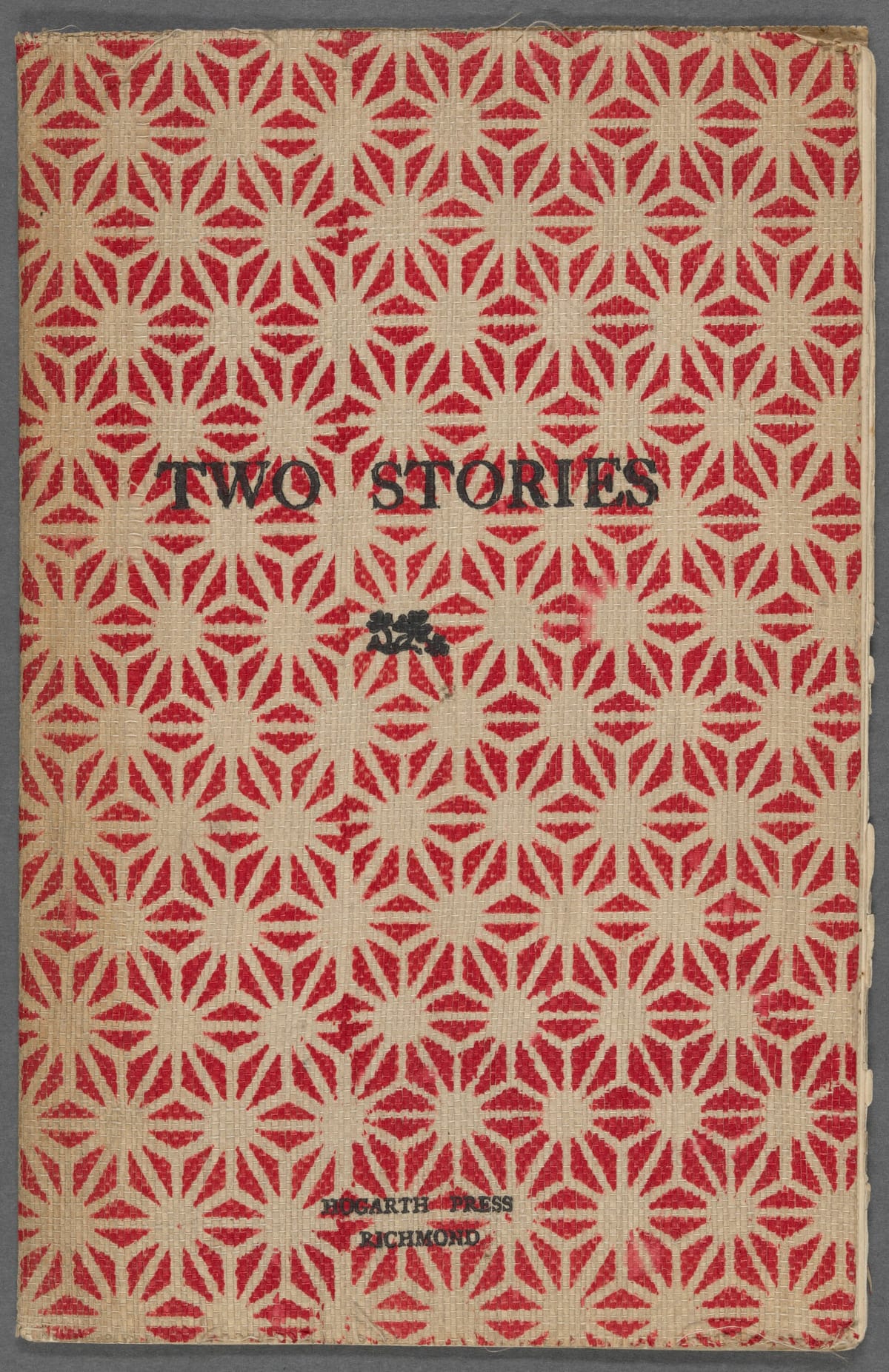
The piece first appeared in July 1917 in Two Stories, the thirty-one-page debut of the Hogarth Press. Leonard and Virginia Woolf printed the booklet by hand at Hogarth House in Richmond; the surviving New York Public Library copy is sewn into red-and-white Japanese-paper covers and includes Dora Carrington's woodcuts.[4][5][6] The text used here is from the 1921 Harcourt, Brace collection Monday or Tuesday, where the story closes a sequence built from similarly quick transfers among sensation, fantasy, voice, and thing. A scholarly versioning edition identifies that American printing as the point at which Woolf's lifetime revisions to the ending stabilized.[1][6] The story's historical importance as an early modernist experiment is real. Its immediate pleasure, however, lies in a simpler trick: every time the mark seems ready to become a period, Woolf turns it into a new beginning.
A dot learns to interrupt
The first paragraph tries to establish a date and produces an atmosphere instead. January is only probable. The narrator reconstructs the moment through firelight, a page, chrysanthemums, tea, cigarette smoke, burning coals, and an old vision of red knights. Before the mark has any identity, it has a function: it interrupts an automatic childhood fantasy. Then it becomes the prompt for another one.
Woolf describes it as a “small round mark, black upon the white wall.”[1] On the page, that description almost draws a printed period. But the grammar around it refuses the period's confidence. The story begins with perhaps; memory advances through qualifications; each proposed identity is revised by the next. A nail-hole calls up a vanished miniature and the taste of the former tenants. Doubt about the nail opens into lost household objects, the violence of speed, and an afterlife made of colored light. A possible rose leaf leads to dust, Troy, fragments, Shakespeare, and the secret vanity of imagining oneself impressive at a dinner party.
This is not formless drifting. The mark returns like a refrain, and each return measures how far the mind has traveled. Karina Jakubowicz describes the story as a question-and-answer structure whose boundaries stay porous: one thing opens out of another without surrendering the enclosing wall.[2] That paradox is a useful guide to the prose. The fixed speck gives the meditation a center, while the narrator's refusal to inspect it keeps that center available for revision.
Nor does Woolf romanticize every association as revelation. The narrator catches herself producing stale historical fiction and flattering versions of her own intelligence. Thought can be inaccurate, vain, or merely habitual. The comedy depends on that self-surveillance. Sitting still does not make the narrator infallible; it lets her notice how quickly a supposedly private mind borrows its furniture from class, gender, museums, newspapers, and books.
Every guess imports an institution
The possible objects form a small social history. If the mark came from a picture, the imagined picture displays the previous household's conventional taste. If it is dirt or a leaf, the narrator's housekeeping becomes visible. If it projects from the plaster, it resembles a burial mound on the South Downs, and that resemblance summons an antiquary, laborers, clergy, a learned society, a pamphlet, and a local museum full of relics with doubtful powers of proof.[1]
The sequence changes the question. The issue is no longer simply What is that thing? It is What machinery will make an answer authoritative? Naming recruits ranks and professions. Evidence accumulates, but so do breakfast letters, status, domestic labor, and the pleasure of being the man who classifies the arrowhead. When the narrator mocks the “masculine point of view” that sets the standard, its emblem is Whitaker's “Table of Precedency,” the official ladder specifying who follows whom.[1]
That satire has a precise limit. The story does not claim that facts are useless or that a snail and a nail are interchangeable. Getting up would settle a real question. What the narrator distrusts is the inflation of a correct label into complete knowledge—the moment when classification begins to look like mastery. An answer can identify the object and still fail to explain its history, its place in the room, or the observer's relation to it.
This distinction is why the mark can steady the narrator without becoming simple. At one point it feels more real than archbishops and chancellors. Yet the apparent refuge from social phantoms does not stay inert. The mark seems to rise from the plaster. It casts a shadow. It becomes mound-like, then wooden, and finally animal. Looking repeatedly does not flatten it into data; looking changes the kind of thing it can be.
The attempted period grows a tree
Late in the story, the narrator explicitly treats the mark as a “full stop” for a painful line of thought.[1] The phrase makes the visual joke unmistakable: a dark point on a pale field promises punctuation, rest, and closure. But the sentence after that imagined stop keeps going. Solidity leads to wood; wood leads to a tree; the tree draws in rivers, cattle, fish, beetles, sap, moonlight, insects, storms, roots, bedrooms, ships, and pavement.
The long arboreal passage is often read as one more digression. It is also the story's quiet preparation for the snail. The narrator moves away from human precedence by imagining material across different scales and spans: timber as furniture, tree as organism, habitat as a crowd of patient lives. The object becomes most definite when it is allowed to have a history that does not begin with human use.
Caroline Hovanec places this movement within Woolf's wider interest in animal perspectives and partial forms of knowledge. In Hovanec's reading, the fish imagined earlier in the story offers an alternative to a mind intent on cutting the world into categories, while the unnamed snail remains just beyond the narrator's access.[3] The crucial point is not that animals possess a pure truth denied to people. It is that another creature's sensory world exposes how provincial any one observer's certainty must be.
This is also where the prose separates solidity from stillness. The narrator wants the impersonal world as proof that something exists outside the self, yet the wood she contemplates is growing, snapping, decaying, and taking new forms. Reality does not have to be a dead surface in order to resist projection. The story's most substantial things are substantial because they continue beyond the narrator, not because she has finished explaining them.
The final voice is the harder stop
The ending changes scale with a “vast upheaval of matter”: somebody is now standing over the seated narrator.[1] Until this moment, the governing rhythm has been an interior voice interrupting and correcting itself. Now an external speaker supplies a public object—the newspaper—and public catastrophe—the war. The speaker dismisses the paper because events are supposedly repetitive, curses the war in the next breath, then objects to the creature on the wall. The speech compresses news, history, and domestic possession into a few abrupt judgments.
Against that burst of certainty, the final recognition is almost weightless: “a snail.”[1] Grammatically, it closes the problem. Formally, it reveals how much the problem's terms have changed. The first mark looked flat and punctual. The last object has a body, adheres to a vertical surface, and has a route the story never records. The answer does not validate the narrator's guesses, but neither does it erase what the guesses discovered about the people and systems eager to call themselves reality.
There is an ethical edge to the other speaker's complaint. The speaker does not merely identify the snail; the wording frames it as an intrusion that should not be on our wall. The classification becomes a claim of household order. By contrast, the narrator's long delay has made room—however accidentally—for an object to remain strange. This does not turn indecision into a universal virtue. It shows that attention and possession are different relations: to look at something for a long time is not necessarily to acquire the right to reduce it to its inconvenience.
Hovanec notes that “The Mark on the Wall” never enters the snail's point of view, whereas “Kew Gardens,” published two years later, gives a snail its own difficult route across a flower bed.[3] That later story sharpens the boundary here. The final animal is not a secret allegorical key, waiting to translate every preceding image. It is a life the narrator has not imagined from within. The label is accurate; the perspective is missing.
Certainty becomes strange again
The best endings do not merely conceal information and release it. They alter the value of the information released. If the mark were a nail, the story would finish with an artifact whose purpose points backward to a removed picture. A snail makes the wall newly present. It converts background into habitat and the visual period into a creature whose life exceeds the prose that stops.
That is why the revelation feels both comic and expansive. Woolf honors the factual correction: the mark is not whatever the narrator would prefer it to be. She also denies the correction total authority. Naming the animal cannot recover its route, supply its sensations, or decide whether it belongs. Even the book's first material form makes the same quiet argument. The black words on the 1917 cover do not float free of their Japanese paper; ink, weave, wear, pattern, and handwork remain visibly involved in what the title is.[5]
The story finally offers a compact lesson in close reading itself. A reader needs the fact of the snail, just as the narrator does. But reading ends too soon if it treats that fact as a key that locks every prior sentence into place. The revelation matters because of its exactness and because of what exactness cannot do. In the 1917 printing, Carrington's snail woodcut follows the final prose line on the same page: the words finish, and the animal receives another patch of paper.[6] Woolf puts a living body where punctuation seemed to be, then stops before the body can be made obedient to a moral. The thought has ended on the page. The snail has not.
Sources
- Virginia Woolf, Monday or Tuesday (Harcourt, Brace, 1921), Project Gutenberg eBook no. 29220 — text of “The Mark on the Wall” used for passage references.
- Karina Jakubowicz, “Scarcely a Brick to Be Seen: Breaking Boundaries in ‘Kew Gardens’ and ‘The Mark on the Wall,’” in Virginia Woolf and the World of Books (Liverpool University Press, 2018) — form, boundaries, and publication context.
- Caroline Hovanec, “Bloomsbury's Comparative Psychology: Bertrand Russell, Julian Huxley, J. B. S. Haldane, Virginia Woolf,” in Animal Subjects (Cambridge University Press, 2018) — animal perspective, classification, and the snail's return in “Kew Gardens.”
- University of Reading Special Collections, “Hogarth Press Archive” — the Woolfs' hand-printed 1917 debut and early press history.
- New York Public Library Digital Collections, “Two Stories” (Hogarth Press, 1917) — Berg Collection catalog record and digitized copy whose original Japanese-paper cover is used for the article image.
- Emily McGinn, Amy Leggette, Matthew Hannah, and Paul Bellew, “Comparing Marks: A Versioning Edition of Virginia Woolf's ‘The Mark on the Wall,’” Scholarly Editing 35 (2014) — lifetime text variants, print context, and Carrington woodcut placement.