Thomas Hardy's The Mayor of Casterbridge is often summarized as a tragedy of bad temper: Michael Henchard is impulsive, proud, jealous, and eventually destroyed by the force of his own nature.[1][2] That reading catches something essential, but it is still too inward. Hardy does not let Henchard's character remain an interior trait. Again and again he forces it into public form. A drunken fairground sale turns marriage into a market transaction. A church oath turns remorse into self-legislation. Grain trading turns judgment into economic risk. The skimmington ride turns private scandal into civic theatre. By the end, even Henchard's final request to the world arrives as a written instrument, a will designed to control how he will be remembered after death.[1]
The book announces that design from the start. Project Gutenberg's text preserves Hardy's full subtitle, The Life and Death of a Man of Character.[1] The phrase matters because it sounds admiring and fatal at once. Henchard is not a weak, diffused, or ordinary man. He has force. Yet Hardy keeps asking what happens when force meets a social world made of weather, prices, rumor, accident, and other people who do not share the same emotional temperature. The answer is severe. Character gives shape to a life; it does not secure mastery over circumstance.
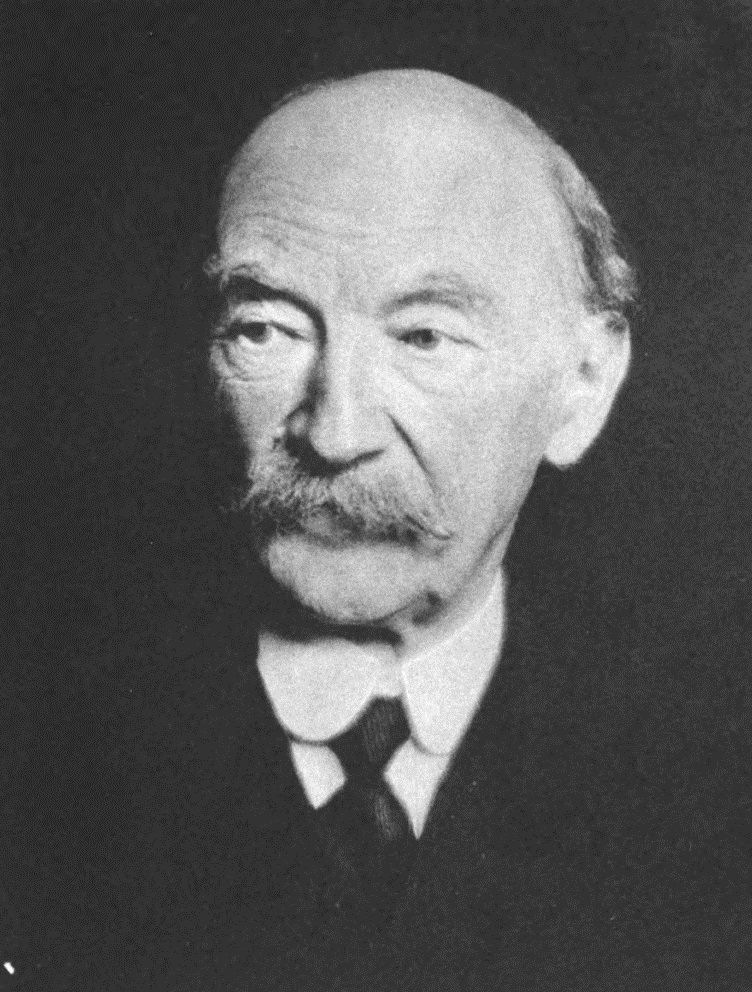
Image context: the cover uses a real archival portrait of Hardy rather than a painted market scene or a scenic Wessex landscape.[5] That choice suits the argument because the novel's pressure lies less in picturesque setting than in public bearing. Henchard stands up, swears, commands, bargains, forbids, and tries to hold himself together before other people; the book keeps asking what such bearing is worth once the world starts answering back.
1) The opening sale turns moral catastrophe into a public act
The first great shock of the novel is that Henchard does not merely wrong Susan in private. He converts a domestic bond into a public exchange. At Weydon-Priors fair, after spiking his furmity with rum, he offers his wife and child for sale and finally fixes a price: "I’ll sell her for five guineas."[1] The obscenity of the episode lies in more than cruelty. Henchard tries to give rage the clarity of a contract. He wants speech, money, witnesses, and transfer to make a moment of impulse feel binding.
That matters because the whole novel keeps returning to this temptation. Henchard repeatedly behaves as though an act of will, stated hard enough, can become reality. In the first chapter that takes the form of market language applied to marriage. Later it takes the form of oath, command, business policy, or personal prohibition. The deeper theme is constant: he longs to turn inward intensity into an enforceable outer fact.[1][2]
Hardy is too exact to let the sale remain only a grotesque opening stunt. The fair setting places Henchard inside a world of barter, livestock, auction, and imperfect value.[1] He commits his worst act in a space where people are already pricing animals and goods. That context does not excuse him. It reveals the novel's larger philosophical field. Casterbridge is a place where human beings keep getting measured through external systems: wages, grain prices, civic office, household respectability, and sexual reputation. Henchard's first crime is to accept that logic too completely and apply it where it should never go.
2) The oath shows will trying to become destiny
The morning after the sale, Henchard kneels in a church and binds himself with one of the harshest vows in Victorian fiction: "I, Michael Henchard ... will avoid all strong liquors for the space of twenty-one years to come."[1] The scene is moving because he is ashamed in earnest. Yet Hardy also shows the limitation of such grandeur. Henchard answers one absolute act with another absolute act. He does not seek moderation, habit, or ordinary amendment. He seeks a counter-fate.
That is why the number matters. Twenty-one years, a year for every year he has lived, gives the promise theatrical proportion.[1] Henchard imagines moral repair as something measurable and total. If he cannot undo the sale, he can impose a punishing symmetry on the self that committed it. The oath is sincere, but sincerity here already carries the flaw that will shape the novel. Henchard always prefers decisive form to durable adjustment.
His later rise to mayor therefore feels less like a simple redemption arc than like an extension of the same instinct. Britannica's overview of the novel emphasizes the rise and fall of Michael Henchard within the fictionalized Dorchester of Casterbridge.[2] What matters inside that rise is that civic office gives him a stage on which personal force can look like order. He becomes a man whom others obey, fear, and consult. For a while, public rank appears to stabilize inward vehemence. Yet Hardy never lets office cure temperament. It only enlarges the consequences when temperament hardens into policy.
3) Grain and weather prove that the world does not bend to force
The novel's business plot is central because it prevents "character" from becoming a merely moral abstraction. Henchard deals in grain, a commodity permanently exposed to harvest uncertainty, storage quality, transport, and timing.[1][4] Hardy's larger Wessex imagination, as Victorian Web notes, is one in which physical setting acts not as decorative local color but as an active conditioning force on human action.[4] In The Mayor of Casterbridge, that environmental pressure enters the town through commerce. Bread quality, corn speculation, and bad weather are not background details. They are the points where human confidence meets material contingency.
This is the deeper reason Donald Farfrae matters. Farfrae is not only a rival in business or love. He is a rival mode of being. At the most famous interpretive hinge in the novel, Hardy gives the comparison its explicit formula: "Character is Fate," then immediately distinguishes Farfrae's temperament from Henchard's.[1] The line is easy to quote as if it settled everything. In context, it does something more interesting. It places character beside luck and then partly withdraws luck, suggesting that Farfrae prospers because his mode of intelligence is fitted to a volatile world while Henchard's mode keeps overspending itself.
Farfrae calculates, adapts, cools situations, and reads process where Henchard reads affront.[1] Henchard wants loyalty in the old singular form. Farfrae builds systems that can survive fluctuation. The novel does not reduce this contrast to a moral fable where calm always deserves to win. It shows instead that a market society increasingly rewards manageability, information, and flexible judgment. Henchard's grandeur belongs to an older order of personal command, one that looks magnificent until conditions shift.
4) Public shame is the final medium of fate
If the fair sale begins the book by making a private wrong public, the skimmington closes the circle by making private history reappear as civic spectacle.[1][2] Henchard has spent years trying to outrun the forms that remember him. He changes social rank, controls trade, buries the past, and imagines he can manage what others know. Yet Casterbridge keeps turning memory outward. The town can embody rumor in pageant form.
That is why Lucetta's shame and Henchard's own humiliation matter so much to the novel's philosophy.[1] Hardy shows that public life does not merely reward strength; it also archives exposure. One can become mayor and still remain vulnerable to old acts, old letters, old witnesses, old enemies, and the ordinary cruelty of collective amusement. Casterbridge is not an abstract moral universe. It is a town. The town remembers through gossip, trade, visibility, and repetition.
The last movement presses this insight into its hardest shape. Henchard falls from civic height into reduced labor, returning in effect toward the old hay-trusser existence from which he rose.[1] His final written instructions ask that he be forgotten: no mourners, no flowers, no inscription, no memory.[1] The will is heartbreaking because it repeats the same old dream of sovereign declaration, only now in negative form. He still wants language to settle relation once and for all. He wants to legislate his disappearance.
Hardy gives him no such victory. The reader is holding the story. The novel itself has become the afterlife Henchard cannot control.
That is why The Mayor of Casterbridge remains so powerful. It does not say that human beings are helpless puppets of weather or commerce, and it does not say that force of character is admirable enough to overcome every contingency. It keeps both pressures in view. Henchard's life has scale because he is not small. His ruin has force because the world around him is not simply an extension of his will. Hardy's tragedy lives in that collision. Character can give a life heat, contour, and memorable shape. It cannot stop the fair from becoming history, the market from turning, the town from watching, or chance from answering back.[1][2][3][4]
Sources
- Thomas Hardy, The Mayor of Casterbridge (Project Gutenberg HTML text, including the subtitle, the Weydon-Priors sale, the church oath, the "Character is Fate" passage, and Henchard's final requests).
- Encyclopaedia Britannica, "The Mayor of Casterbridge" (publication context, Casterbridge setting, and Henchard's rise-and-fall outline).
- Encyclopaedia Britannica, "Thomas Hardy" (biographical context and placement of The Mayor of Casterbridge among Hardy's major novels).
- Philip V. Allingham, "An Introduction to Hardy's Novels: Physical Setting," The Victorian Web (Hardy's use of environment as an active force rather than decorative background).
- Wikimedia Commons, "File:Photograph of Thomas Hardy.jpg" (source page for the 1913 Alvin Langdon Coburn portrait used as the lead image).