
In February 1977, months before her death, Clarice Lispector arrived at TV Cultura in Sao Paulo intending to appear on a program about film. Instead, the journalist Julio Lerner persuaded her to sit for an interview that would become her only televised record.[1][2][3] The archival value of the clip is immediate. It is not a memorial retrospective assembled after the fact. It is Lispector in late life, wary of the camera, impatient with literary packaging, funny without warmth performance, and startlingly clear about the distance between the work and the public costume built around the person who wrote it.[1][3]
That is why this footage matters as literature rather than celebrity residue. Lispector had long since become a singular figure in Brazilian writing: Britannica notes her 1943 debut Near to the Wild Heart made her a literary sensation while still in her early twenties, and by the 1970s she had already produced the strange inward pressure of books such as The Passion According to G.H., Agua Viva, and finally The Hour of the Star, published in 1977.[4][5] Yet the interview does not monumentalize that career. It keeps puncturing monumentality. Lispector answers as someone who knows that readers have turned "Clarice Lispector" into a category, and who mistrusts categories even when they are flattering.[1][3]
The archive gains force because of timing. IMS's contextual essay says Lispector asked that the interview air only after her death, and it places the recording in the same year as The Hour of the Star, the brief final novel that condenses poverty, narration, pity, cruelty, and self-exposure into one unstable act of storytelling.[3][5] Read beside that late fiction, the interview stops looking like supplementary material. It becomes part of the same late style: a voice trying to stay plain while every plain statement opens an abyss under it.
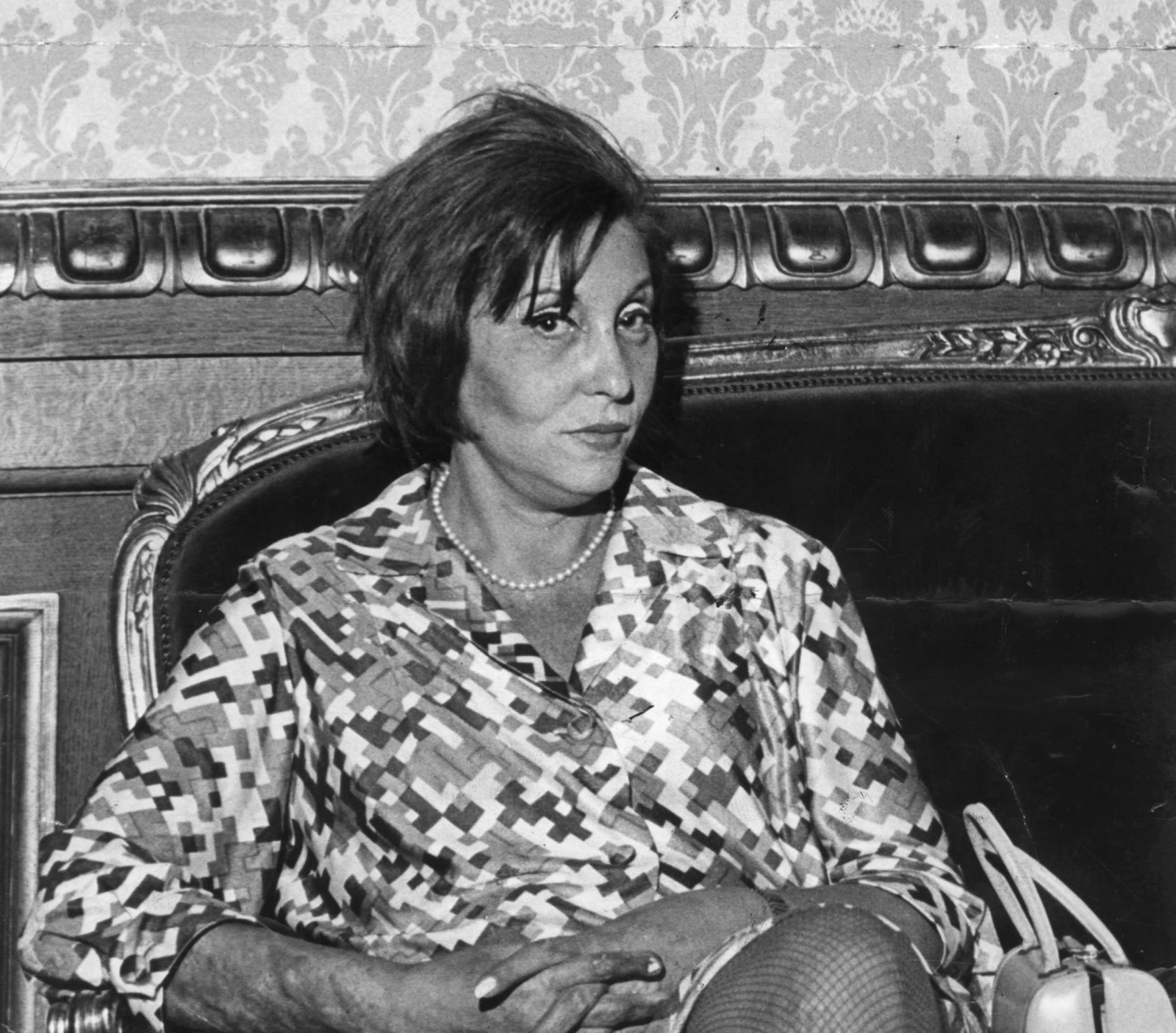
Image context: the cover uses a real 1972 archival photograph from Wikimedia Commons rather than a book jacket or a stylized portrait. That choice fits this piece because the interview keeps returning to the problem of exposure. Lispector is visibly there before the camera, but nearly every answer resists turning that visible self into a stable explanation of the books.[6]
Historical context: by 1977, Lispector had already turned inward life into a public literary shock
Lispector's path into literature was unusually early and unusually decisive. Britannica's biography notes that after her family fled anti-Jewish violence in the former Russian Empire and settled in Brazil, she came of age in Recife and Rio de Janeiro, published Near to the Wild Heart in 1943, and was quickly recognized as one of Brazil's major writers.[4] Penguin's edition page for that debut still describes the shock of the book's arrival: a fiercely interior novel written in her early twenties, already marked by unstable consciousness, sudden shifts in tone, and a refusal to keep thought neatly subordinated to plot.[4] By the time she sat in the TV studio in 1977, she was not an emerging novelist explaining herself for the first time. She was a canonical writer facing the burden of her own canonization.
That burden matters because Lispector's reputation had hardened around difficulty. Readers approached her books expecting opacity, mysticism, or a species of literary trance. The interview complicates all three expectations. Paris Review's short presentation of the clip emphasizes how restless and curt she appears, but also how quickly she gives unusually strong answers under visible discomfort.[2] Instead of performing "Clarice Lispector" as an oracle, she keeps cutting back to very blunt propositions about reading, labeling, and composition. The shock of the archive is that the woman attached to these books sounds less interested in mystery than in precision.
The late date intensifies that precision. New Directions describes The Hour of the Star as her consummate final novel, centered on Macabea and the intrusive narrator Rodrigo S. M., with simplicity, identity, and the violence of narration under pressure at once.[5] That matters here because the interview keeps circling the same formal questions. Who has the right to interpret a life? Why do some readers arrive through feeling while others bounce off explanation? How can a sentence stay simple without becoming thin? The camera catches Lispector answering those questions in ordinary language just as her last book was converting them into fiction.[1][3][5]
Video provenance
The embedded video is the Penguin Books UK upload of the February 1977 TV Cultura interview, presented with English subtitles.[1] Penguin's description says this is the only footage they have of Lispector and explains the immediate production context: she had come to the station for another program, the director seized the chance to request a personal interview, and the result preserved the writer "at the end of her life" looking back on her novels.[1] IMS provides the archival frame from the Brazilian side, identifying the interviewer as Julio Lerner, naming the program as Panorama Especial, and noting that the interview was broadcast only after Lispector's death later that year.[3] Between those two descriptions, the clip has unusually strong provenance: original television setting, identifiable host, known month and year, and an institutionally preserved afterlife rather than a stray reupload.
Around the middle of the interview, Lispector turns difficulty away from intelligence and toward contact
One of the strongest moments comes when Lerner asks about younger readers and about the reception of The Passion According to G.H..[1] Lispector answers with an anecdote that is almost too neat: a Portuguese teacher tells her he read the novel four times and still does not know what it is about; the next day a seventeen-year-old says the book is her bedside book.[1] The point is not that expertise fails and innocence wins. The point is that understanding, for Lispector, does not line up cleanly with credentials. Around the 17:40 mark she says, in effect, that understanding is not a matter of intelligence but of feeling and contact.[1] That sentence does important critical work. It explains why her fiction can seem sealed when approached as a puzzle to be solved and suddenly intimate when approached as an experience to be entered.
This is where the archive sharpens literary history. It is easy to describe Lispector from outside as a writer of inwardness, but the interview gives her own account of how that inwardness reaches readers. She does not defend obscurity as prestige. She does not claim to write beyond comprehension. She describes a different order of legibility, one in which rereading matters because contact is cumulative rather than instantaneous.[1] The anecdote about the teacher and the seventeen-year-old reader sounds casual, but it becomes a late poetics of readership: the books are not asking who is smartest in the room, but who can remain in the room long enough for the sentence to keep opening.
Around 19:00 to 20:50, the interview becomes a battle over the label "writer"
The next revealing turn comes when Lerner asks what problems "Clarice Lispector, writer" brings into the life of Clarice Lispector the person. Her answer is startlingly compact: sometimes considering herself a writer isolates her; it puts a label on her; through that label, everything she says is treated either as something beautiful or as nonsense simply because it comes from "the writer."[1] This is one of the best reasons to watch the clip rather than merely quote it. You can see her impatience with the role while also seeing that she knows she cannot step outside it. Fame has made interpretation automatic. The public no longer hears a sentence before deciding what kind of sentence it must be.
That complaint belongs directly beside the structure of The Hour of the Star.[5] Rodrigo S. M. keeps worrying the relation between narration and possession, between pity and display, between speaking for another life and converting that life into literary property.[5] In the interview, Lispector describes a milder but related violence: once the label is attached, ordinary speech is confiscated by interpretation. That is why her resistance to interviews is not just shyness. It is formal self-defense. She is trying to protect speech from the machinery that immediately turns speech into "Clarice."
The same section also produces one of the clearest statements about style in the entire recording. Around 20:30, Lispector says that at bottom she writes very simply, and a few seconds later adds: "I don't adorn."[1] That sounds almost paradoxical to readers who know her through the shimmering instability of Agua Viva or the metaphysical pressure of The Passion According to G.H. But the paradox is precisely the point. Lispector's sentences are not ornate in the decorative sense. Their force comes from stripping away the connective tissue that would normally reassure the reader. The prose feels difficult not because it is overembellished, but because it arrives without the expected padding. Simplicity here is not ease. It is exposure.
Near the end, the archive crosses into late style when Lispector says she is speaking from her grave
The clip's most famous line comes late. Asked whether she renews herself with each new work, Lispector answers that for now she has died and is speaking from her grave.[1][3] Paris Review pulled a different sentence for its headline claim about the interview, quoting her remark that writing changes nothing and that the task is somehow to open things up.[2] Taken together, these statements give the archive its real charge. Lispector does not sound triumphant, reconciled, or eager to summarize a career. She sounds exhausted with identity and still committed to the opening force of literature.
The phrase about speaking from the grave matters because it is not just gothic self-dramatization. In 1977, with The Hour of the Star either newly published or imminent depending on the edition in circulation, Lispector was already writing in a mode that seems to narrate from both inside and outside the living self.[3][5] The interview makes that mode audible. She keeps speaking in a nearly matter-of-fact register, but the content of the statements is terminal, posthumous, and oddly free. Death becomes a way of shedding the expectation that the writer explain herself coherently. What remains is the sentence, stripped down to pressure and contact.
Why this footage still matters
This is why the 1977 interview deserves to stay in circulation as an archival spotlight and not as a literary curiosity. It preserves Lispector at the point where public legend, late style, and bodily fatigue all meet. The clip shows her refusing three bad summaries at once: that difficulty is a badge of intellect, that the author can be reduced to the label "writer," and that simplicity is the opposite of risk.[1][2][3] What the archive gives instead is a writer insisting that simplicity is hard-won, that rereading is a form of contact, and that literature's task is opening rather than explaining away.
Seen from that angle, the interview belongs beside the books rather than behind them. It does not decode Clarice Lispector. It clarifies the stakes of reading her. The woman on camera keeps trying to remove ornament from both self-description and literary prestige, and what survives that stripping is unusually severe: a plain sentence, a refusal of labels, and a voice that already sounds as if it knows posterity will misunderstand it and is speaking anyway.[1][5]
Sources
- Penguin Books UK, "Interview with Clarice Lispector - Sao Paulo, 1977 (English subtitles)," YouTube video, February 1977 footage uploaded January 24, 2014.
- Dan Piepenbring, "It Changes Nothing," The Paris Review, December 10, 2014.
- Elizama Almeida, "I'm Talking From My Grave," IMS Clarice Lispector, June 7, 2017.
- Encyclopaedia Britannica, "Clarice Lispector."
- New Directions Publishing, The Hour of the Star.
- Wikimedia Commons, "File:Clarice Lispector, 1972.jpg" (source page for the lead photograph used in this article).