Before Markheim murders the antiques dealer, he objects to a mirror. He has supposedly come shopping for a Christmas present, and the dealer offers a hand-glass. Markheim recoils: who would want to look at himself? In a shop full of things that can change owners, this particular object threatens to return something he cannot sell or leave behind. He calls it a “hand-conscience.”[1]
Robert Louis Stevenson gives the room plenty of other ways to disturb him. Clocks tick, reflections multiply, and sounds penetrate from the street. Yet being frightened by these things does not make Markheim good. The story’s exacting distinction is between feeling watched and accepting responsibility. Following its mirrors, clocks, and doorbell shows how far apart those experiences can be.
The discussion below includes the ending.
“Markheim” appeared in December 1885 in The Broken Shaft: Tales of Mid-Ocean, Unwin’s Christmas Annual, and entered The Merry Men and Other Tales and Fables in 1887.[2] Its first readers encountered a Christmas story in which the gift-shopping pretext ends in murder. This was also Stevenson’s Bournemouth period, when illness frequently confined him to the house while his literary output remained vigorous.[4] The photograph below belongs to that working life: a real room and writing table behind the invented shop.
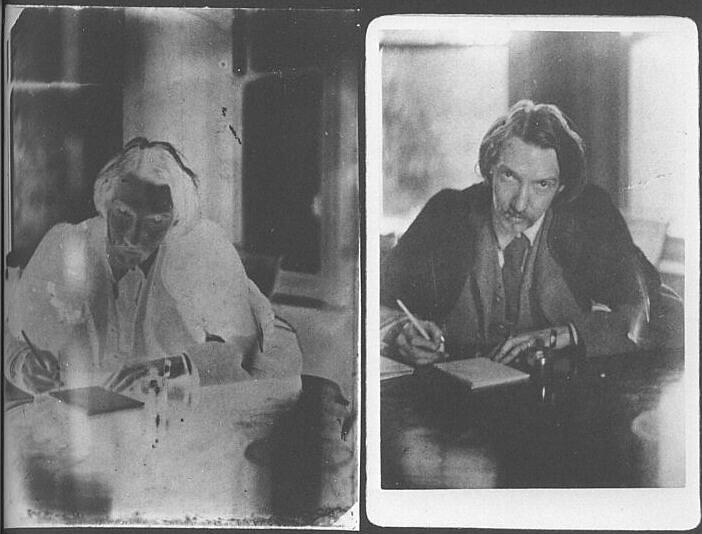
The mirror makes a witness of his own face
The first mirror matters because Markheim understands its accusation before committing this particular crime. His discomfort cannot be explained entirely as a murderer’s immediate shock. He already finds his own history difficult to look at. The dealer treats the glass as merchandise; Markheim hears a judgment in the offer. Their conversation keeps slipping between a commercial transaction and an unwanted examination.[1]
After the stabbing, the single hand-glass becomes a roomful of reflections. Carrying a candle among the goods, Markheim sees his face repeated in the shop’s mirrors, an “army of spies.”[1] The striking detail is whose eyes discover him. He supplies both the fugitive and the pursuers. An empty shop can therefore feel crowded without Stevenson having to introduce a real witness.
But this exposure has limits. Markheim worries that he chose the wrong hour, neglected an alibi, and used the wrong method. His regrets include both the thought that he should have spared the dealer and the thought that he should have killed the servant too.[1] The sequence makes uncomfortable reading because conscience and criminal calculation occupy the same rushing paragraph. Anxiety alone gives us no reliable measure of repentance.
Hilary J. Beattie’s study of Stevenson’s mirrors reads this scene through the collapse of Markheim’s flattering image of himself. She also notes the critical disagreement over whether the visitor who appears later embodies his better or worse self.[3] That disagreement helps keep the glass from becoming a tidy symbol with a single translation. It exposes something, but exposure can produce shame, resentment, better concealment, or change. The reflected face does not choose among them.
The clocks turn time into something he cannot buy
Even before the murder, Markheim tries to prolong the conversation. He proposes friendliness and asks about the dealer’s emotional life. “Every second is a cliff,” he says.[1] The metaphor makes the ordinary passage of time precipitous: one movement might carry a person beyond recovery. Moments later, he makes that movement himself.
Afterward the clocks strike three in the afternoon, in different tones and at different speeds. The hour has not acquired new properties, but Markheim’s relation to it has changed. Time has ended for the dealer; for the killer, each passing minute brings discovery closer. The shop’s varied stock supplies a whole chorus to announce this unequal division.[1]
Stevenson then catches him wanting to stop the clocks because their ticking seems intolerably loud. He does not actually stop them. Instead he swings between stealth and conspicuous bustle, afraid first of making noise and then of the suspicious silence.[1] His imagined audience can interpret either behavior against him. There is no performance that guarantees innocence.
This is where the clock motif exceeds a conventional reminder of mortality. Markheim wants the murder to purchase a different future: money now, freedom and better conduct afterward. Yet the act that is supposed to release him has made every second more expensive. While he searches, he must also listen, invent explanations, and anticipate arrivals. His promised new life requires another interval of evasion before it can begin.
The upstairs visitor presses on that bargain. Markheim argues that his actions misrepresent his true nature; circumstances have prevented the good within him from emerging. The visitor returns to his pattern of conduct and predicts its continuation.[1] Read beside the clocks, the argument becomes a dispute about postponement. How long can goodness remain a future intention while present conduct keeps contradicting it?
The bell demands an answer
Earlier, a cheerful man knocks on the shop door and calls to the dealer. He eventually leaves. That interruption only makes Markheim more eager to finish the robbery. The later doorbell changes the situation because the returning maid will need an answer.[1]
The visitor offers a plan: pretend that her master is ill, admit her, kill her, and gain the rest of the evening to search. It is the fantasy of purchased time in its ugliest form. Another person’s future can be extinguished to make room for Markheim’s.
Here he finally refuses. “I can cease from action,” he says.[1] Taken alone, the phrase sounds like withdrawal. What follows gives it a precise object: he can cease the criminal sequence, surrender his escape, and expose himself to punishment. He still has something to do.
The visitor’s face brightens and softens before fading, but Stevenson does not name the being. Markheim himself does not stop to interpret the transformation.[1] A supernatural reading remains available; the action at the threshold does not depend on settling it. The story moves away from the fascinating stranger toward the person waiting outside.
The bell rings again. Markheim opens the door, tells the maid to fetch the police, and says, “I have killed your master.”[1] The sentence contains none of his earlier qualifications about circumstances or his inward character. He names himself as the person responsible.
That is the movement the objects have traced. The mirrors make him see himself; the clocks make him fear what comes next. The bell brings another person within reach of his decision. At the threshold, the maid receives a confession instead of the attack planned for her. For once, his words give someone else the truth she needs.
Sources
- Robert Louis Stevenson, “Markheim,” in The Merry Men, and Other Tales and Fables. Project Gutenberg, ebook 344 — primary text, from the opening mirror exchange through the final confession.
- Robert Louis Stevenson Archive, “A Chronology of Robert Louis Stevenson’s Works” — the December 1885 first publication and the 1887 collection.
- Hilary J. Beattie, “Stevenson’s mirrored images or, games of Hyde and seek,” Journal of Stevenson Studies, volume 8 (2011), pp. 197–213, especially pp. 198–201 — mirrors, self-image, and the visitor’s disputed identity.
- Robert Louis Stevenson Archive, “Bournemouth” — Stevenson’s residence, illness, and literary work during 1884–1887.
- Lloyd Osbourne, photograph of Robert Louis Stevenson at his writing table, Skerryvore, Bournemouth (1885), reproduced by Alwyn Ladell — image and attribution to the Beinecke Collection, Yale University.