A boy looks up at the fir trees and thinks their tips almost touch the sky. Years later, he can recognize the mistake. Thomas Hood gives him that correction, then leaves him with a harder problem: knowing better has done nothing to make him feel less distant.
This is the small, devastating movement of the final stanza of “I Remember, I Remember,” lines 25–32. The University of Toronto's Representative Poetry Online identifies its original text as Friendship's Offering, a literary album dated 1826.[1] The poem remembers a childhood house, flowers and a swing before arriving at these trees. Its last view upward might seem to offer the adult a moment of superiority. Instead, the adult has to ask what his superiority is worth.
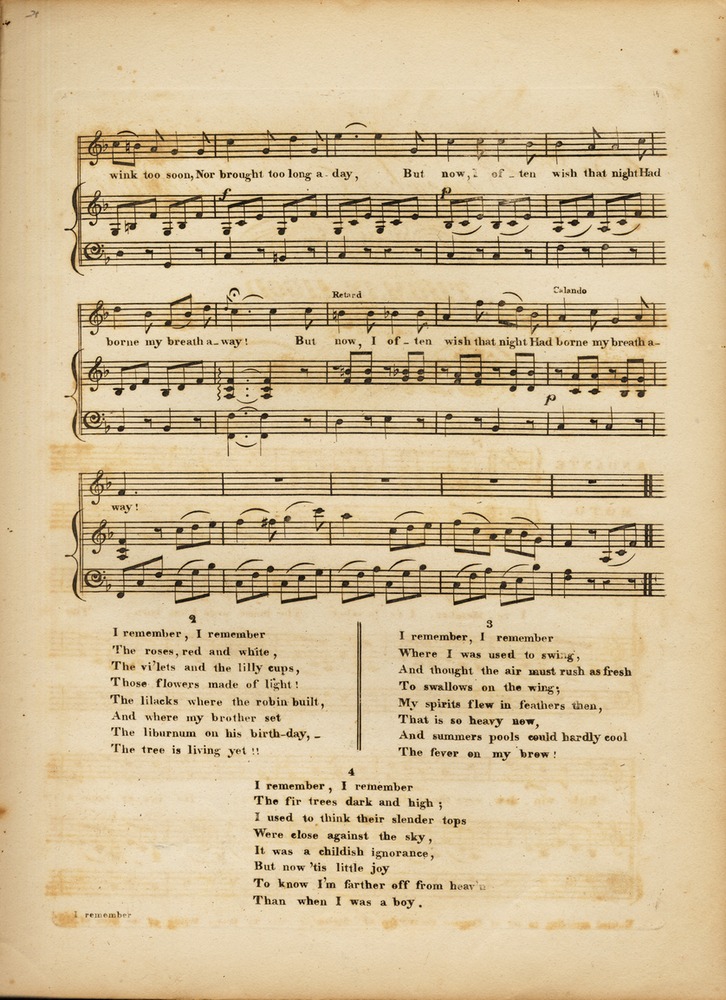
The adult calls his former belief “childish ignorance.” The phrase seems to close the case: childhood supplied a lovely picture, experience has corrected it. But the next line makes the correction emotionally inadequate. There is “little joy” in the knowledge that follows:
To know I'm farther off from heav'n
Than when I was a boy.[1]
Notice that Hood has changed the destination. The child was looking toward the sky; the adult speaks of heaven. We begin with an apparent gap between visible things and end with a distance that cannot be checked by looking. The trees have made a spiritual or emotional condition imaginable without settling exactly what that condition is.
Heaven can retain its religious meaning here. It can also gather the felt blessedness of a childhood in which the world seemed intimate and welcoming. The stanza leaves room for both. Declaring that the speaker has lost his faith would make the ending more definite than Hood makes it. So would reducing heaven to a cheerful synonym for childhood. The word's reach is part of the ache.
The grammar sharpens that uncertainty. What the adult explicitly knows is his present distance from heaven. His more accurate understanding of the trees and sky is something we infer from his dismissal of the earlier belief. The poem never stages a scientific explanation. Its subject is the strange experience of possessing a correction that fails to console you.
Even the understatement matters. The speaker does not deliver a grand denunciation of knowledge. He registers how little happiness this particular knowledge brings. That modest claim is harder to dismiss: we do not have to believe that children are always wiser, or that ignorance is desirable, to recognize an adult's disappointment in what growing up has yielded.
Read the last two lines aloud and the thought feels almost disarmingly easy to carry. The contraction in heav'n keeps the longer line compact; the shorter final line lands on boy, answering the earlier rhyme on joy. The rhyme brings the words together precisely when the sentence declares their separation. Childhood still fits the music of happiness, even as the speaker places himself outside it.[1]
The poem's musical afterlife gives that ease a material form. Johns Hopkins preserves an 1828 setting for voice and piano by C. Meineke, catalogued as strophic: successive stanzas use the same musical framework.[2] That does not tell us how every reader heard Hood. It does show how early these words became something a voice could return to. The repeated opening of each stanza already offers that invitation on the page.
There is a temptation to explain the sadness by reaching straight for the poet's life. William Michael Rossetti's biographical introduction to Hood's collected poems encourages such sympathy, describing comic invention sustained through illness and financial strain.[3] That history matters, but it cannot tell us precisely what the lyric speaker means by heaven. The passage earns its force through the change of word, the qualification and the rhyme, all available to a reader who knows nothing of Hood's circumstances.
Modern criticism also gives childhood recollection a larger setting. The published summary of Sara Lodge's chapter on work, play and criticism describes Hood's playfulness and childhood memory as alternatives to the relentless rhythms of work.[4] That is a frame for his writing, rather than a specific explanation of these eight lines. It helps us notice that remembering may preserve a way of experiencing life whose value adult competence cannot measure.
Hood's final stanza preserves the child's view while allowing the adult to question it. We can still picture those slender treetops. The poem has made the apparent nearness available to our imagination even as its speaker withdraws his belief. He cannot inhabit the old certainty again, but he can give it a shape another person will recognize. The trees remain within reach of language. Heaven remains farther away.
Sources
- Thomas Hood, “I Remember, I Remember,” Representative Poetry Online, University of Toronto Libraries — primary text, especially lines 25–32; original-text reference to Friendship's Offering (1826).
- Lester S. Levy Sheet Music Collection, Johns Hopkins University, “I Remember I Remember,” box 064, item 036 — C. Meineke's setting for voice and piano, Baltimore, 1828; archival image and catalogue record.
- William Michael Rossetti, “Biographical Introduction,” in The Poetical Works of Thomas Hood, enlarged and revised edition, A. L. Burt Company; Project Gutenberg — biographical framing of Hood's humor, illness and financial difficulties.
- Sara Lodge, “Sine qua non-sense: Work, play, and criticism,” chapter 6 of Thomas Hood and Nineteenth-Century Poetry: Work, Play and Politics, Manchester University Press — publicly available chapter summary on Cambridge Core; context for play, childhood memory and work.