The swans are drunk, but the water is sober. Near the middle of Friedrich Hölderlin’s “Half of Life,” birds intoxicated by kisses dip their heads into a lake whose defining adjective is heilignüchtern: holy and sober pressed into one word. The scene has yellow pears, wild roses, beautiful birds—enough beauty to become a picture of uncomplicated happiness. That strange adjective prevents it. Even before winter enters the poem, delight meets something that does not share its intoxication.[1]
Published in 1804 in an almanac dated 1805, the poem belongs to the group known as the Nachtgesänge, or night songs. Its two seven-line stanzas make the division promised by its title visible on the page. Yet the halves are not sealed compartments labeled happiness and sorrow. Translation makes their entanglement especially audible: a choice about one adjective can change whether the first scene contains a tension or performs an awakening.[1][2]
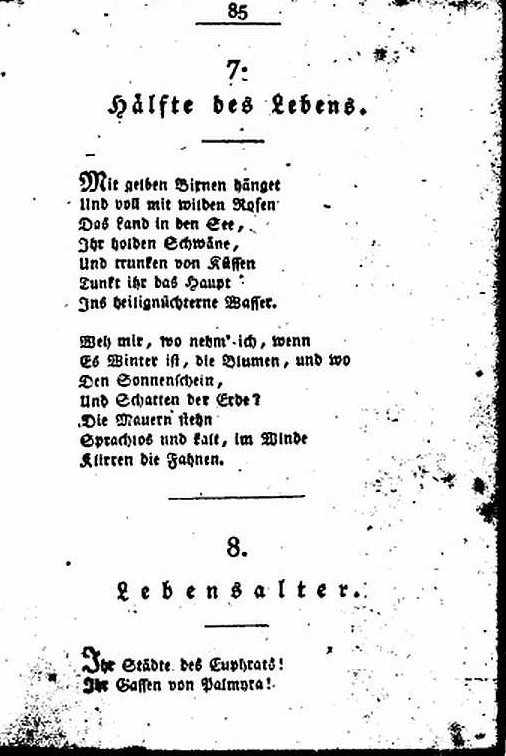
Two qualities, or an action?
In lines 5–7, the birds’ condition comes first: “trunken von Küssen,” drunk with kisses. Their downward movement then brings them into contact with the compound adjective. The proximity matters. Sobriety does not arrive as a moral explanation from outside the scene; it belongs to the same water that receives the birds.[1]
Michael Hamburger and Richard Sieburth give that contact different weights. In the versions compared by Priscilla A. Hayden-Roy in the Hölderlin-Jahrbuch, Hamburger writes “Into water, the holy-and-sober”; Sieburth writes “In the sobering holy water.” The review identifies Hamburger’s 2004 Poems and Fragments and Sieburth’s 1984 Hymns and Fragments. These are specific published choices, not interchangeable English equivalents.[4]
Hamburger lets the two qualities remain beside each other. His hyphens make a conspicuous little structure in English, keeping the German compound’s resistance to easy speech. Water can be sacred without being ecstatic; sobriety can belong inside the holy. The line asks the reader to hold those conditions together without explaining how they fit.
Sieburth’s sobering suggests an effect. The water can act upon whoever enters it. After the intoxicated kisses, the English participle makes the dip sound like an encounter with something capable of dispelling intoxication. It gives the reader a possible movement from rapture toward recognition.
That movement is an interpretive gain with a cost. It helps the first stanza lean toward the second, where the voice asks what will remain in winter. But it also makes a process more explicit than sober would. I hear Hamburger preserving the uneasy coexistence of two states, while Sieburth brings out the possibility that contact changes the birds. Neither choice licenses us to say the swans have learned a lesson: the poem never reports their thoughts. The distinction is between what the English wording encourages us to imagine.
A question interrupts the view
At line 8, “Weh mir”—roughly, alas for me—breaks into the landscape. The speaker asks where flowers, sunshine and the earth’s shade can be found when it is winter. The German sentence spills across four lines, leaving wenn, when, at the end of one line and wo, where, at the end of the next. The voice keeps reaching beyond the line for what it needs.[1]
This is a different kind of incompleteness from the compressed adjective. There, two meanings crowded together; here, a question cannot quickly reach its objects. A translation that preserves some of those delays lets the reader experience the search. A fluent sentence can give us the information sooner, but then the speaker sounds more composed.
The requested shade is particularly revealing. Sunshine would be an obvious thing to miss in winter. Shade complicates the wish: the speaker wants the world in which light and shelter from light belong together. On this reading, the loss concerns a whole way of inhabiting a place, including its contrasts. Turning the passage into a general complaint about cold would narrow it considerably.[1]
The question also leaves the timing unsettled. Winter first enters as a condition the speaker anticipates; the closing walls then stand before us in the present tense. We are not given a narrated walk from one season into another. The blank between stanzas has already carried us across a distance the poem declines to explain. Ian Cooper’s study places that rupture within a larger argument about reflection and the divided self. Even without adopting his philosophical account, a translator has to decide how much connective language to supply.[2]
The sound left after speech
The final three lines bring walls, speechlessness, cold and wind. Then comes Fahnen. English can hear flags in the word, but the rattling verb, klirren, also directs attention toward weather vanes. The choice changes the objects we imagine above the walls.[1]
Translator John Irons’s workshop on the poem makes the sonic stakes concrete. The Hamburger version he prints ends with “Weathercocks clatter”; Sieburth’s ends with “The weathervanes creak.” Clattering suggests repeated hard contacts. Creaking draws out a strained movement. Both make an audible object emerge from the winter scene, but they leave different sounds in the reader’s ear.[5]
Weather vanes clarify the physical noise, yet they can also close off an association. Cooper argues that the German retains the political implications of flags as signs of the state. That is a critical interpretation, not proof that every flag in the poem carries a fixed political message. It is nevertheless a reason to hesitate before treating the word as a puzzle with one tidy English answer.[2]
The poem’s ending has noise without an answering voice. Its walls cannot speak, while the wind can still set something rattling. This is why the first stanza’s difficult water deserves to remain difficult. The poem begins with a world that can hold intoxication and sobriety together; it ends with a speaker who cannot recover the world by asking for it. English gives that break a different force depending on whether the water simply is sober or has already begun to sober someone.
Sources
- Friedrich Hölderlin, “Hälfte des Lebens,” first-print text from Taschenbuch für das Jahr 1805, p. 85; Wikisource transcription checked against the scan. All German line references follow this text.
- Ian Cooper, “Hölderlin’s ‘Hälfte des Lebens’ and the Fate of Reflection,” Publications of the English Goethe Society 91:3 (2022), pp. 176–192; publication history, stanza division and the interpretation of flags. Open-access copy at the University of Kent.
- Wikimedia Commons, “Hälfte des Lebens.jpg”; archival scan of the first printing, credited to Hölderlin.de, with image provenance and original file.
- Priscilla A. Hayden-Roy, review of Selected Poems, translated by Emery George, Hölderlin-Jahrbuch 38 (2012–2013), pp. 302–307, especially p. 305 and notes 8–9 comparing Hamburger and Sieburth. Full volume hosted by the Hölderlin Society.
- John Irons, “Hölderlin – Hälfte des Lebens,” translation workshop, pp. 4–6; comparison of English versions, including the final sounds in Hamburger and Sieburth. The Hamburger wording reproduced here differs from the edition cited in source 4.