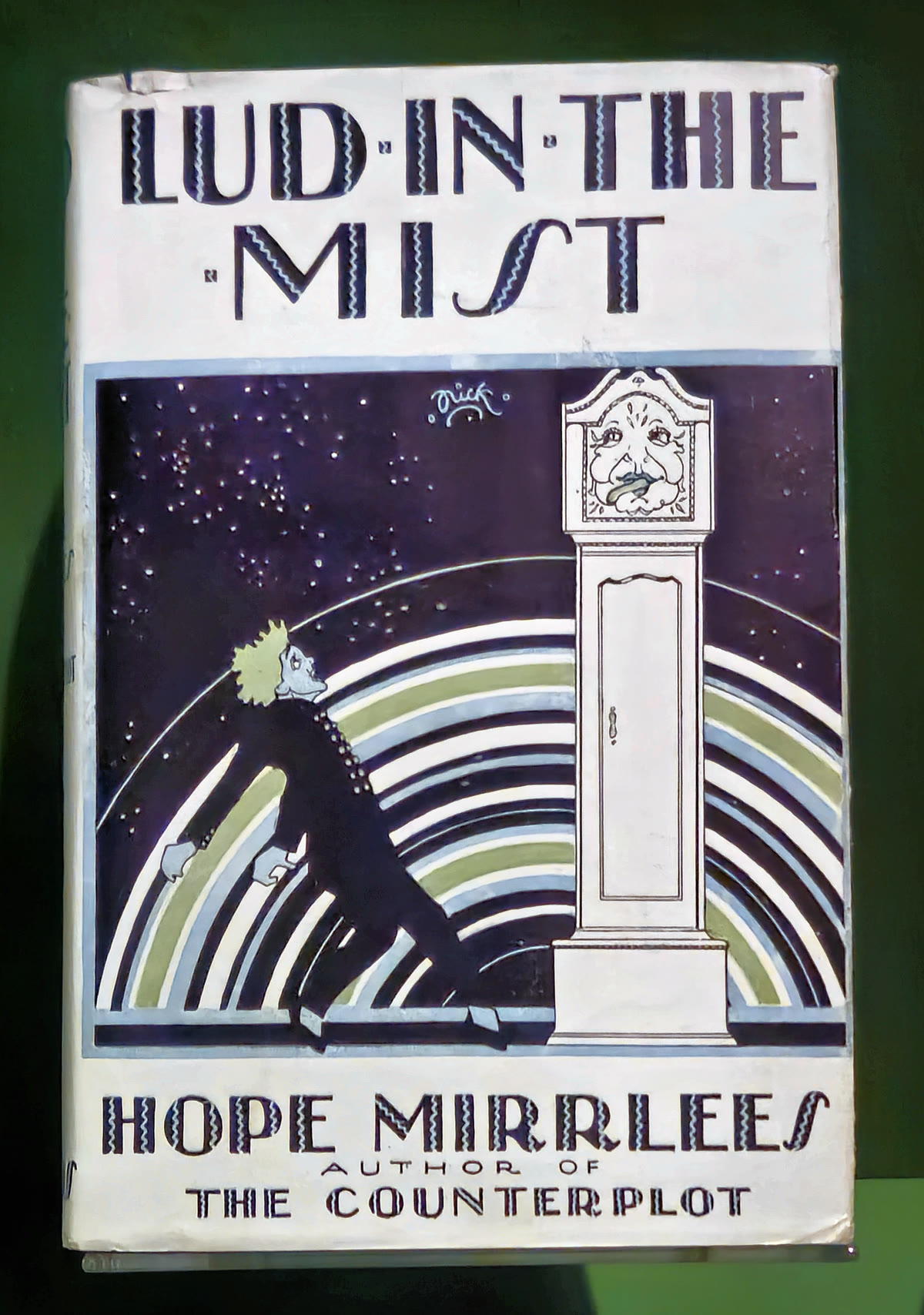
Most fantasies ask the reader to cross a border. Hope Mirrlees begins with a city that has solved its border problem on paper. Fairyland lies just beyond the Debatable Hills; one of its rivers runs through the mayor's garden; its fruit can be bought in low taverns. In the eye of Lud-in-the-Mist's law, however, none of these things exists.
That contradiction is not a loose piece of whimsical world-building. It is the engine of Mirrlees's 1926 novel. The respectable merchant republic of Dorimare has not defeated enchantment. It has built a public vocabulary that lets everyone encounter enchantment while denying that encounter has occurred. Fairy fruit becomes contraband cloth. Old sacred designs become advertisements. A forbidden history is burned, but its traces remain in surnames, oaths, buildings, songs, and rural customs.[1]
The result is a fantasy of unusually sharp philosophical comedy. Lud-in-the-Mist is often praised as a recovered classic or a “fantasy novel of ideas,” while recent criticism has connected its carnival to queer inclusion and its social transformations to modernist and anti-authoritarian thought.[2][3][5] Those readings open real doors. Yet the novel resists becoming a one-key allegory in which fairy fruit simply equals art, sexuality, intoxication, or political freedom. Its stranger proposition is about denial itself: a community does not need to erase a fact in order to suppress it. It needs only to control the names under which the fact may appear.
Two rivers, one city
Lud stands at the meeting of the Dawl and the Dapple. The broad Dawl carries trade and makes the town wealthy. The smaller Dapple arrives from Fairyland, contributes nothing acknowledged to commerce, and slips past the Chanticleer family's house. Local wisdom nonetheless insists that “The Dapple flows into the Dawl.”[1] Geography has already spoiled the republic's preferred story. The practical city and the fantastic country are not sealed worlds; their waters mix before the plot begins.
Mirrlees is too alert to make this a simple contest between grey merchants and liberating fairies. Dorimare's merchant revolution had cause. Duke Aubrey was a gifted poet and a capricious ruler who burned a ship for pleasure, rode through standing crops, and treated his subjects as material for jokes. The middle class challenged unchecked privilege because arbitrary power obstructed trade and ordinary security. Their constitution was an achievement before it hardened into mythology.[1]
The new rulers then repeated the old regime's most dangerous habit: they made their own perspective identical with reality. The duke was expelled, the priests vanished during the upheaval, and the merchant rulers placed a taboo on the fairy cult. They treated the tragic sense in poetry as a social sickness. Eventually the polite word fairy became an obscenity, even though the countryside still remembered Aubrey, ancient fairy imagery remained built into modern Lud, and the Dapple kept flowing through town.[1]
That mixed inheritance matters. If Fairyland were only good, denial would be cowardice and the cure would be surrender. Instead, fairy fruit can bring vision, agony, compulsion, disappearance, and death-like transformation. The republic is right that contact carries danger. It is wrong to imagine danger can be managed by refusing the noun. Its citizens lose the ability to distinguish use from abuse because official speech permits no intelligible use at all.[1]
Jean Mills reads the novel's carnival as a subversive space in which the excluded fairy self can rejoin the body politic; James Gifford's account places Mirrlees in a modernist fantasy tradition attentive to ideology and material social change.[2][3] Both frames help explain why the border is political as well as magical. Mirrlees's decisive formal choice is to keep the border porous. The fantastic is not an invading abstraction. It is already inside the republic's language and goods, carrying meanings that respectable Lud consumes while pretending not to recognize their source.
The law's most imaginative object
The novel's funniest invention is also its cleanest theory of power. Because the law cannot prosecute an object it declares nonexistent, Dorimare creates a legal fiction: fairy fruit counts as a kind of woven silk. Smugglers may now be charged without any court saying what crossed the border.[1]
This fiction does more than hide embarrassment. It changes what evidence can mean. A stained pocket, a suspicious shipment, or an altered child can enter public reasoning only after being mistranslated. The state remains perfectly capable of punishment; it has merely disabled honest description. Law has not expelled magic. Law has become the most institutionally successful magic in the book.
Mirrlees makes the parallel explicit in the writings of Nathaniel Chanticleer's jurist father: the revolutionaries “substituted law for fairy fruit.”[1] The comparison initially flatters the republic. The old fruit belonged to duke and priest, while law is formally offered to rich and poor. Yet both systems reshape reality through agreed fictions. The moral difference therefore cannot rest on one being imaginary and the other real. It must rest on who can use the fiction, who bears its costs, and whether it can be questioned.
On those tests, Lud's law is failing. The senators are hereditary merchants who know little about the people for whom they legislate. During a drought, villagers eat fairy fruit for relief while the Dapple alone continues to flow; the government answers desire with disgust and fails to stop supply. The official fiction preserves the rulers' sense of order while pushing actual knowledge into taverns, farms, kitchens, and gossip. What looks like ignorance from above is often practical knowledge kept below the threshold of respectability.[1]
This is why the prohibition produces hypocrisy rather than innocence. Everyone knows the fruit is obtainable, and the historical record includes youths from good families among its users. Public rhetoric nonetheless assigns consumption to foreigners, poor people, and the disreputable. Denial becomes a class privilege: those secure enough to control the language can assign the forbidden appetite to somebody else.[1]
Nathaniel's private constitution
The city's public evasion has an intimate counterpart in its mayor. As a young man, Nathaniel plucks one terrible, alluring note from an ancestral instrument. He never names what the sound disclosed, but afterward he abandons his appetite for travel and clings to routine. Domestic happiness becomes painfully fragile because he experiences the things in front of him as if they were already memories.[1]
Nathaniel does not lack imagination. He suffers from imagination without a usable language. A pipe, ledger, chair, or familiar face might at any moment disclose time, loss, and death. He responds as Lud does: not by testing the experience, but by building ordinary life into a defensive institution. His comfortable house is a private version of the republic—full of inherited fairy objects, organized around not seeing them.
When his son Ranulph eats fairy fruit, the city's fiction enters the family. Nathaniel first wants a discreet diagnosis and a cure. The more desperately he protects the household's reputation, the more vulnerable the household becomes to Endymion Leer, the doctor who can move between polite society and the illicit traffic it denies. Leer gains power not because nobody suspects anything, but because suspicion cannot be converted into speakable public knowledge.[1]
Mirrlees refuses to make Nathaniel's awakening pure. When he finally tells the Senate to call fairy fruit by its name, he also demands a hanging. His new honesty still imagines truth as something authority can secure through a clean accusation and a dead offender. The Senate replies with its own ancient fiction and declares the mayor “dead in the eye of the Law.”[1] The reversal is comic and exact. A legal system trained to detach words from facts can do the same to the person who presides over it.
Recognition is not surrender
Nathaniel's education begins when his official role ends. Outside Lud, he must listen to servants, farmers, children, smugglers, old court records, and nursery lore. Evidence reaches him in forms his office taught him to despise. He solves the conspiracy not by abandoning reason for ecstasy, but by allowing testimony, material traces, dreamlike correspondences, and legal records to correct one another.[1]
That distinction protects the novel from a lazy moral about believing anything. Endymion Leer is associated with Fairyland and remains a manipulator. The old duke's beauty does not erase his cruelty. Nathaniel's passage beyond the hills brings no neat revelation, and initiation does not cure his melancholy. The book asks for hospitality to what exceeds a system, not obedience to every mystery.[1]
The change in Lud is therefore less a victory of fantasy over reality than a change in civic posture. When the fairy host approaches, Ambrose Honeysuckle persuades the town to open its gates. Fruit once reserved for a ruler and then driven underground is distributed to every household. The excluded is received publicly, so contact no longer needs to masquerade as vice or silk.[1]
Even this reconciliation carries a wink. Practical Ambrose promptly creates an industry that candies fairy fruit, packs it in decorated boxes, and exports it. Art returns through packaging; enchantment becomes a commodity; the Dawl finds a way to sell what came down the Dapple. Mirrlees neither condemns this compromise nor presents it as transcendence. A functioning city absorbs its revelation through trade, habit, and jokes. The border opens, but Lud remains Lud.[1]
The warning on the last page
Published in 1926, Lud-in-the-Mist belongs to a larger body of Mirrlees novels, poetry, and translations.[1][4] Its continuing Hachette edition supplies one visible measure of how decisively the book has outlived its reputation as a forgotten curiosity.[5] Its critical afterlife is equally fitting. A book about suppressed knowledge has been renamed across literary categories: fairy tale, modernist experiment, cult fantasy, political satire, queer counterworld.[2][3]
But recovery can become another way to make the novel safe. Calling it a neglected masterpiece risks turning strangeness into prestige, just as Lud turns ancient sacred imagery into a cheese advertisement. Mirrlees plants a resistance to that process in the conclusion. The narrator labels “the Written Word” a fairy and warns that it speaks in a feigned voice.[1] The joke reaches backward through every official history, court record, epitaph, and page we have trusted.
That does not make language useless. It makes reading an ethical practice rather than an act of possession. Words can disclose what a community has hidden, but no final label—law, fantasy, allegory, classic—owns the thing it names. The best answer to the novel's mist is neither to deny it nor to pretend it has cleared. It is to notice what moves through it, who decides what that movement is called, and whose reality a convenient name allows the city to forget.
Sources
- Hope Mirrlees, Lud-in-the-Mist (Collins, 1926), Project Gutenberg eBook no. 68061 — primary text used for plot, quotations, and chapter references.
- Ardel Haefele-Thomas, review of The Female Fantastic, Nineteenth-Century Gender Studies 15.2 (2019) — an accessible account of Jean Mills's reading of the novel's Menippean satire, queer codes, and inclusive carnival.
- Nick Hubble, “A Modernist Fantasy: Modernism, Anarchism and the Radical Fantastic by James Gifford,” Strange Horizons (2019) — critical context for Mirrlees's relation to modernism, fantasy, ideology, and social change.
- Open Library, “Hope Mirrlees” — author bibliography and edition records for Mirrlees's novels, poetry, and translations.
- Hachette UK, “Lud-In-The-Mist by Hope Mirrlees” — current edition record and a concise sample of the novel's modern critical reception.
- Wikimedia Commons, “Lud-in-the-Mist 1926 cover” — source page for Eric Polk's photograph of the period cover displayed at the Bowers Museum.