People often summarize Bleak House as Dickens's great attack on Chancery, and the summary is correct as far as it goes.[1][2] Jarndyce and Jarndyce is the novel's public scandal: a suit so old, swollen, and self-consuming that it seems to have generated a social class of dependents around its delay.[1][2] But the novel would not feel so inexhaustible if Dickens left the problem at the level of legal argument. He keeps translating procedure into atmosphere. In Bleak House, institutions do not merely rule people. They seep into weather, sidewalks, houses, habits of speech, and piles of paper. Fog, mud, and documents become the novel's three great recurring signals.[1][3][4]
That is why the opening remains so powerful. Dickens does not begin with a case summary or a reform speech. He begins with London thickened beyond ordinary use. "Fog everywhere," he writes, before giving us marsh, river, shipping, barges, throats, and eyes all under the same smothering medium.[1] A few lines later, the Lord Chancellor sits "in the midst of the mud and at the heart of the fog."[1] The sentence is more than scene-setting. Dickens has already turned legal delay into a civic climate. The court is not simply located in the city; it seems to radiate through the city.
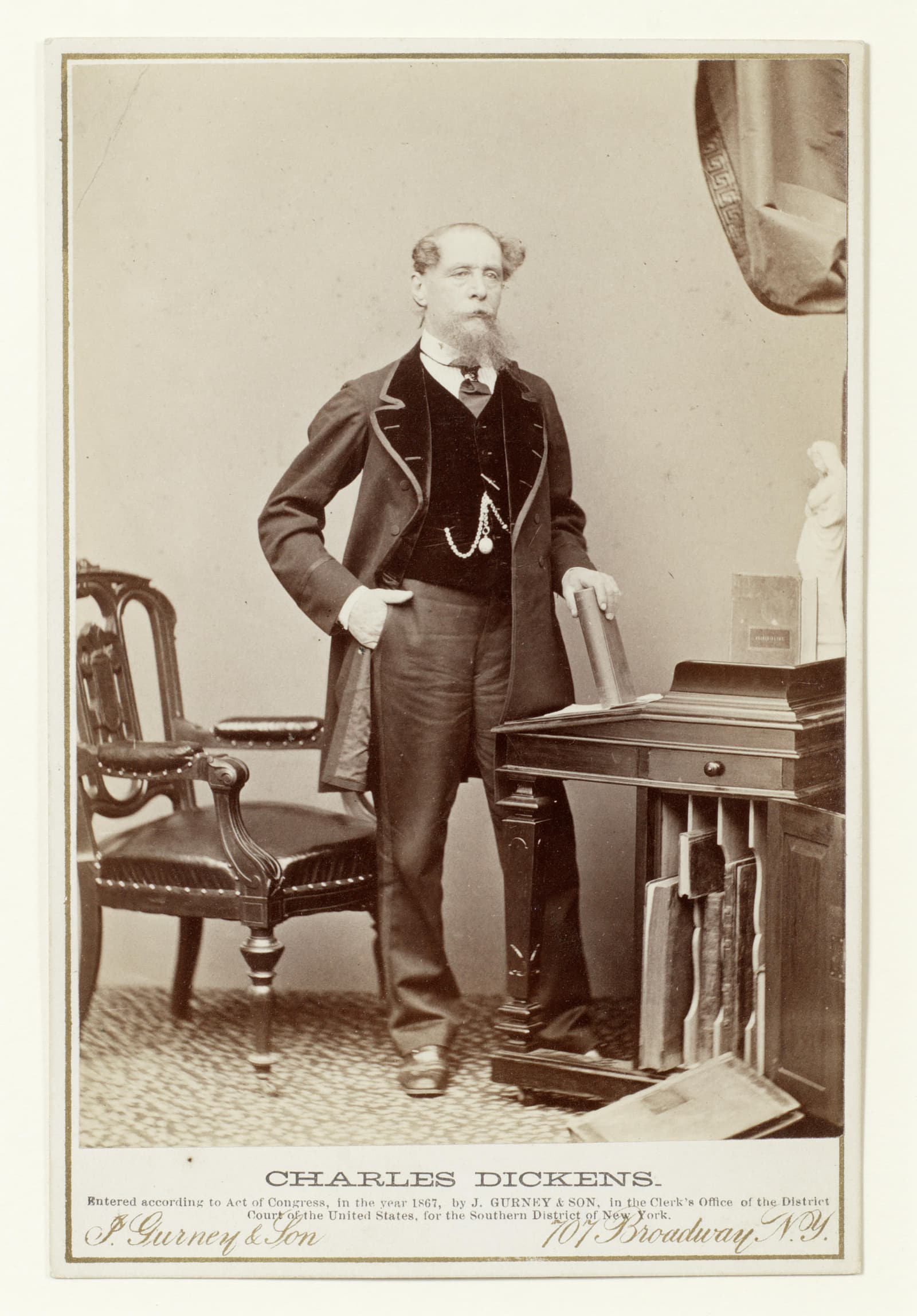
Image context: the cover uses a real archival portrait of Dickens rather than an engraving of the Court of Chancery or a modern London street scene. That choice keeps the essay anchored in literary making. The point here is not documentary reconstruction of one place. It is the precision with which Dickens keeps remaking one institutional logic across multiple kinds of matter.[5]
1) Fog is the novel's first proof that delay has become an atmosphere
The obvious force of the opening fog is visual. It obscures, spreads, settles, and climbs.[1] Yet the deeper force is conceptual. Fog is what happens when ordinary distinctions lose edge. The river and the street, the shipping lanes and the courthouse quarter, the natural world and the industrial one all begin to share one blurred condition.[1][3] Dickens does not need to tell us in abstract terms that Chancery has become a civic nuisance larger than any single lawsuit. He makes London breathe it.
That matters because Bleak House is not simply a novel about corruption. It is a novel about distributed consequence. Jarndyce and Jarndyce harms Richard, Ada, Esther, and John Jarndyce directly, but Dickens keeps showing how its logic has spread outward into a culture of postponement, indifference, and self-excusing drift.[1][2] Before we meet most of the central characters, the narrative has already suggested that whole professions and whole habits of mind have learned to live inside suspended resolution.
The novel says as much with bitter clarity when it describes all the lesser forms of evasion grown from the case's example: "Shirking and sharking in all their many varieties" have been "sown broadcast" by Jarndyce and Jarndyce.[1] Fog is the right emblem for that spread because it does not behave like a single villain. It has no center you can point to once it settles. Cambridge's chapter on Bleak House as a "liquid city" is helpful here because it notices how Dickens turns climate into narrative method, making environment itself carry institutional meaning.[3] The result is that readers do not merely learn about delay. They enter it sensorily.
Fog also sharpens the novel's double structure. Esther Summerson's chapters often seek warmth, tact, and local recognitions, while the omniscient voice keeps reopening London at a more systemic scale.[1][4] The fog belongs especially to that second register. It lets Dickens write totality without flattening the city into one diagram. The medium is everywhere, but people still move through it differently. Some profit. Some wait. Some get lost.
2) Mud makes procedure physical
If fog is the novel's broad atmosphere, mud is its street-level cost. Dickens's opening pages do not give us picturesque London grime. They give us matter that sticks, accumulates, and exacts payment in movement.[1] The mud deposits "crust upon crust" and gathers "at compound interest," one of the novel's shrewdest little turns of metaphor because it makes the street surface itself seem to have learned financial behavior from the institutions around it.[1] Even the ground has become usurious.
That metaphor reaches full force once Jo enters. The novel tells us that he knows it is "hard to keep the mud off the crossing in dirty weather, and harder still to live by doing it."[1] The line is devastating because it compresses economics, class, and bodily labor into a single narrow fact. Mud is not decorative realism here. It is a tax paid by the poor first. Jo's work is to clear temporary passage for people whose world keeps generating more filth than his broom can answer.[1][2]
This is one reason Bleak House feels morally larger than a satire of lawyers alone. Chancery delay does not stay in chambers. It appears in the expensive friction of ordinary life. Mud slows errands, soils clothing, marks neighborhoods, and turns mere crossing into labor.[1][3] By the time Dickens shows us Jo living in Tom-all-Alone's, the novel has made one connection plain: social neglect is not abstract either. It clings.
Mud also helps Dickens bind together ranks that would rather imagine themselves separate. The Dedlocks move through "fashionable intelligence"; Tulkinghorn moves through precedent; Jo moves through street refuse; Krook moves through dust and rags.[1] Yet the novel keeps redistributing one substance-world among them. High and low are not sealed compartments. They belong to one dirty circulation system. That is part of what makes the book modern. Dirt is not outside the respectable order. It is one of its products.
3) Papers are the novel's slowest and most dangerous organic form
Fog diffuses and mud clings, but paper multiplies. Dickens makes documents feel alive in Bleak House: copied, stored, misfiled, pursued, hidden, inherited, pocketed, and waited upon.[1][2] The law's promise is that paper will stabilize meaning. The novel keeps discovering the reverse. Documents do not clarify life fast enough to save it. They breed further handling, further dependence, further delay.
Krook's rag-and-bottle shop is the book's grotesque center for this motif. He boasts that he has "so many old parchmentses and papers" in his stock and that this is why he and his place have gained "the ill name of Chancery."[1] The joke is one of Dickens's greatest compressions. Krook is a hoarder of dead writing, of matter that once claimed authority and now sits in a dirty afterlife of rust, cobwebs, and indefinite retention.[1] He and the court are not identical, but the novel insists on their kinship: both "grub on in a muddle."[1]
Paper therefore becomes a symbol of displaced agency. Richard waits on the suit; Nemo's handwriting triggers Lady Dedlock's recognition; Esther's parentage depends on letters, concealments, and proofs; Bucket's detective work follows traces that exist because things have been written down and kept.[1][2][4] The whole plot moves because documents preserve the past while also refusing to release it cleanly. Paper remembers, but it remembers badly. It turns human lives into pending files.
That is why one of the novel's cruelest satirical statements lands with such force: "The one great principle of the English law is to make business for itself."[1] Dickens does not mean only fee extraction. He means self-propagation. A paper regime designed to settle questions instead manufactures new handling. More copies. More references. More guardians. More delays. In that sense, documents in Bleak House behave almost like weather as well. They pile up, circulate, settle on people, and alter the conditions under which they can move.
4) The motifs matter because they keep turning satire into form
Many Victorian novels condemn institutions. Dickens does something harder here. He builds an institution into the novel's sensory design.[1][3][4] Fog changes vision. Mud changes locomotion. Paper changes time. Taken together, the three motifs teach readers how Chancery feels before any reform argument has been completed.
They also prevent the novel from shrinking into a single-issue tract. Bleak House contains inheritance law, aristocratic secrecy, slum disease, journalism, philanthropy, detective procedure, and domestic tenderness.[1][2] The motifs let Dickens hold that variety together without forcing everything into one direct causal line. When "fashionable intelligence says so" about Lady Dedlock's movements, the phrase sounds light and social, but it belongs to the same world as the case files and the mud-sweeping.[1] Information circulates; status circulates; neglect circulates. The novel's symbols keep making those circuits legible.
Victorian Web's critical overview is useful on this point because it treats Bleak House not just as a law novel but as a work where legitimacy, identity, and institutional force keep colliding.[4] A motif map helps explain why. Dickens does not isolate these questions in debates. He embeds them in repeated objects and substances, so that readers keep meeting the same pressure in altered forms. The weather outside the court, the dirt underfoot, and the papers indoors all rhyme.
5) Why the book still feels contemporary
What survives in Bleak House is not only its indignation. It is Dickens's understanding that bureaucratic harm rarely presents itself as one dramatic blow.[1][2] More often it arrives as thickened process, sticky passage, and expanding documentation. People wait. They pay to keep moving. They cannot find the center of the system that is exhausting them because the system has already become part of the environment.
That is why the novel's imagery still feels current. We still know institutions that turn procedure into weather, clerical accumulation into destiny, and everyday navigation into hidden labor. Dickens saw that one of power's great successes is to make itself feel atmospheric rather than chosen.[1][3] In Bleak House, fog, mud, and paper are not ornaments laid over satire. They are the form by which the satire becomes unforgettable.
Sources
- Charles Dickens, Bleak House (Project Gutenberg HTML edition).
- Encyclopaedia Britannica, "Bleak House."
- Cambridge University Press, "Bleak House, Liquid City: Climate to Climax in Dickens" (chapter page in A Global History of Literature and the Environment).
- Victorian Web, "Charles Dickens's Bleak House" (critical overview hub).
- Wikimedia Commons, "File:Charles Dickens by Gurney, 1867.jpg" (lead portrait source page).