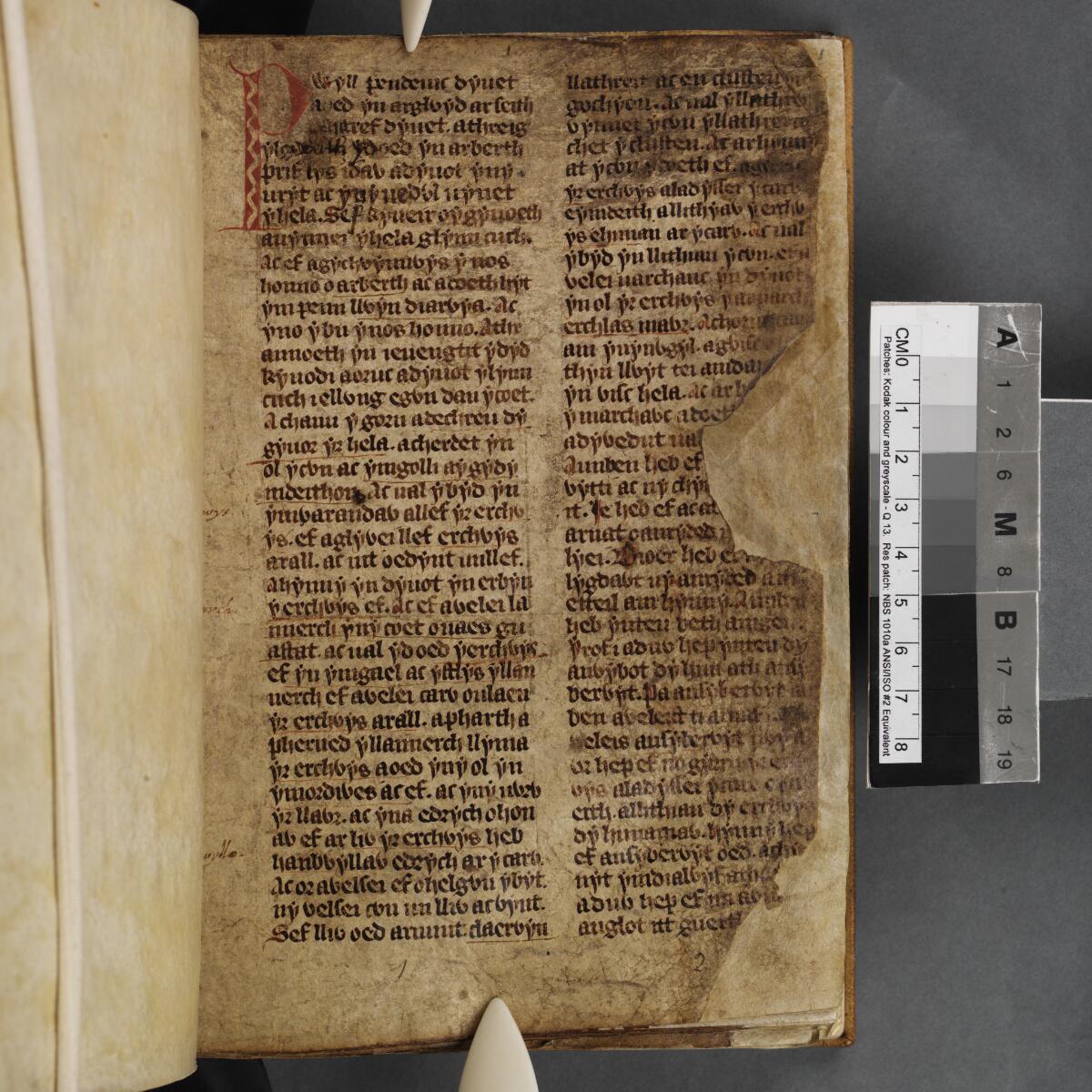
The title The Mabinogion promises a book that medieval Wales never quite made. It sounds singular and monumental: perhaps a national epic, perhaps a continuous Arthurian cycle, perhaps one enormous legend whose eleven episodes ought to lock together. Open it with that expectation and the collection can seem strangely assembled. A prince trades identities with a ruler from the Otherworld. An insult over horses ends in slaughter across the Irish Sea. Arthur’s warriors accumulate in a roll call of extravagant names. A young hero encounters a severed head where a reader trained on French romance expects a Grail. Two men fall asleep and dream their way into incompatible visions of Britain.[2][3]
The apparent disorder is not a defect to solve. It is the best way into the book.
What English readers call The Mabinogion is a modern umbrella title for eleven anonymous Middle Welsh prose tales composed across different periods and preserved principally in two later manuscript compilations, the White Book of Rhydderch and the Red Book of Hergest.[1][2][3] The White Book, copied around the middle of the fourteenth century, is the earliest substantial compendium of medieval Welsh prose and contains ten of the eleven; The Dream of Rhonabwy appears in the Red Book but not the White.[1][2] Even the familiar order can change from edition to edition because the manuscripts do not arrange the tales identically.[2]
So do not begin by hunting for a master plot. Enter through four different doors, each with its own reading contract: the Four Branches as a sequence of consequences; Culhwch and Olwen as an exuberant performance; the three romances as experiments in chivalric form; and the remaining dream-and-history tales as unstable visions of Britain. This route does not pretend to recover a lost medieval table of contents. It gives a first-time reader enough structure to notice when the book deliberately changes its rules.
First door: keep the Four Branches together
Read Pwyll, Branwen, Manawydan, and Math in that order, even if you sample the rest of the collection more freely. They are the only group that announces itself as four branches of the mabinogi, and they share a connective figure in Pryderi, the child promised near the end of the first tale who passes through the later three.[2][4] He is not the hero of a four-part modern novel. He is closer to a thread carried through changing patterns of courtship, sovereignty, kinship, enchantment, war, and repair.
The opening of Pwyll teaches the right pace. Pwyll, prince of Dyfed, is hunting when he hears hounds with “a cry different from his own.”[4] He drives them from a stag and lets his pack feed, only to learn that the strange white dogs belong to Arawn, ruler of Annwn. The offense is not spectacular villainy; it is a breach of courtesy. Its remedy is spectacular: the two rulers exchange appearances and kingdoms for a year, and Pwyll must defeat Arawn’s rival while inhabiting another man’s life.[4]
That combination—social error, magical enlargement, exacting restitution—recurs throughout the Branches. Pwyll later wins Rhiannon but cannot prevent the disappearance of their newborn son. Rhiannon is falsely accused and made to carry visitors on her back; Pryderi is eventually restored. In Branwen, a mutilation of Irish horses becomes an international catastrophe from which only seven Welsh survivors return. In Manawydan, Dyfed is emptied by enchantment, and patient craftwork succeeds where heroic force would fail. In Math, sexual coercion, punishment, transformation, and the manufacture of a woman from flowers produce consequences that no single act of magic can contain.[2][4]
The practical reading rule is to track damaged obligations rather than adventures. Who offers hospitality? Who insults it? Who speaks for a woman, a child, or a kingdom? What form does repair take, and who pays for it later? The Four Branches become much clearer when cause and consequence are allowed to cross the border between one tale and the next.
Also notice the endings. Lady Charlotte Guest’s public-domain English version preserves the repeated closure, “And thus ends this portion of the Mabinogi.”[4] The formula separates the parts while insisting that each belongs to a larger act of telling. It is a useful model for reading the entire collection: connection without the expectation of seamlessness.
Second door: let Culhwch and Olwen be excessive
After the controlled recurrences of the Branches, turn to Culhwch and Olwen and permit the book to become louder. Culhwch’s stepmother curses him so that he can marry only Olwen, daughter of the giant Ysbaddaden. To win her, he appeals to Arthur’s court and must complete a swelling series of impossible tasks. The most famous involves hunting the enchanted boar Twrch Trwyth to obtain the comb and shears lodged between its ears.[2][4]
That synopsis makes the tale sound like a neat quest. On the page it behaves more like a feat of memory and abundance. Warriors arrive with compressed biographies, place-names gather, objects acquire pedigrees, and the list of Arthur’s companions becomes so long that the pleasure shifts from anticipation—who matters to the plot?—to performance: how many marvels can this telling hold? The tale retains the textures of oral tradition even though the surviving work is a deliberately literary composition, not a transcript of somebody speaking by a fire.[2][3]
First-time readers often skim the catalogues while waiting for narrative to resume. Try the opposite. Read one long list aloud. Do not look up every name. Listen for rhythms, comic escalation, alliteration, and the tiny narratives embedded in titles. A character who appears for only a phrase can open a window onto a story the text assumes its audience might already know.
This is also the right moment to reset your idea of Arthur. In Culhwch, he is less the solitary tragic king familiar from later English tradition than the center of an enormous network of specialists, kin, warriors, tricksters, animals, and remembered wonders.[2] His court is an engine for assembling help. If you ask only whether this Arthur resembles Malory’s, you replace a very early and distinctive Welsh tale with the future literature it helped make possible.
Third door: read the three romances sideways
Next take The Lady of the Fountain, Peredur son of Efrawg, and Geraint son of Erbin one at a time. They are often called the Three Welsh Romances because each has conspicuous affinities with a work by the twelfth-century French poet Chrétien de Troyes: Yvain, Perceval, and Erec et Enide respectively.[2] “Affinities” is the useful word. Treating the Welsh tales as late, damaged copies of French originals makes their most interesting choices disappear.
Read each first as its own machine. The Lady of the Fountain tests what happens when prowess wins a marvel, marriage converts it into a social position, and a knight abandons that position to recover the very reputation that courtship was supposed to crown. Geraint turns suspicion inside marriage into a perilous itinerary: the hero demands silence from Enid, while her repeated disobedience becomes the means of saving him. These stories use recognizable chivalric furniture, but the moral pressure sits in the Welsh arrangement of speech, loyalty, landscape, and return.[2][4]
Peredur needs the strongest warning label. A reader who knows the Grail tradition will recognize the naive youth, the wounded host, the strange procession, and a missed question. But the object carried in procession is a severed head, not a Grail, and the surviving Welsh text has its own difficult manuscript history. Peredur exists in four medieval manuscripts that appear to preserve two or possibly three versions; scholars disagree over its date, authorship, development, and relation to Perceval.[5] Its turns can feel sewn together because, in an important sense, more than one shape of the story survives inside what modern readers receive.
Do not “correct” the tale as you read. Mark its seams. Ask what repeated arrivals, partial recognitions, forgotten vows, and changes of scale accomplish. Only after finishing should you compare it with a Grail romance. Comparison then becomes illumination rather than a verdict that the Welsh text has failed to be another book.
The three romances are not a trilogy. Arthur’s court joins them, but no continuous protagonist or plot demands that they be consumed as one arc.[2] Give each a clean start. The mental space between them will help you see how differently courtly identity can be built, lost, and restored.
Fourth door: save Britain’s dreams for last
Three tales remain: The Dream of Macsen Wledig, Lludd and Llefelys, and The Dream of Rhonabwy. Only two are dreams, and they are unrelated to each other; grouping all three is a reading convenience, not a claim about medieval genre.[2] They work well at the end because the rest of the collection has taught you enough names, territories, and courtly habits to feel how strangely each tale imagines Britain as a political space.
In The Dream of Macsen Wledig, the Roman emperor dreams of a journey across mountains and seas to a hall where he sees a woman of extraordinary beauty. Envoys retrace the dream’s geography and find Elen in Wales. The story turns a private vision into an imperial route, then turns conquest back upon Rome when Elen’s brothers build their own power abroad.[2][4] Read it with a finger on the map but without trying to make every place perfectly modern. The movement—from Rome toward Wales, then outward again—is the argument.
Lludd and Llefelys is more compact and more diagnostic. Britain suffers three plagues: an invading people who can hear every conversation, a scream that devastates the land, and the unexplained disappearance of provisions. Lludd consults his brother Llefelys in France and receives a separate technical remedy for each affliction.[4] The tale’s satisfaction comes from classification. A kingdom’s terrors become problems that can be named, isolated, and treated. After the Branches, however, its neat repairs should feel almost suspiciously efficient.
Finish with The Dream of Rhonabwy. A man seeking a rebel takes shelter in a filthy house, lies on a rough yellow calfskin, and dreams himself into the world of Arthur. Yet heroic access brings no clean heroic meaning. Colors, weapons, clothing, horses, gestures, and ranks arrive in almost oppressive detail. Arthur plays a board game while ravens and warriors destroy one another, and the dream repeatedly interrupts the kind of forward motion a quest reader expects.[2][4]
That density explains why the tale belongs last. It turns the reader’s newly acquired wish for an orderly Arthurian world into the subject of a baffling dream. The White Book’s omission of Rhonabwy is also a useful final reminder: there was no single medieval codex identical to the modern book in your hands.[1][2]
Choose an edition without mistaking it for the collection itself
Lady Charlotte Guest popularized the title Mabinogion in the nineteenth century through her translations, and her English text remains freely available through Project Gutenberg.[2][4] It is historically important and still readable, but it also carries Victorian diction, editorial choices, and an extra tale, The Tale of Taliesin, that is not normally included among the canonical eleven.[2][4] If your edition contains Taliesin, enjoy it as an attached tradition, not as the missing twelfth chapter of a unified plot.
A modern translation will usually make the tonal differences easier to hear, but no translation removes the book’s basic instability. Names may vary. A title may be given in Welsh in one table of contents and English in another. The stories may be arranged differently. Instead of treating those variations as obstacles, write four small headings on a bookmark:
- Four Branches: Pwyll, Branwen, Manawydan, Math.
- Early Arthurian abundance: Culhwch and Olwen.
- Three romances: The Lady of the Fountain, Peredur, Geraint.
- Britain reimagined: Macsen Wledig, Lludd and Llefelys, Rhonabwy.
That is enough apparatus. Read the four Branches over four sittings. Give Culhwch a session with some of its lists spoken aloud. Read each romance separately, resisting comparison until the end. Pair Macsen with Lludd, then let Rhonabwy close the door behind you.
The reward is not a secret unity that makes all eleven tales parts of one epic. It is a more interesting kind of togetherness. Medieval scribes copied different works into manuscript neighborhoods; later translators and editors named a collection; generations of readers discovered echoes among stories that preserve distinct tempos and designs.[1][2] The Mabinogion becomes coherent when you stop asking it to be continuous. Its four doors do not lead into the same room. They lead into a literature large enough to have several kinds of inside.
Sources
- National Library of Wales, “The White Book of Rhydderch”—manuscript history, contents, digitized folios, and the archival cover image.
- University of Rochester, The Camelot Project, “The Mabinogion Project”—collection history, manuscript order, tale groupings, Arthurian contexts, and translation history.
- Amgueddfa Cymru—Museum Wales, “Welsh folktales: Background reading”—the eleven medieval tales, Middle Welsh context, and their relationship to oral tradition.
- Lady Charlotte Guest, The Mabinogion, Project Gutenberg—public-domain English text used for plot references and short quoted wording.
- University of Wales Press, “Is This Not a Grail Romance?”—Sioned Davies on the manuscript versions, structure, and comparative problems of Peredur.