
Lucille Clifton’s “let there be new flowering” is only nine lines and 43 words long. Its scale suggests a blessing; its verbs refuse the ease of one. The poem asks for fields to change, then people, then time, then war. By the time love appears, every earlier noun has been made to carry something forward.[3]
That forward motion is almost hidden on a first silent reading. The lines have no punctuation, and the repeated word at one line’s edge becomes the subject of the next clause. What looks like plain statement is a relay. “Fields” passes into fields; “men” into men; “time” into time; “war” into war. The poem advances because it keeps taking the word it has just reached and making that word begin again.
The Academy of American Poets’ 69-second video is a compact way to hear the relay. Clifton appears in close view, seated before a daylight window, and reads without a lectern, crowd, or ceremonial frame. The recording belongs to Poetry Breaks, a series created by Leita Luchetti and co-produced with the WGBH New Television Workshops in the late 1980s and early 1990s; the Academy later returned selections to circulation online.[1][2] The modest frame suits a poem whose political argument arrives through ordinary words rather than public-speaking grandeur.
Listen for the handoff
The recording makes one formal fact impossible to miss: the poem is one long act of letting. “Let” appears six times, but it does not issue six separate orders. Each request grows out of the preceding one. The first line, “let there be new flowering,” sounds scriptural without naming a speaker who possesses scriptural power. Clifton’s speaker can propose conditions for renewal; she cannot simply declare renewal accomplished.[3]
That distinction is the poem’s ethical pressure. A wish can skip the work between violence and repair. Clifton’s syntax cannot. Flowering has to alter the fields; the changed fields have to alter the people who depend on them; those people have to remain tender while time itself is taken back from war. No single image is permitted to stand for peace. The poem builds a chain of dependencies.
On the page, a line break briefly leaves each repeated noun facing two directions. “Fields” completes a prepositional phrase and then starts a new action. “Men” first receives the fields’ ripening and then receives the demand to stay tender. “Time” is something people must endure before it becomes the object to be reclaimed. “War” names the force from which time is taken and then the contest that must be won. Reading aloud cannot display those line breaks visually, but it can preserve their double pull: an ending word remains in the ear when the next clause asks it to start again.
This is why the video adds more than authorial prestige. Clifton does not supply a secret explanation of the poem. She demonstrates that its smallest repeated words are structural joints. A listener who never sees the lineation can still hear nouns returning with altered grammatical duties. The reading turns enjambment into memory.
Tenderness is not the reward
The poem’s most demanding turn comes before its language of victory. The people in the fields are asked to remain tender through time, not to become tender once war is over. Tenderness is therefore neither a medal nor a mood reserved for safety. It is a discipline practiced while historical pressure continues.
Clifton’s word “men” carries useful friction here. It can sound generically human, historically masculine, or specifically tied to those whose bodies and authority are organized for war. The poem does not resolve those senses. Instead, it places “mellow” beside “tender,” words that can describe ripening land, softened texture, emotional openness, or vulnerability. Agriculture and human conduct share a vocabulary without becoming the same thing.
That proximity matters because the poem never treats peace as a purely inward achievement. A kind person inside an unchanged war system is not enough. Nor is a fertile landscape if those who inhabit it remain hardened. Material renewal and moral renewal have to move together, even though the poem never claims that one automatically produces the other.
Clifton’s larger reception helps explain why such compression should not be mistaken for simplicity. The Academy’s biography places this poem within a career that moved from Good Times and An Ordinary Woman to the Pulitzer-nominated Good Woman and the National Book Award-winning Blessing the Boats.[4] Rita Dove, writing in tribute, describes Clifton’s poems as compact but generous, able to hold illness, death, humor, and spiritual clarity without swelling into abstraction.[5] Here that generosity takes grammatical form: each word is allowed to become more than the role it occupied one beat earlier.
Victory is a dangerous stopping place
The sharpest hinge is the movement from “be wrested from the war” to “let the war be won.” The verb “wrested” admits force. Time will not drift free by itself; someone has to take it back. Yet the next line’s victory language is deliberately not the poem’s conclusion.[3]
Stopping at “won” would leave the poem inside war’s own grammar: opposing sides, conquest, finish. Clifton continues with “let love be / at the end.”[3] Love is not said to win. It is asked to exist. The difference sounds small, but it changes the goal from defeating an enemy to making a livable aftermath.
The last phrase also refuses to specify whose end it is. It may mean the end of war, the end of the poem, the end toward which action should be directed, or the final condition by which victory is judged. Those possibilities reinforce rather than cancel one another. Whatever “won” means, it is insufficient if love does not survive the winning.
This is the point at which the poem’s repeated “let” reveals its humility. The speaker does not control fields, people, time, war, or love. The form can only keep arranging them into relation. Its power lies in refusing a shortcut: no flowers without changed ground, no changed ground without changed people, no durable people without tenderness, no reclaimed time without confrontation, no meaningful victory without an aftermath that deserves to be called love.
What the small screen preserves
Clifton’s close-up in the Poetry Breaks frame resists the visual habits of a war poem. There are no flags, ruins, maps, or crowds. A face, a voice, and daylight carry the argument. That is not a retreat from politics. It locates the poem’s test in the human capacity to pass a word onward without preserving its old function.
The recording’s archival afterlife extends that relay. WGBH and the Library of Congress now preserve records from the Clifton Poetry Breaks material in the American Archive of Public Broadcasting, while the Academy’s upload gives this individual reading a public route back into circulation.[1][2][6] The institutions do not make the reading definitive. They make it available for another act of attention.
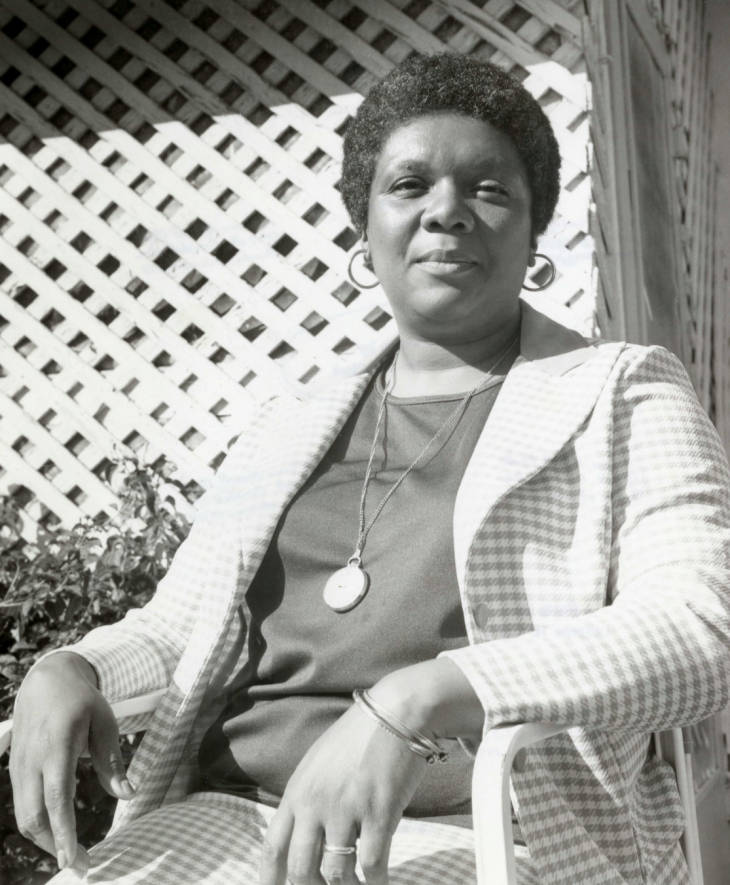
The 1975 cover portrait offers a related but distinct document. LaVerne Harrell Clark photographed Clifton at the University of Arizona Poetry Center years before the video series; it should not be mistaken for a production still.[7] Its quiet, seated encounter nevertheless belongs beside the clip because both refuse symbolic filler. They show the actual poet in literary settings, leaving the poem’s analysis to language.
Return to the printed lines after watching. The poem will still look spare. But its spareness now has mechanics: recurrence, handoff, reversal, and a final refusal to confuse the end of fighting with the presence of peace. Clifton’s achievement is not to fit a political program into 43 words. It is to make each word responsible for what the next one becomes.
Sources
- Academy of American Poets, “Poetry Breaks: Lucille Clifton Reads ‘let there be new flowering,’” video, YouTube.
- Academy of American Poets, “Poetry Breaks: Lucille Clifton Reads ‘let there be new flowering,’” series provenance and video page, January 7, 2017.
- Poetry Society of America, “let there be new flowering,” poem text and publication credit to Good Woman: Poems and a Memoir 1969–1980.
- Academy of American Poets, “About Lucille Clifton,” biography, bibliography, honors, and reception context.
- Rita Dove, “Tribute to Lucille Clifton,” Academy of American Poets, critical appreciation first delivered for the 2001 Anisfield-Wolf Lifetime Achievement Award.
- American Archive of Public Broadcasting, “Poetry Breaks for Schools and Libraries: Lucille Clifton,” GBH and Library of Congress catalog record.
- Ballot & Beyond, “Lucille Clifton | Maryland State Poet Laureate,” source page reproducing LaVerne Harrell Clark’s 1975 portrait with Arizona Memory Project credit.