Laura Willowes does not begin Lolly Willowes as a rebel. That is the trick. Sylvia Townsend Warner first lets her become useful. After her father's death, Laura is absorbed into her brother's London household, renamed by domestic habit as "Aunt Lolly," and turned into the kind of unmarried woman whose life can be praised only when it is available to other people's needs.[1] The character study begins in that soft theft. Nobody drags Laura into a dungeon. They give her rooms, errands, nephews, nieces, seasonal routines, and gratitude. The cage works because it looks like care.
Warner's 1926 debut novel is often introduced through its delightful late swerve into witchcraft, and NYRB's current edition rightly frames it as a story of a spinster breaking from family control into a strange supernatural freedom.[2] But the book's sharpest character work arrives before the magic announces itself. Laura's crisis is not that she is unloved. It is that she is too easily loved as a function. She is wanted as aunt, helper, listener, shopper, household presence, and emotional spare part. The novel asks what remains of a person when affection itself becomes a system of appropriation.[1][2]
That question explains why Laura is one of modern fiction's great characters of delayed self-possession. She is not fiery like a stage heroine. She does not argue her way into independence through manifesto or melodrama. She notices, stores, recedes, and then one day makes a decision that sounds almost absurdly mild: she will move to the Chiltern village of Great Mop.[1] The mildness is the point. Laura's revolution begins as a change of address because, for her, geography is the first available grammar of selfhood.
Usefulness is the first enclosure
The early London chapters make domestic usefulness feel almost frictionless. Laura's relatives do not experience themselves as jailers. They are respectable, practical, and convinced they have provided the obvious solution for a single woman. The brilliance of Warner's characterization is that she lets this arrangement be comfortable enough to be morally dangerous. Laura has security, but security has been purchased by making her future imaginatively unnecessary.[1]
The name "Aunt Lolly" is therefore not cute decoration. It is a social instrument. "Laura" belongs to a woman with inward weather, private memory, and unspent appetite. "Aunt Lolly" belongs to a family role. Once the nickname settles, it does what family language often does in Warner's novel: it turns a person into a serviceable shorthand. The household can summon her without asking who she is becoming.
Project Gutenberg's edition classifies the book under subjects including single women, witches, feminist fiction, and English social life in the twentieth century.[1] Those tags are useful because Laura stands exactly where those categories cross. She is not only an unmarried woman in a family story, and she is not only a witch in a fantasy. She is a woman whose social identity has become so complete that supernatural allegiance begins to look less like escape from realism than realism's hidden answer.
Great Mop gives Laura back errandless time
When Laura chooses Great Mop, she does not choose glamour. That matters. The village is not a romantic paradise built to reward the reader with scenery. It is stranger, smaller, and more stubborn than that. It gives Laura a kind of time London cannot tolerate: time not organized around somebody else's convenience.[1]
This is the hinge of her character. Freedom, for Laura, is not mainly possession, romance, travel, or public victory. It is errandlessness. She can walk without converting the walk into family logistics. She can observe without being recruited. She can feel seasons as bodily knowledge rather than as holiday management. Warner's woodland and village writing makes solitude active: not loneliness, not vacancy, but a field in which Laura's own perception starts to thicken.[1][4]
Lucy Scholes's Guardian review catches the novel's strange tonal path: what can seem at first like family saga tips into lucid wildness without losing its social intelligence.[4] That helps clarify Laura's movement. She is not simply leaving town for countryside because country is pure and city is corrupt. She is finding an environment where she is no longer automatically interpreted through kinship duty. In Great Mop, the ground does not call her aunt.
Witchcraft is jurisdiction, not spectacle
The great surprise of Lolly Willowes is how unsensational its witchcraft feels. Warner does not treat the supernatural as a fireworks display. The Devil is not there to make Laura theatrically wicked. Witchcraft gives her jurisdiction. It names a counter-contract after decades of family contract. Laura's new allegiance does not make her powerful in the crude sense; it makes her unavailable.[1][2]
That is why the novel's Satan is oddly restful. He offers less a program than a permission. Laura does not want to rule anyone. She wants not to be ruled through affection, obligation, and the small claims that have accumulated around her body. Her rebellion is therefore ethically precise. She does not reject human relation because she hates people. She rejects absorption. Family life has taught her that being cherished can become another way of being consumed.[1]
The NYPL finding aid for the Sylvia Townsend Warner papers is a reminder that Warner's own career cannot be reduced to one eccentric first novel: the archive includes manuscripts, correspondence, diaries, musical work, and later fiction across a long life in letters.[3] That breadth matters for reading Laura. Warner knew how private forms, notes, manuscripts, and daily records preserve selves that public labels flatten. Lolly Willowes turns that archival intuition into character: Laura's inward life has existed all along, but it needed a form that her family could not file under helpful aunt.
The novel refuses the rescue plot
Laura's character would be simpler if Warner gave her a conventional rescue. A lover could arrive. An inheritance could free her. A social movement could give her language. Instead, the novel chooses witchcraft because it is more exact than any of those answers. Marriage would merely move Laura from one sanctioned role to another. Money helps, but money alone cannot stop relatives from narrating her. Public doctrine would be too loud for a character whose deepest refusal is the right to be left unconverted.
This is why Laura's late clarity feels both comic and severe. She has spent much of the book being managed by categories that pretend to honor her: daughter, sister, aunt, spinster, dependent, useful woman. Witchcraft creates a category that does not ask to be respectable. It is a deliberately improper shelter. It lets Laura escape not into chaos but into a privacy that middle-class family language cannot domesticate.[1][2]
The novel's first-publication moment sharpens that point. Project Gutenberg records the original 1926 London publication by Chatto & Windus, while NYRB's Warner collection notes that Lolly Willowes became the first Book-of-the-Month Club selection.[1][6] The book therefore entered circulation as both oddity and chosen commodity: a quietly subversive novel passed into a mass reading system. That afterlife suits Laura. She, too, looks acceptable until one understands what she has smuggled inside the form.
Why Laura still feels dangerous
Laura Willowes remains dangerous because her desire is modest and therefore hard to neutralize. She is not asking for a grand exceptional destiny. She is asking for a life that is not automatically spendable by others. That wish can sound small only to people who already possess it.
Warner's feminism in Lolly Willowes is not a slogan added to a fantasy. It is embedded in the character mechanics. Laura's selfhood is damaged less by open cruelty than by a culture that can imagine unmarried women only as appendages, helpers, eccentrics, or problems to be kindly solved. The supernatural element exposes the absurdity of that realism. If ordinary society cannot imagine Laura as sovereign, then the novel will imagine a covenant outside ordinary society.[1][2][4]
That is why the ending does not feel like mere whimsy. Laura's witchcraft is the final name for a long character process: the movement from being interpreted to interpreting herself, from use to refusal, from family availability to private jurisdiction. She becomes a witch by declining to remain useful. Warner makes that decline feel not selfish but sane.
Sources
- Sylvia Townsend Warner, Lolly Willowes: or, the Loving Huntsman (Project Gutenberg ebook page; original publication, public-domain text, subject classifications, and cited character details).
- New York Review Books, Lolly Willowes by Sylvia Townsend Warner (current NYRB Classics edition page; novel summary, publication data, and reception framing).
- The New York Public Library, "Sylvia Townsend Warner papers" finding aid (biographical and archival context for Warner's manuscripts, correspondence, diaries, and literary career).
- Lucy Scholes, "Lolly Willowes by Sylvia Townsend Warner - review," The Guardian, March 18, 2012 (reception framing and description of the novel's family-saga-to-wildness turn).
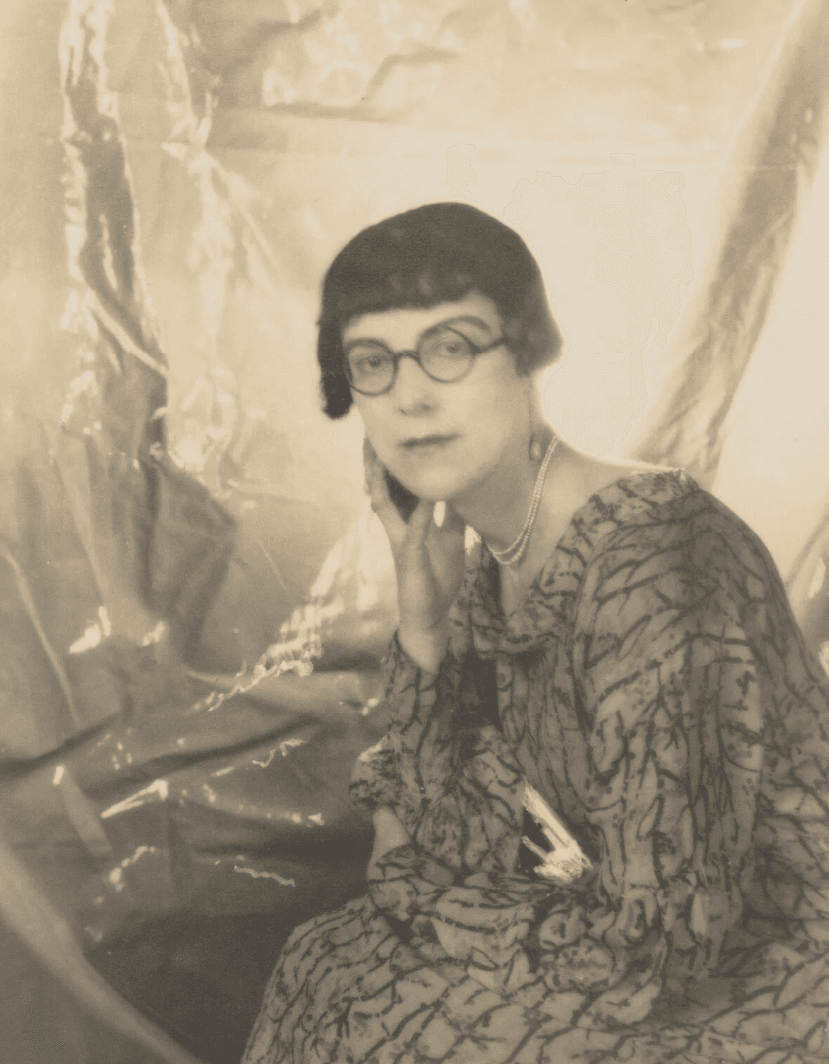
- Wikimedia Commons, "File:Sylvia Townsend Warner in 1930.png" (source page for the 1934 archival portrait used as the article cover).
- New York Review Books, "Sylvia Townsend Warner" author collection page (publisher context including Lolly Willowes and the Book-of-the-Month Club note).