Mary Wollstonecraft is often introduced as a pioneer of women's rights, which is true and still too small. The phrase can make A Vindication of the Rights of Woman sound like a set of positions waiting to be summarized: equal education, criticism of dependency, better civic standing for women. The book is all of those things. But its staying power comes from the way Wollstonecraft writes argument as a discipline of mind. She does not merely ask that women be admitted to education; she makes the reader feel what an education in reason would sound like.[1][2]
That is why a work-centered profile of Wollstonecraft has to begin with prose. A Vindication was published in 1792, after her reply to Edmund Burke had brought her into Britain's radical print culture and before the posthumous scandal around William Godwin's memoir complicated her public reputation.[2][3] Britannica describes the book as a trailblazing feminist treatise centered on education, politics, society, and marriage; Stanford's account places it inside a wider moral and political project concerned with acquisitiveness, consumption, and human relations.[2][3] Both frames are useful. Yet the book's most literary achievement is narrower and sharper: it turns the conduct-book world that trained women for display into the object of a public cross-examination.
Wollstonecraft's famous sentence, "I do not wish them to have power over men; but over themselves," is often quoted as a compact feminist maxim.[1] On the page, it does more than declare a belief. It resets the scale of power. The book is not asking for a theatrical reversal in which women dominate men by adopting the same corrupt habits. It asks for self-command, and that phrase matters because it belongs equally to moral philosophy, education, and political citizenship. A citizen cannot deliberate if she has been trained only to please. A wife cannot be a friend if she has been taught dependency as charm. A mother cannot form judgment in children if her own judgment has been deliberately starved.
The Sentence Fights Ornament
Wollstonecraft's first recurring enemy is ornament. She attacks an entire social grammar in which women are praised for delicacy, beauty, submission, and pleasing weakness, then blamed for the intellectual weakness that the system produced.[1][4] The British Library's overview of A Vindication emphasizes that the book challenges an educational order built to make women decorative rather than rational.[4] Wollstonecraft's prose keeps making that order sound absurd by refusing to flatter it.
Her method is not calm neutrality. She uses address, impatience, irony, and repetition. She speaks to men, to women, to mothers, to writers of conduct books, to legislators, and to the reader's own habits of excuse. The tone can feel severe, but the severity is part of the craft. A polite style would risk reproducing the very refinement she is criticizing. Wollstonecraft instead writes sentences that keep asking whether softness has been confused with virtue.
The phrase "the toy of man" is one of her harshest reductions.[1] Its force lies in how small it makes the ornamental ideal. A toy may be cherished, displayed, and handled gently; it still has no moral agency. By choosing that word, Wollstonecraft pulls courtship language out of the clouds and returns it to possession. The issue is not whether women are admired. It is whether admiration has become a prettier name for use.
Education Becomes The Plot
Because A Vindication is an argument rather than a novel, it has no heroine moving through scenes. Education supplies the plot instead. Wollstonecraft repeatedly returns to the same causal chain: girls are denied robust training; they learn to value appearance, dependence, and feeling detached from judgment; marriage then turns this training into economic and moral constraint; society finally complains that women lack the seriousness it never cultivated.[1][2]
That chain gives the book its rhythm. It is not a random collection of grievances. The chapters keep converting social symptoms into educational causes. Coquetry, vanity, poor health, unhappy marriage, bad motherhood, and intellectual triviality are not treated as innate female defects. They are produced outcomes. This is where Wollstonecraft's profile as a writer matters. Her own work as teacher, governess, reviewer, translator, novelist, and political pamphleteer gave her practical knowledge of what women were allowed to learn and what they had to teach themselves.[2][3]
The strongest passages therefore do two things at once. They diagnose a political condition and dramatize a mind refusing to be trained into prettiness. Wollstonecraft's prose models the education it demands: exacting, impatient with cliche, alert to cause and effect, willing to test inherited language. When she argues for girls and boys to be educated together, the point is not merely curricular reform. It is a different model of personhood, one in which women must be prepared for reason, work, friendship, motherhood, and public responsibility rather than for display.[1][2]
The Afterlife Is Not Just "First Feminist"
Wollstonecraft's later reputation has often been simplified in two directions: heroic founder or scandalous radical. The text is more useful when read as a demanding literary instrument. Britannica notes that A Vindication influenced later women's rights advocates in Britain and the United States, while Stanford stresses that Wollstonecraft's influence also reaches into Romantic-era thinking about imagination, travel writing, and moral feeling.[2][3] That broader afterlife matters because A Vindication is not only a platform. It is a style of public thinking.
The book's limitations are real. It often makes its case through virtue, marriage, motherhood, and national improvement in ways that do not map neatly onto later feminist vocabularies. It can sound more committed to reforming domestic life than escaping its frame. But those limits are also part of its historical precision. Wollstonecraft is writing inside the late eighteenth century's language of reason, virtue, manners, and republican improvement. Her originality lies in forcing that vocabulary to include women as full moral agents.
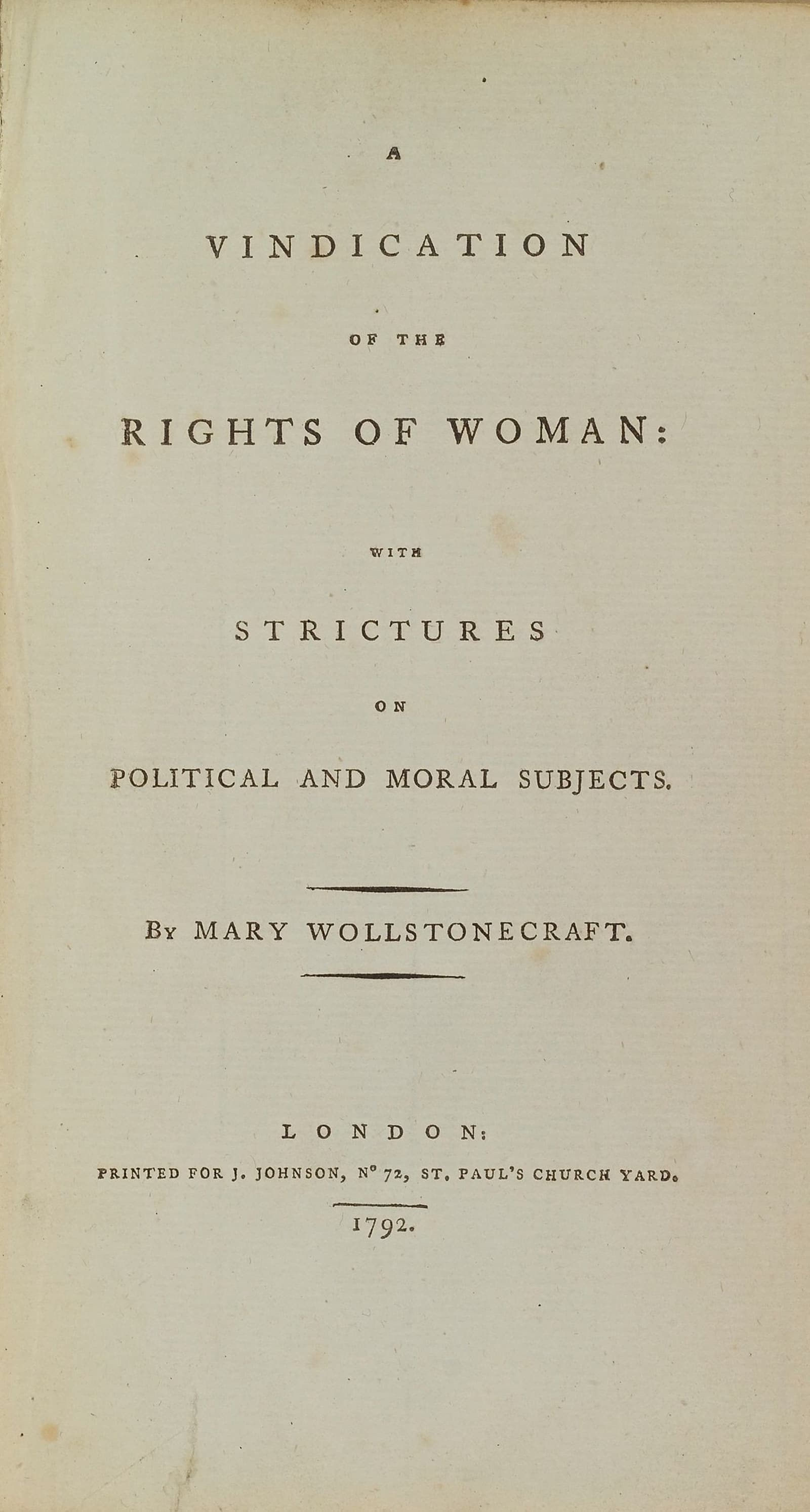
That is why the title-page image is more than a decorative archival object. It shows the book as public print: a work entering libraries, collections, classrooms, and political memory under a title that announces "rights" while filling the pages with education. The title promises a rights argument. The prose delivers a training in how to read social custom as a manufactured condition.
To read Wollstonecraft well, then, is not only to agree that women deserved better schooling in 1792. It is to hear how thoroughly she makes schooling into the foundation of a life. Education is where a person learns whether beauty is destiny, whether dependence is natural, whether marriage is friendship, whether virtue belongs to one sex, and whether reason can be practiced by anyone denied the chance to practice it. Wollstonecraft's durable achievement is that she makes those questions sound less like policy abstractions than like tests of the reader's own mind.
Sources
- Mary Wollstonecraft, A Vindication of the Rights of Woman - Project Gutenberg ebook page with public-domain text.
- Encyclopaedia Britannica, "Mary Wollstonecraft" - biographical overview and account of A Vindication of the Rights of Woman.
- Sylvana Tomaselli, "Mary Wollstonecraft." Stanford Encyclopedia of Philosophy, substantive revision February 22, 2025.
- British Library, "A Vindication of the Rights of Woman" - work overview and contextual note on education and equality.
- Wikimedia Commons, "Category: Vindication of the Rights of Woman (1792)" - source category for the archival title-page image used as the article cover.