People often remember Little Women as if it arrived already softened by nostalgia: firelight, sisters, Christmas, moral uplift, the long afterglow of family feeling.[1][3][4] But Alcott opens the book in a lower key. The first sentence is not gratitude, prayer, or seasonal wonder. It is Jo's complaint: "Christmas won't be Christmas without any presents."[1] A line later Meg answers with a second blunt fact: "It's so dreadful to be poor!"[1] Before the novel becomes exemplary, it becomes economic.
That is the opening chapter's real intelligence. Alcott does not treat money as a vulgar obstacle standing outside the moral life. She places scarcity inside the room from the start and lets each sister react to it in her own register: Jo with impatient appetite, Meg with injured dignity, Amy with sharp grievance, Beth with the smallest attempt at consolation.[1] The scene is warm in atmosphere, but its structure is argumentative. The March girls do not begin as plaster saints. They begin as girls who know what they are missing.
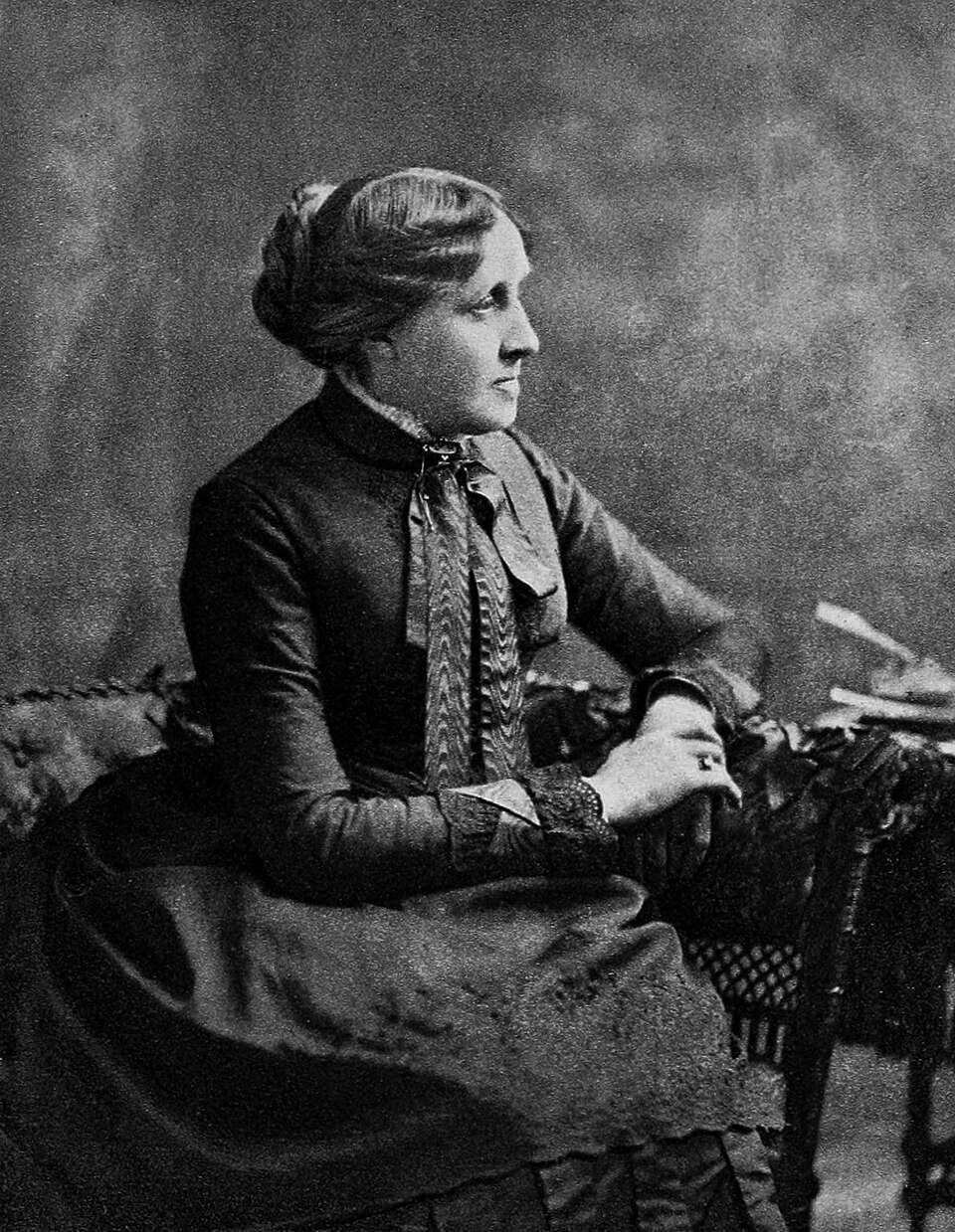
Image context: the cover uses a real archival photograph of Louisa May Alcott from Wikimedia Commons. That choice fits this essay because the first chapter of Little Women is less interested in decorative domesticity than in labor, authorship, and household pressure. The portrait helps keep Alcott visible as the working intelligence that organized complaint, tenderness, and money into one opening scene.[6]
1) The novel opens by refusing cozy falsehood
The brilliance of the first page lies in how quickly Alcott unsettles the reader's expectation of a "good girls" book.[1][4] The complaint about presents is funny, but it is not trivial. It tells us that the March household measures deprivation concretely. Dresses are old, pleasures are rationed, small purchases matter, and comparison with richer girls has already entered the sisters' imagination.[1] In other words, the novel does not protect virtue from resentment. It lets resentment speak first.
That choice helps explain why the book still feels alive. The National Women's History Museum notes that Alcott's own family repeatedly faced financial strain and that she worked to help relieve it.[2] The Library of Congress resource guide likewise frames her career through a distinctive voice shaped by family hardship, Concord life, and the pressure to turn writing into usable support.[3] When Little Women opens with irritation about money, it is not merely staging a lesson to be corrected in the next paragraph. It is admitting the ordinary emotional weather of a household that cannot afford innocence about costs.
JSTOR Daily's essay on the novel's "grumpiness" is useful here because it names something readers often smooth away after the fact: the March sisters are lovable partly because they are not perfectly composed.[4] Their goodness has friction in it. Alcott understands that complaint does not cancel affection. It reveals the conditions under which affection has to operate.
2) Alcott turns poverty into a map of character
The opening conversation is short, but it distributes character with extraordinary efficiency.[1] Jo wants movement and experience; Meg feels class injury; Amy feels the scandal of unequal prettiness; Beth instinctively shrinks the scale back toward family. None of this is abstract. Each response is tied to the material world of the chapter: shoes, drawing pencils, dresses, little luxuries, the small weekly sum the sisters imagine spending on themselves.[1]
That matters because Alcott is doing more than differentiating four temperaments. She is establishing the novel's moral method. Character in Little Women will emerge through how each sister handles shortage, substitution, and the need to convert desire into some more durable form of use. The argument is not that wanting things is shameful. The argument is that wanting things exposes the structure of the self.
This is one reason the book keeps escaping the soft-focus version of its own reputation. The March sisters are memorable because Alcott gives each of them an ambition with texture. Even at the Christmas hearth, no one is just "good." Everyone is already leaning toward a future shape of life.
3) Marmee does not erase desire; she redirects it
The chapter's most important turn comes when breakfast is prepared and then given away to the Hummels, the poorer family nearby.[1] A weaker novel would use this as a simple scolding device: selfish girls learn charity, and that is that. Alcott does something better. She keeps the girls' desire visible while changing its direction. Hunger remains hunger. The holiday remains a holiday. The deprivation does not disappear; it is reorganized by action.
That is why the scene feels morally persuasive instead of mechanically improving. Marmee does not ask the girls to pretend they never wanted presents or a hot breakfast. She asks them to measure their want against another household's greater need.[1] The ethical imagination here is comparative, not sentimental. It works by scale.
The result is that charity in Little Women is never just a feeling-state. It becomes labor, carrying, serving, sewing, visiting, and making do.[1][2] After the breakfast is given away, the sisters return home, and the chapter moves toward work-baskets and domestic tasks rather than toward a dreamy glow of virtue achieved.[1] Alcott makes usefulness the form that love must take if it wants to survive the facts of the world.
4) The opening chapter makes domesticity active, not decorative
This is where the novel's reputation can most seriously mislead. Because Little Women has become one of the central Christmas-family books in English, readers sometimes approach it expecting consolation first. But the opening chapter offers a more strenuous model of home. Domestic space is not a shelter from economics; it is the place where economics becomes intimate. A family table reveals wages, absence, rank, and sacrifice. Needlework is not background charm. It is how the chapter converts moral intention into visible effort.[1]
The official Orchard House site still presents the Concord home as the "Home of Little Women," and that phrase is useful so long as we hear both halves of it.[5] Home in this novel is a place of affection, but it is also a workplace of constant adjustment. The girls are always learning how to turn disappointment into structure: a meal shared differently, a gift postponed, a task divided, a mood mastered badly and then tried again.
That active domesticity is part of why the opening chapter never goes slack. Everything sentimental is nailed to a task. The hearth is warm, but the room is also managerial. Alcott keeps asking who cooks, who earns, who gives up the desired object, who notices another person's lack, and who can transform irritation into service without losing the memory of irritation altogether.[1][2][4]
5) Why the complaint has to come first
If Little Women began with saintliness, the rest of the novel would have nowhere to go. The complaint about presents is necessary because it establishes the scale of the book's moral ambition.[1] Alcott is not writing about girls who are naturally beyond envy or appetite. She is writing about girls who feel these things vividly and then have to learn what kind of adulthood can be built out of them.
That is why the opening still reads with more force than the book's reputation sometimes allows. It does not deny material life in order to praise family feeling. It insists that family feeling becomes meaningful only under material pressure. The first chapter knows that money is never merely money inside a household. It becomes time, dress, dignity, mood, fantasy, quarrel, embarrassment, and care.[1][2]
So the famous Christmas opening is not a cozy prelude that the novel later outgrows. It is the novel in miniature. Complaint, comparison, labor, redistribution, renewed affection: the whole Alcott method is already there. Little Women lasts because it understands that moral beauty needs resistance. Without shortage, the March sisters might be charming. Under shortage, they become legible.
Sources
- Louisa May Alcott, Little Women. Project Gutenberg ebook 514.
- Arlisha R. Norwood, "Louisa May Alcott." National Women's History Museum.
- Library of Congress, "Louisa May Alcott: A Resource Guide."
- JSTOR Daily, "The Grumpiness of Little Women."
- Louisa May Alcott's Orchard House, "Home."
- Wikimedia Commons, "File:Louisa May Alcott.jpg" (source page for the lead photograph).