
On October 19, 2009, Chinua Achebe sat down with Kwame Anthony Appiah at the 92nd Street Y in New York for a conversation that now plays less like a victory lap than like a compact manual for reading his whole career.[1] By that point Achebe was already fixed in public memory as the author of Things Fall Apart, the editor linked with the African Writers Series, and one of the central literary critics of empire.[1][2][3] The archival value of the clip is that it cuts through the monument. Achebe keeps bringing the discussion back to working habits: where judgment should stand, what kind of schooling forms readers, how a child keeps a language, and who a book is actually for.[1]
That makes the conversation unusually revealing. Literary fame often turns older writers into symbols of positions they once had to build sentence by sentence. Achebe's public image can flatten in exactly that way. He becomes "the anti-colonial novelist," or "the African classic," and the deeper texture of his thought gets reduced to a few familiar headlines.[2][3] In this recording, though, the ideas arrive in a much more usable order. He talks about the Igbo value of the middle ground, about a school library that felt like another world, about a principal who banned textbooks for part of the week, and about telling American teachers that two languages would not kill a child.[1] Literature, in this frame, is not decorative prestige. It is a social technology for memory, judgment, and survival.
The timing matters too. The conversation was recorded the same month that Penguin published the ebook edition of The Education of a British-Protected Child, the essay collection Appiah is effectively drawing from throughout the night.[1][4] Penguin's description of the book emphasizes home, identity, colonialism, and language; the 92Y clip shows those themes still attached to lived institutions and family stories rather than floating as abstractions.[4] You hear Achebe explain not only what empire damaged, but what kinds of reading culture, moral balance, and linguistic confidence are required after the damage.
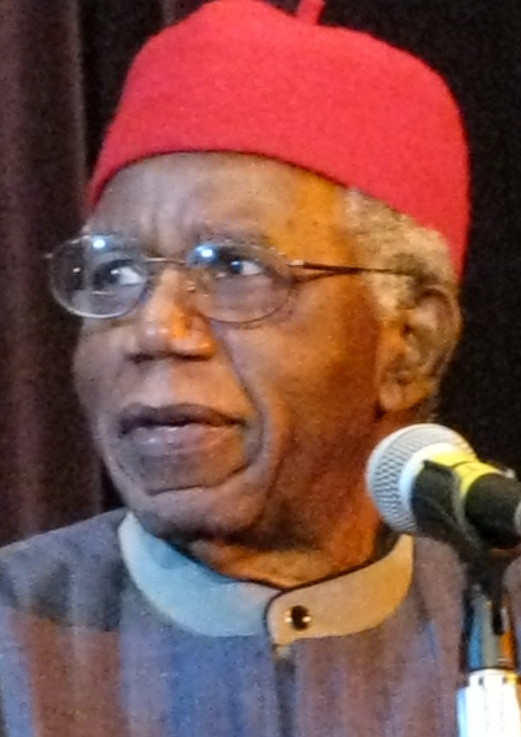
Image context: the cover uses a real 2008 photograph from Wikimedia Commons showing Achebe speaking in Buffalo. It belongs here because the argument of this piece depends on seeing him as a public talker as much as a canonical novelist. The 92Y archive preserves a voice that keeps converting reputation back into conversation.[5]
Historical context: Achebe's literary politics began with education, translation, and local inheritance
The official biographical record helps explain why the conversation keeps drifting toward schools and language. Britannica's biography places Achebe's childhood in Ogidi, his early education under Christian influence, and his later studies at Government College Umuahia and University College, Ibadan, at the center of his formation; it also traces the longer arc through radio work, fiction, essays, editorial labor, and international teaching.[3] In other words, Achebe did not emerge only as a novelist with opinions about colonialism. He emerged inside a chain of classrooms, reading institutions, and broadcast publics.
That broader frame is essential because Achebe's literary argument was never only negative. He certainly spent decades exposing the violence and falsifications of colonial discourse, but his career also involved building alternative routes for language and attention.[3][4] The African Writers Series, the classroom afterlife of Things Fall Apart, and the steady movement between essays and fiction all belong to that effort.[1][3] Brown's 2014 Achebe Colloquium announcement is useful here because it treats his writing not merely as a famous body of work, but as something that had already become a durable institutional reference point for modern African literature at the university where he taught late in life.[2] When Appiah opens by calling him both the father and godfather of modern African literature in English, the introduction lands because it names not just one novel but a whole public ecology of reading.[1][2]
Penguin's page for The Education of a British-Protected Child sharpens the same point from another angle. It describes the essays as concerned with home, identity, colonialism, and the uses and abuses of language, and even the praise collected there circles Achebe's suspicion of fanaticism and his attachment to nuance.[4] Brown's own retrospective framing of his impact points in the same direction.[2] The clip catches a writer late in life still resisting easy polarities: tradition against Christianity, local audience against global audience, English against Igbo, protest against pleasure. What he preserves instead is a disciplined center.
Video provenance
The embedded video is the official upload from The 92nd Street Y, New York. Its description states that Achebe speaks with K. Anthony Appiah about growing up in Nigeria, Nigerian literature, education, and cultural politics, and notes that the event was recorded October 19, 2009 at 92Y.[1] That is strong archival provenance for a literature piece of this kind: original institution, original interlocutor, topic description, and recording date are all supplied by the hosting archive itself.
Around 21:45, the middle ground stops sounding like moderation and starts sounding like method
One of the best moments comes when Appiah asks Achebe about the "middle ground" running through the book and through his response to colonial history.[1][4] Achebe answers by rooting the idea in Igbo instruction rather than in liberal politeness. In the story he recalls, the child in front is exposed to danger, the child at the back is diminished, and the best place lies in the middle.[1] This matters because it clarifies something readers often miss when they reduce Achebe to righteous denunciation. He is not advocating a soft compromise with power. He is describing a standpoint from which one can register injury without surrendering complexity.
That distinction becomes clearer when the conversation turns to his father's world and the missionaries. Achebe does not erase the violence of colonial intrusion, yet he refuses a cartoon in which every person on the colonial side is morally identical and every encounter produces only one kind of outcome.[1] He speaks of praise for some missionaries, skepticism toward others, and the need to tell a fuller story than a simple ledger of virtues and crimes. In the archive, that ethical balance sounds less like hesitation than like discipline. The middle ground is where history can actually be seen.
Around 30:40, the library becomes literary infrastructure
If the middle ground names Achebe's moral position, the memory of Government College Umuahia names his material one. Around the 30:40 mark, he recalls entering the school library and feeling that he had arrived in another world.[1] A few moments later he remembers the principal's "textbook act": three afternoons a week, students were forbidden to touch exam books and had to read novels, biographies, or do something else entirely.[1] This is one of those details that sounds charming until you realize how much of Achebe's worldview it contains.
What he is describing is not simply personal nostalgia. He is identifying the condition under which literature becomes possible. A reading culture has to be built through institutions that create surplus attention, not only through patriotic slogans about education.[1][2][3] The ban on textbooks is almost paradoxical, but that is why it matters. It protects non-instrumental reading from the pressure of credentialism. Achebe is effectively saying that a country does not produce writers by preaching seriousness alone. It produces them by giving young readers access to libraries, time, diversion, and forms of curiosity that are not immediately tied to examinations.
Placed against his later editorial and pedagogical work, the memory carries even more weight. The man who helped make African writing legible to huge international readerships is telling you, in old age, that the decisive scene was not an abstract awakening into genius. It was a room full of books and a school rule that interrupted the tyranny of the textbook.[1][2][3]
Around 59:10 and 1:08:40, language and audience meet
The other extraordinary passage arrives late, during audience questions, when Achebe describes having to fight American teachers who did not want his children speaking their own language to each other at school.[1] His answer is dry and devastating: he and his family did not happen to believe that two languages would kill a child.[1] This line belongs with the library memory because it names another precondition for literary freedom. A language survives not only in novels and essays, but in the ordinary right of children to keep using it without being treated as deficient.
That moment also helps explain the clip's final turn, when Appiah asks who Achebe imagined as the audience for Things Fall Apart. Around 1:08:40, Achebe answers that he would like his books to touch "everybody who wants to be touched."[1] The line is generous, but its generosity comes after the defense of rooted speech, not before it. That sequence matters. Achebe's public scale does not depend on dissolving local inheritance into generic universality. It depends on the opposite move: begin from Igbo memory, defend the right to keep its language alive, and the audience may become global precisely because the work has remained answerable to somewhere.
This is what makes the 92Y archive so useful now. It restores the chain linking culture, education, language, and readership.[1][2][3][4] Achebe is not offering a grand theory in polished lecture form. He is showing how literary authority is assembled out of stories about fathers, libraries, daughters, classrooms, and books that travel farther than their first imagined public. The conversation leaves behind a stronger image of him than the monumental one. It leaves a writer who kept insisting that moral clarity without institutional memory is thin, and that world literature begins with the stubborn defense of a local voice.
Sources
- The 92nd Street Y, New York, "Chinua Achebe with K. Anthony Appiah | 92Y Readings," YouTube video, recorded October 19, 2009.
- Brown University News, "Achebe Colloquium to explore African literature" (2014 retrospective on the impact of Achebe's writing at Brown).
- Encyclopaedia Britannica, "Chinua Achebe" (biography and career overview).
- Penguin Random House, The Education of a British-Protected Child by Chinua Achebe (book page and description).
- Wikimedia Commons, "File:Chinua Achebe - vertical rectangle crop.jpg" (source page for the lead photograph).