Rainer Maria Rilke's sonnet is remembered by its last line because the last line is unforgettable. But the poem is weaker when that ending is lifted out and treated like free-floating wisdom for notebooks, posters, and commencement speeches.[1][3] The command at the end of Archaic Torso of Apollo does not arrive from nowhere. It is earned by a sequence of translation problems: how to render a headless statue whose gaze still burns, how to keep the chest dangerous rather than decorative, and how to make the torso's broken edges feel active enough that the viewer can no longer stand outside the poem.[1][4]
That is why the best way into this sonnet is not to start with "You must change your life" and work backward. It is to notice how much pressure sits in the lines before it. Rilke wrote the poem in the Paris years when, as Britannica notes, Rodin and the Louvre helped drive him toward the object-centered lyric practice of Neue Gedichte.[2] Alice Fulton makes the same point from another angle: the poem belongs to a 1908 moment in which Rilke was trying to make art objects radiate thought without dissolving them into explanation.[3] Translation matters here because the poem's moral shock depends on whether the object stays alive long enough to issue that shock.
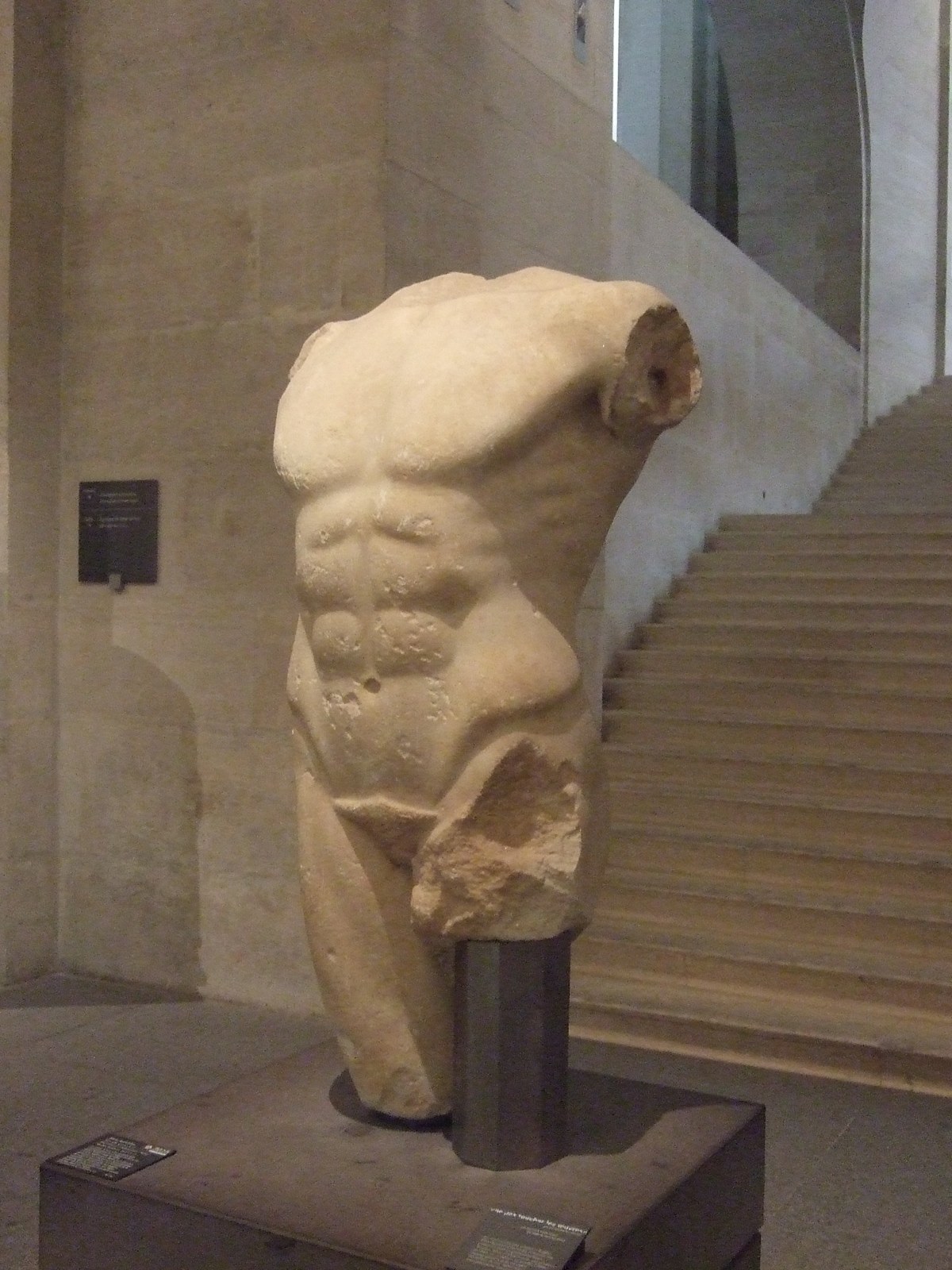
Image context: the cover uses a real photograph of the ancient male torso from Miletus in the Louvre, the same object type that gives the poem its charged incompleteness.[5] That choice suits a translation-notes essay because Rilke's sonnet is built on the fact of damage. The statue has lost head, arms, and much of its original wholeness, yet the poem keeps finding motion, light, and judgment in what remains.
The poem's first problem is how a fragment can still possess a gaze
The opening quatrain refuses a simple museum description. We are told that we do not know the astonishing head, where the eyes once ripened, yet the torso still glows like a candelabrum and continues to hold Apollo's seeing in reduced form.[1] The key word here is zurückgeschraubt, which several translators smooth in different directions. MacIntyre pushes the gaze backward and partly out of sight, Mitchell lowers its brightness, and Sarah Stutt renders it more simply as diminished.[1] None of these is absurd, but each makes a different claim about what survives in the stone.
Mitchell's choice is especially useful because it keeps the light active while lowering its intensity.[1] The god's seeing has not vanished; it has been dialed down, as if the statue were still running on a reduced current. Bernd Jager's essay helps explain why this matters. He notes that the German image suggests a lamp or lantern whose brightness has been turned lower rather than extinguished.[4] If a translation lets the gaze die, the poem loses the condition that makes the ending persuasive. The final command has to come from an object still charged with presence, not from a ruin we are sentimentally decorating.
This is also why the poem belongs so naturally inside Rilke's object-poem phase. Britannica describes the Ding-Gedicht as an attempt to capture the plastic essence of a physical object.[2] In this sonnet, however, "object" does not mean stillness. The torso is missing crucial parts, yet it exerts more pressure because it is incomplete. The translation has to preserve that paradox: less body, more force.
The chest has to stay dangerous
The middle of the poem often gets translated too politely. One word matters more than it first appears to: Bug.[1] MacIntyre and Mitchell both favor curvature, while Stutt keeps a more bow-like pressure in the chest.[1] That latter choice sounds odd at first, but it keeps a harder edge. Jager points out that Bug can suggest the prow of a ship and can also echo Apollo's bow, which means the chest is not merely beautiful shape. It carries forward thrust, aim, and a latent capacity to strike.[4]
That matters because the torso's power in the poem is never only visual. The viewer is dazzled, almost physically overrun.[1][4] If the chest becomes a softly glowing art-history detail, the poem settles into admiration. If the chest keeps the sense of bow, curve, and directional force, the reader feels what the sonnet is doing: converting sculpture into an encounter that advances on the viewer. The smile moving through the loins matters for the same reason. This is not a static object being cataloged. It is a fragment whose remaining forms still seem to organize life around themselves.[1]
One good test for a translation, then, is whether the torso remains unsettlingly alive. The poem is not trying to restore the statue to completeness. It is making incompleteness itself into evidence of radiating power. That is a difficult balance. Too much reverence, and the poem turns precious. Too much plainness, and it turns inert.
The real hinge is the claim that there is no place outside the statue's regard
The last tercet works only if its final turn feels inevitable. Rilke says there is keine Stelle that does not see you.[1] Translators variously make that a place, a point, or even an angle from which the viewer cannot escape.[1] The broader wording is more oracular. The more physical wording makes the reader imagine walking around the statue and still failing to find cover. Both are defensible, but the important thing is that the line must deny safety.
This is where the sonnet stops being a poem about sculpture and becomes a poem about exposure. The torso does not merely survive damage; it survives as a field of vision.[1][4] Every edge participates. The starburst image just before the end prepares that expansion: the statue seems to break out from all its borders, so the viewer's ordinary distance collapses.[1] By the time the imperative arrives, the poem has already taken away the spectator's neutral position.
That sequence is why the last line can sound either monumental or merely motivational depending on the translation around it. A more absolute English imperative keeps the force of judgment, while a more spoken version softens it slightly.[1] Either can work, but neither can carry the sonnet alone. The command is credible only because the translation has already kept the dimmed gaze alive, the chest dangerous, and the statue's seeing inescapable.
Why the poem keeps outrunning quotation culture
People keep extracting the last line because it is useful. But the poem keeps defeating that extraction because its real drama is formal before it is aphoristic.[1][3] Rilke does not hand the reader a moral slogan. He builds a scene in which a damaged object still holds enough concentrated life to reverse the direction of looking. We arrive expecting to inspect a fragment; we leave feeling inspected by it.
That is the standard a translation has to meet. It does not need to settle every lexical dispute once and for all. It does need to preserve the poem's sequence of pressure: reduced light, advancing form, totalized gaze, and only then command.[1][4] When that sequence holds, the final line lands as a verdict. When it breaks, the poem shrinks into elegant advice. Rilke's sonnet has survived so many acts of quotation precisely because, in full, it is harsher and stranger than quotation culture wants it to be.
Sources
- Charles Bernstein, "Rainer Maria Rilke, Torso of an Archaic Apollo" - German text plus translations by C. F. MacIntyre, Stephen Mitchell, and Sarah Stutt.
- Encyclopaedia Britannica, "Rainer Maria Rilke" - Rodin, Neue Gedichte, and object-poem context.
- Alice Fulton, "On 'Plaster Cast Torso of Apollo'" - Poetry Foundation note on the 1908 poem, Rodin, and the work's transformative force.
- Bernd Jager, "Rilke's 'Archaic Torso of Apollo'" - close reading of light, gaze, Bug, and the poem's final command.
- Wikimedia Commons, "File: Paris - Louvre - Torso.jpg" - photograph and object metadata for the Miletus male torso in the Louvre (Ma 2792).