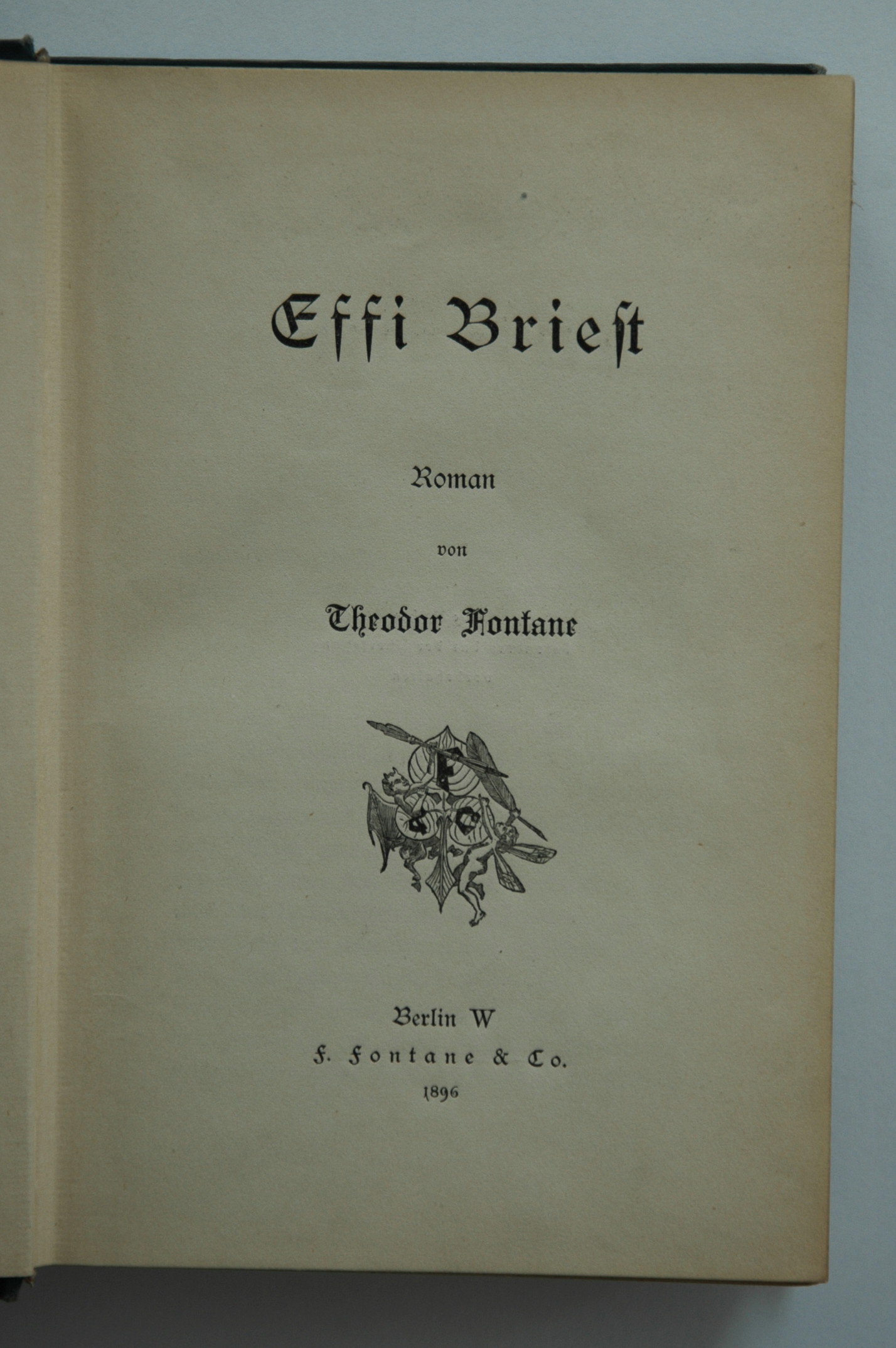
Before anyone speaks in Effi Briest, Theodor Fontane has quietly placed the ending in the garden. The Briest house and a churchyard wall form a horseshoe around a lawn. Near a pond stands a swing whose posts already lean. At the center of a circular flower bed sits a sundial. Thirty-six chapters later, the sundial is gone; a white stone bearing Effi's birth name occupies its place.[1][2]
This is not a novel in which symbols float above ordinary life. Ropes, curtains, and stone remain stubbornly material. Their power comes from what people make them do. The swing permits movement but determines its arc. A ghost story turns foreignness and a drafty room into an instrument of supervision. A surname comes home only when it can no longer restore the person who bore it. The packet of old letters between them is an analytical hinge: it exposes the social machinery that makes such meanings enforceable.
The motif sequence is therefore less a code than a tightening frame:
swing → ghost → name
Fontane drafted the novel after hearing the real Ardenne marriage scandal, serialized it from October 1894 through March 1895, and published the first book edition in October 1895 with 1896 on its title page.[3][6] But the book's afterlife does not depend on recognizing its model. Its sharper achievement is formal: it makes social constraint visible not as a wall that suddenly appears, but as a set of familiar objects whose meanings harden around a young woman.
The swing: an arc is not an exit
In Chapter I, Effi is seventeen and still dressed in a loose sailor-like smock. She interrupts her embroidery with stretches, wants a mast and rope ladder beside the swing, and would rather keep playing than meet the older district councillor waiting inside. Her mother calls her a Tochter der Luft—a daughter of the air.[1][2]
It is tempting to stop there and decode the swing as freedom. Fontane has built a more exact object. The board hangs from ropes. The posts lean, but hold. The garden opens toward a pond, yet the house and churchyard wall enclose it on three sides. Even at the height of her flight, Effi remains inside a structure designed to bring her back.
The swing returns twice, and each return changes its meaning. In Chapter XV, after marriage has taken Effi to remote Kessin, a visit to Hohen-Cremmen lets her stand on the board again. William A. Cooper's 1914 abridged English translation calls the sensation “sweet danger”: the pleasure of feeling she might fall at the next instant.[1] The phrase does not make her later affair a punishment foretold by playground recklessness. It identifies a mismatch. Effi experiences aliveness as movement near a boundary; her marriage offers rank, routine, and an older husband's idea of education.
Near the end of Chapter XXXIV, sick and socially exiled, she returns to the swing once more. She drives it with the practiced movement of her body, waves a handkerchief with one hand, then stops. When the pastor says she is unchanged, she answers that she wishes she were. The flight is now both recovery and measure: for seconds she can reproduce the old motion, but not the old future.[1][2]
The swing thus refuses two easy readings. It is not pure liberty, because its path is fixed. It is not simply a trap, because the exhilaration is real. Fontane lets both truths occupy the same object. Effi's problem is not that she wants motion; it is that almost every sanctioned form of motion available to her—marriage, travel, social promotion, even the swing—has already chosen the point of return.
The haunted room: a story becomes an apparatus
Kessin replaces the bright garden with an old house full of maritime souvenirs, long curtains, and rooms Effi does not control. Before she knows the local legend, Innstetten mentions the grave of an unnamed Chinese man among the dunes. The fuller story comes later: Captain Thomsen brought the man to the Baltic port; at the captain's niece's wedding, the bride danced with him and then disappeared; he died soon afterward. No witness explains the disappearance, the relationship, or the death.[1][2]
That incompleteness matters. The man has no name and no speech. He reaches Effi as a grave, a tiny paper figure pasted to a chair, and a racialized story already shaped for European listeners. Debra N. Prager places the novel's Orientalized fantasy against Imperial Germany's growing colonial ambitions in Africa and China.[4] The haunting cannot responsibly be reduced to a neutral emblem of Effi's anxiety. The household converts a foreign person into “the Chinese ghost,” using distance and stereotype to make fear portable.
Yet the mechanism is pointedly shabby. The sounds overhead can be explained by overlong curtains dragging across the floor in a draft. The visual apparition resembles the little cutout on the chair. The legend persists because explanation does not neutralize a story when the people with authority keep it in circulation.[1][2]
Major Crampas supplies the most damaging interpretation. He tells Effi that Innstetten likes an unusual house and, worse, may be using its reputation as a calculated educational device. Effi's mind condenses the charge into “a ghost to keep me in my place.”[1] Crampas is hardly a disinterested critic; discrediting the husband helps the seducer. Fontane never gives readers a signed confession from Innstetten that proves the theory.
The bounded claim is stronger than a verdict on his secret intent. Effi asks her husband for reassurance, and he repeatedly protects his dignity before her peace of mind. Whether he manufactured the haunting or merely found it useful, the result is the same: she learns that fear will not make him gentler. The ghost becomes an apparatus because marital authority, household rumor, and Effi's isolation make it one.
Valerie Greenberg's revisionist reading emphasizes how the novel's unfinished stories destabilize a heroine and ending often treated as safely understood.[5] The Chinese man's fragment is the most conspicuous of those stories. It mirrors Effi only imperfectly—another rumored attachment, another punitive marriage plot—but its refusal to resolve also marks an ethical limit. Readers can see how he is used without pretending to recover the life the novel withholds.
The interval: the frame explains itself
The affair with Crampas is not staged as a sequence of grand love scenes. It appears through evasions, winter travel, shame, and then an abrupt move to Berlin. For more than six years, Effi and Innstetten build a life in which the earlier relationship has no active presence. Time has altered the marriage even if it has not erased what happened.[1][2]
Then their daughter is briefly ill. While putting a sewing table back in order, Innstetten finds a packet tied with red cord at the bottom of a drawer. The letters do not reveal a current betrayal; they give physical edges to an old one. His friend Wüllersdorf immediately notices the interval—six years, perhaps six and a half—and asks whether it changes what must follow.[1]
Innstetten admits that it has. He feels no immediate thirst for revenge and still loves Effi. What compels him is the knowledge that another man now knows. Once the letters have been read and the injury has entered a social circuit, he believes he must challenge Crampas or become contemptible to that circuit and eventually to himself.[1][2]
Paper performs here what the ghost story performed in Kessin. Neither object acts alone. The cutout cannot haunt without a legend; the packet cannot demand a duel without a code of honor. But once an institution supplies the interpretation, matter seems to issue commands. A draft becomes surveillance. Old handwriting becomes present tense.
This is why the delay is central rather than incidental. If the letters merely exposed fresh deceit, the plot could rest on anger. By making them old, Fontane separates personal feeling from social performance. Innstetten can imagine forgiveness in private and still insist on violence in public. The interval proves that the punishment is not an involuntary reflex. It is a choice made to appear choiceless.
The name: homecoming arrives as inscription
The novel repeatedly summons Effi by name. Fontane later wrote that the remembered words Effi, komm were what made the real scandal stay with him.[3] In the fiction, calls home acquire opposite pressures. At the beginning, Effi is drawn from play toward the visitor who will become her husband. Much later, after her parents have joined society in excluding their divorced daughter, her father finally breaks the arrangement with a telegram: “Effi, come.”[1][2]
The second call is merciful, but late. At Hohen-Cremmen, Effi can inhabit her old rooms, walk beside the pond, and swing again. She cannot re-enter childhood. She cannot see her daughter freely. Her body continues to fail. Home is no reset; it is the place where the novel lets the opening landscape receive everything that has happened since.
That reception becomes literal in Chapter XXXVI. Effi asks for “back my old name” on her stone because, in her judgment, she brought no honor to Innstetten's.[1] The request can sound like total submission to the moral code that destroyed her. Greenberg's account of the ending warns against treating its surface reconciliation as the only available meaning.[5] Effi does absolve Innstetten, but her final description of him also preserves a limit: goodness without the right kind of love.
The stone makes the ambiguity visible. “Effi Briest” restores the name she had before marriage, yet only as an epitaph.[1][2] It returns her to the family garden while announcing that return as death. It also displaces the sundial. The object that measured passing light gives way to an inscription that tries to settle identity permanently.
But the garden will not quite hold still. Leaves scatter around the circular bed; heliotrope survives at the stone's edge; the dog Rollo lies beside it. Effi's parents look at the grave and at last ask whether she was too young. Their question does not reverse the plot, but it prevents the inscription from closing the case.
What the frame finally reveals
These three motifs do not say that Effi was secretly free, nor that she had no agency at all. They show a narrower and more disturbing process: choices occur inside frames that disguise their own construction.
The swing's ropes are visible, so its limit can be felt as pleasure. The ghost's frame is harder to see because it is made of household authority and colonial fantasy. The letters look like evidence, hiding the honor code that converts evidence into a duel. The gravestone looks final, yet the parents' unanswered question opens judgment again.
Read this way, the swing is the novel's governing object because it holds constraint and exhilaration together without confusing them. Effi really moves. She also returns. Her brief flights are not fraudulent, and the frame is not imaginary. Fontane's realism lives in that double vision: a life can contain genuine motion while the available path keeps bending it toward the same enclosed garden.
Sources
- Theodor Fontane, Effi Briest, translated and abridged by William A. Cooper in The German Classics of the Nineteenth and Twentieth Centuries, vol. 12 (1914), Project Gutenberg — English wording and scenes from Chapters I, XV–XVII, XXVII–XXVIII, and XXXIV–XXXVI.
- Theodor Fontane, Effi Briest (first book edition, Berlin: F. Fontane & Co., 1896), Deutsches Textarchiv, Berlin-Brandenburg Academy of Sciences and Humanities — digitized German text and page images used to check chapter placement and original wording.
- Fontane Online, “Theodor Fontane: Effi Briest” — work chronology covering the 1888/89 idea, 1894–95 serialization, surviving manuscript material, and first book edition.
- Debra N. Prager, “The Oedipal and the Orient in Theodor Fontane's Effi Briest,” in Orienting the Self (Boydell & Brewer, 2014), Cambridge Core — the Chinese ghost and the novel's Imperial German context.
- Valerie D. Greenberg, “The Resistance of Effi Briest: An (Un)told Tale,” PMLA 103, no. 5 (1988), Cambridge Core — incomplete stories, resistance, and the ending's political implications.
- Wikimedia Commons, “Theodor Fontane — Effi Briest. Titelblatt der ersten Buchausgabe 1896” — provenance and original file for the photographed first-edition title page used as the article image.