
Kenzaburo Oe's Nobel lecture is easy to misremember as a title before it becomes a speech. "Japan, The Ambiguous, and Myself" sounds at first like a national thesis, a formal answer to Yasunari Kawabata's earlier Nobel lecture, or a compact label for postwar Japanese identity.[2] The archival video shows something more difficult. Oe does not stand at the Swedish Academy to offer a smooth national self-portrait. He turns ambiguity into a problem of literary conduct: how to speak from a damaged century without making suffering ornamental, how to write from personal wound toward public consequence, and how to keep humanism from becoming a ceremonial word.[1][2]
The lecture was delivered on December 7, 1994, after Oe received the Nobel Prize in Literature. Nobel's official account frames the prize around fiction that creates an imagined world where myth, life, and the modern human predicament compress into disconcerting forms.[3] That wording is useful, but the video is useful in a different way. It lets a reader watch Oe build an argument by lowering the grandeur of the occasion. He begins not with a great theory of Japan, but with childhood reading in a wooded valley on Shikoku during the Second World War.[2] The speech's first movement is domestic, bodily, and remembered: books, forest, fear, and the child's need for language that can make a person feel human again.
That opening matters because Oe's fiction so often refuses the clean border between private ordeal and historical responsibility. His best-known English-language novel, A Personal Matter, turns the birth of a disabled child into a crisis of escape, shame, violence, and eventual moral confrontation.[5] The lecture revisits the autobiographical pressure behind that imaginative world without reducing the novels to confession. Oe speaks about his son Hikari, about bird calls becoming an opening into human speech, and about music as a form of answered prophecy.[2] In the archive, this is not sentimental biography. It is Oe explaining how private difficulty can become a disciplined route toward other people.
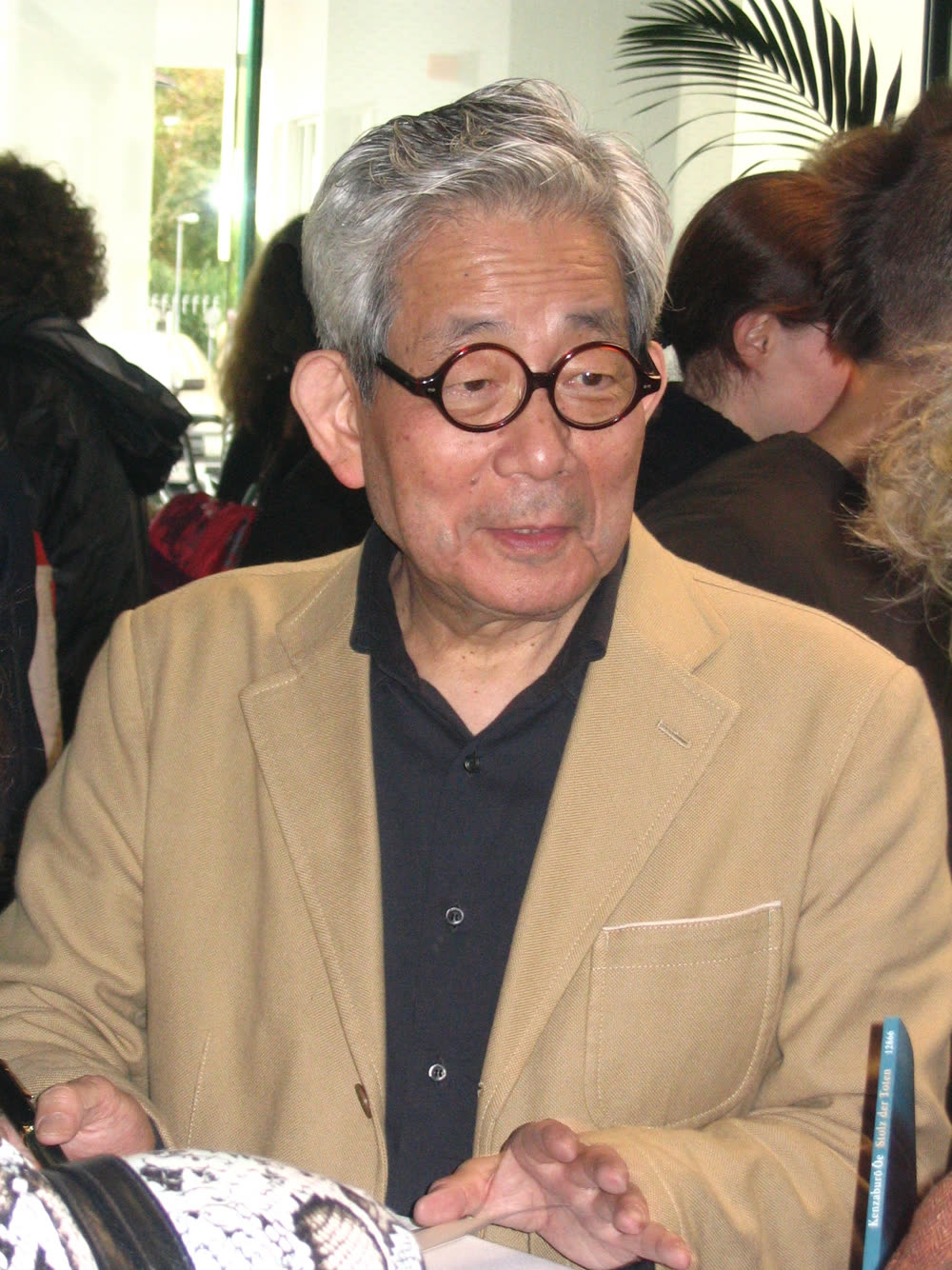
The video embedded below was posted by the Nobel Prize channel and preserves the lecture as an authorial event rather than simply a transcript.[1] The provenance matters: this is not a fan montage or a decontextualized quotation clip. It is the Nobel lecture recording attached to the official institutional archive. Watch for the way Oe uses pace. The lecture has the structure of an essay, but its force depends on a speaker testing transitions in real time: from children's books to disability, from Kawabata to Yeats, from Japanese ambiguity to nuclear-age responsibility.[1][2]
The central contrast in the lecture is with Kawabata, the first Japanese Nobel laureate in literature. Oe treats Kawabata's "beautiful Japan" not as an enemy, but as an inheritance he cannot simply occupy.[2] Kawabata's beauty depends on aesthetic vagueness, on suggestive attachment between self and nation. Oe's ambiguity is harsher. It belongs to a postwar writer formed by defeat, democratic reconstruction, nuclear danger, disability, and the uneasy relation between Japanese cultural memory and modern political responsibility.[2][4]
That is why the title's "ambiguous" should not be heard as indecision. Oe is not saying that Japan is mysterious, ineffable, or charmingly contradictory. He is saying that a writer has to live inside unresolved moral material without polishing it too quickly. The lecture repeatedly pulls away from any usable national brand. Childhood Shikoku is not a tourist landscape; it is a place where a frightened child reads world literature while war surrounds him.[2] Family is not a private sanctuary sealed from politics; it is where the question of human dignity becomes concrete. Literature is not national decoration; it is a way to test whether language can connect injury to responsibility.[2][3]
The archival recording also helps clarify Oe's relation to weakness. In print, his modesty can seem ceremonial, another Nobel laureate performing humility. On video, it feels more structural. Oe speaks as someone refusing the heroic pose because heroism would simplify the very material he is trying to hold. His lecture's moral vocabulary depends on limitation: the peripheral position, the marginal speaker, the "weak person" who still has to answer the century.[2] This is close to the pressure running through A Personal Matter, where the crisis is not solved by grand virtue but by a painful refusal to flee the human claim in front of the protagonist.[5]
Around the lecture's middle stretch, Yeats enters as an unexpected companion.[2] The comparison matters because Oe is not only discussing Japanese literature before a European institution. He is asking what happens when a writer from an island culture, marked by historical violence and a contested relation to nationhood, receives global recognition. Yeats offers a model of literary dignity under national strain, but Oe carefully avoids turning affinity into imitation. The move lets him widen the speech beyond Japan while keeping its Japanese historical pressure intact.[2]
This is where the lecture becomes most valuable as literary archive. Oe's books can look, from a distance, like separate zones: postwar village memory, disabled-child narratives, political essays, nuclear-age anxiety, mythic structures, family crisis. The Nobel recording shows the connecting tissue. Oe's method is to begin from the personal matter, then refuse to leave it personal.[2][4][5] The son's first words, the child's wartime reading, the national comparison with Kawabata, and the late-century worry about technology and destruction all become parts of one ethical pattern. The writer's task is not to escape ambiguity but to make it answerable.
That makes the video especially strong for readers coming to Oe now. A short biographical summary can tell us that he was born in 1935, grew up in Ehime Prefecture, studied French literature, won the Akutagawa Prize early, and became internationally known through fiction shaped by postwar memory and family experience.[3][4] Those facts are necessary. The lecture shows how Oe organized them in public: not as career milestones, but as a chain of obligations. The child reads; the father listens; the novelist writes; the citizen inherits a century's wrongs; the laureate refuses to turn the prize into a pure honor.
The legacy of the recording lies in that refusal. Oe does not offer ambiguity as a mood. He makes it a discipline of accuracy. To be ambiguous, in his sense, is to acknowledge the split between beauty and damage, nation and person, private suffering and public consequence, without allowing one side to erase the other. The lecture's calm surface is therefore misleading. Under it is a hard demand: literature should keep the human being visible at precisely the points where history, ideology, and polite ceremony would prefer a cleaner shape.
Sources
- Nobel Prize, "Kenzaburo Oe, Nobel Prize in Literature 1994: Nobel Lecture" (official YouTube video).
- NobelPrize.org, "Kenzaburo Oe - Nobel Lecture: Japan, The Ambiguous, and Myself" (lecture text and archival context).
- NobelPrize.org, "Kenzaburo Oe - Facts" (1994 Nobel Prize in Literature citation and summary).
- NobelPrize.org, "Kenzaburo Oe - Biographical" (official biographical essay).
- Grove Atlantic, A Personal Matter by Kenzaburo Oe (publisher book page).
- Wikimedia Commons, "File:K oe.jpg" (2005 photograph of Kenzaburo Oe by Reinhold Embacher).