Mary Shelley is still too often introduced through a single thunderclap: Frankenstein, the young author, the laboratory, the creature. That is a powerful doorway, but it can make her later work look like an aftershock. The Last Man, published in 1826, is not a weaker repetition of the famous monster story. It is the book in which Shelley asks what authorship means after the people who made a life intelligible have disappeared.
That makes a work-centered author profile useful. The important Shelley here is not only the prodigy of 1818, nor only the widow of Percy Bysshe Shelley, nor only the daughter of Mary Wollstonecraft and William Godwin. She is a novelist who used the machinery of future history to test an intimate problem: if community fails, politics fails, friendship fails, and even species survival fails, what remains of the obligation to tell the story? The answer is not triumph. It is companionship carried past its practical use.
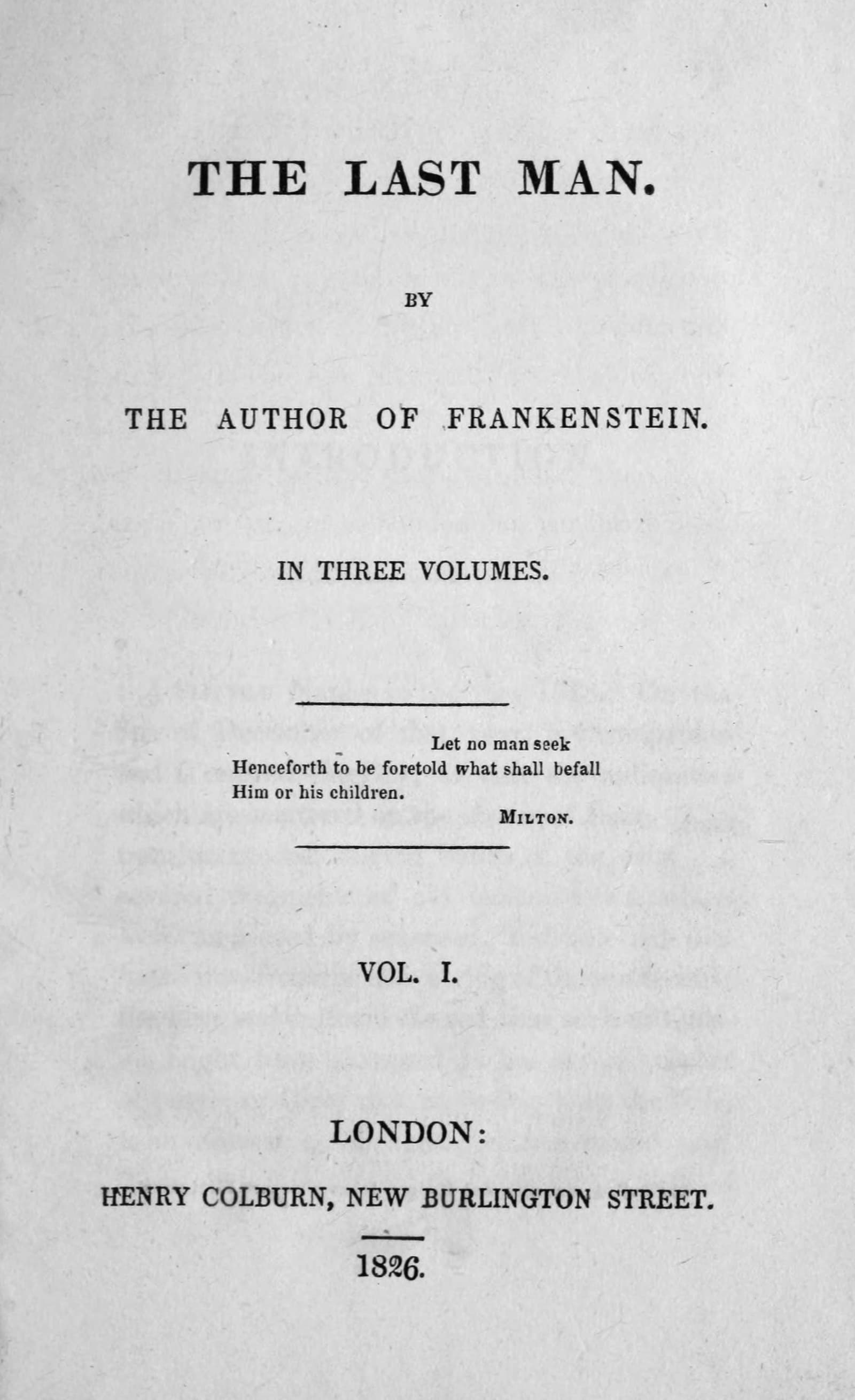
The first edition was issued by Henry Colburn in London in three volumes, a material fact preserved in the Internet Archive scan and echoed by the title page used for this post's image.[2] Project Gutenberg's text keeps the strange shape of the book visible: an introductory frame in which the editor-narrator claims to have found Sibylline leaves near Naples, followed by Lionel Verney's late twenty-first-century account of war, plague, travel, political collapse, and near-total extinction.[1] Shelley gives apocalypse an archive before she gives it a plot.
A Future Built Out Of Grief
The Broadview edition describes The Last Man as Shelley's third published novel and as a disillusioned vision of civilization's end, set in the twenty-first century.[3] That description is accurate, but the word "disillusioned" needs care. The novel is not simply saying that hope is foolish. It is asking what hope becomes when its usual supports have been removed.
The personal ground matters because the novel's catastrophe is not abstract. Broadview's edition notes the dense weave of fantasy, allusion, convention, and autobiography, including Shelley's own journal language about feeling like the last remnant of a beloved circle.[3] By 1826, Shelley had lived through repeated bereavements: children had died, Percy Shelley had drowned in 1822, and Byron had died in 1824. It would be easy to reduce The Last Man to coded mourning for that circle. The stronger reading is that Shelley turns mourning into form.
Lionel Verney begins as a rough outsider and becomes educated into language, feeling, and political attachment.[1] His development matters because the apocalypse does not begin with an already finished witness. Shelley builds a narrator who has to be made capable of witness. Reading, friendship, love, and civic imagination enlarge him before the plague strips his world down. The book's cruelty depends on that preparation. Civilization is not valuable because it is permanent; it is valuable because it teaches a person how much can be lost.
The Plague Is Not Just Weather
Modern readers often approach The Last Man through pandemic recognition, and for good reason. Eileen M. Hunt's Cambridge Core article calls the novel a major early post-apocalyptic pandemic work and places it inside political thought, existential writing, and dystopian literature.[4] But the plague in Shelley is not merely a medical premise. It is a pressure that reveals the fragility of systems people had mistaken for destiny.
The novel moves through parliamentary hope, aristocratic memory, republican aspiration, war in the eastern Mediterranean, family bonds, and artistic cultivation before the disease becomes the final solvent.[1] This sequencing matters. Shelley does not begin by flattening the world. She first shows the world as a mesh of ambitions and affections. When the plague crosses borders, it does not simply kill individuals. It makes institutions look provincial. It exposes how little any nation, ideology, or heroic temperament can promise once vulnerability becomes universal.
That is why The Last Man feels less like disaster spectacle than like a long argument with confidence. War and politics are not decorative backstory. Hunt's Cambridge article reads the novel as a work in which interpersonal conflict can widen into political violence and collective disaster.[4] That claim helps explain the book's unusual emotional weather. Shelley is not interested only in plague as fate. She is interested in the ways humans make catastrophe worse before they are forced to admit that catastrophe has escaped their management.
Companionship As The Last Ethic
The most moving part of The Last Man is not that Lionel survives. Survival by itself is nearly meaningless. Shelley makes survival painful because it leaves him with memory but no ordinary audience. Near the end, he resolves to write even while asking, with terrible plainness, "for whom to read?"[1] The question turns the whole novel into an ethics of address.
An apocalypse story can flatter the survivor by making him the chosen exception. Shelley does almost the opposite. Lionel's lastness is not glory. It is a burden of relation. He has to carry the dead not because they can reward him, answer him, or confirm his account, but because love has made their absence morally active. This is where Shelley's authorial intelligence feels most severe. The dead do not stop making claims simply because they can no longer read.
Penn Press's page for Hunt's The First Last Man emphasizes the novel's long afterlife in postapocalyptic imagination and its question of what humans do after disaster.[5] That framing is helpful, but Shelley's own answer is smaller and more difficult than genre influence. Humans write, remember, misread, preserve, and address. They build fragile continuities out of forms that cannot save bodies but may keep humane attention from vanishing.
This is also why the title page matters as more than a bibliographic relic. A title page usually points forward to readers, sales, circulation, review, and reputation. In The Last Man, the title points toward a fictional condition in which circulation has become impossible. The book still appears as a book. Shelley lets print culture survive as a ghost of social life.
Why The Book Still Feels Unsettling
The current revival of The Last Man is not only a pandemic aftereffect. The Cambridge and Penn Press accounts both stress the novel's importance for postapocalyptic thought, political imagination, and later speculative traditions.[4][5] Yet the reason it keeps returning is not just that it predicted a global plague plot. Its deeper modernity lies in the way Shelley refuses to make catastrophe intellectually tidy.
The novel does not offer a clean hierarchy among grief, politics, disease, and art. Each presses on the others. Private loss teaches Lionel what public loss costs. Political ambition shows how easily noble language becomes helpless. Plague makes every distinction between center and margin unstable. Writing remains necessary, but not because writing is magic. It is necessary because without witness, disaster completes itself by erasing relation.
That is the work-centered Mary Shelley this novel reveals: a writer who understood that imagination is not escape from loss but a way of giving loss a durable shape. Frankenstein asks what a maker owes to the life he has made. The Last Man asks what a witness owes to lives that cannot answer. The second question is quieter, but it may be even harder.
Read in 2026, The Last Man does not need to be rescued as a prediction. Predictions age quickly. Shelley's book endures because it makes the end of the world feel like the end of conversation, then keeps talking anyway. Its apocalypse is not only the death of humanity. It is the test of whether companionship can remain an ethic after companionship has become impossible.
Sources
- Mary Wollstonecraft Shelley, The Last Man, Project Gutenberg ebook text (1826 novel text and frame narrative).
- Internet Archive, The last man, volume 1, London: H. Colburn, 1826 (first-edition scan and publication metadata).
- Broadview Press, The Last Man, edited by Anne McWhir (edition page, context, appendices, and reception framing).
- Eileen M. Hunt, "Mary Shelley's The Last Man: Existentialism and IR meet the post-apocalyptic pandemic novel," Review of International Studies, Cambridge Core, 2022/2023.
- University of Pennsylvania Press, The First Last Man: Mary Shelley and the Postapocalyptic Imagination by Eileen M. Hunt (book page and scholarly scope note).
- Wikimedia Commons, "File:The Last Man 1st edition.jpg" (source page for the 1826 first-edition title-page image used as the article cover).