
Isaac Bashevis Singer's 1975 92NY talk, "Mysticism and Modern Man," is easy to misfile as a period curiosity: a Nobel-bound Yiddish writer addressing religion, superstition, and modernity to a New York audience three years before the Swedish Academy made him internationally official.[1][2][5] That summary is accurate, but it misses the recording's literary force. The talk is not valuable because it lets Singer confess a doctrine. It is valuable because it lets us hear how he turns belief and disbelief into craft.
Singer's fiction often begins where a rational modern reader expects folklore to remain safely ornamental. Demons, dybbuks, astrologers, rabbis, peddlers, dreamers, deceivers, refugees, skeptics, and hungry bodies move through the same moral weather. The supernatural is rarely only a supernatural event. It is a pressure on character: what a person wants, fears, invents, excuses, remembers, and refuses to know. That is why a talk on mysticism belongs inside a literature post rather than a religious-history note. Singer's mysticism is narrative equipment.
The historical frame matters. The Yiddish Book Center places Singer's life between Warsaw's Krochmalna Street, immigration to New York in 1935, work for the Yiddish daily Forverts, and a postwar career that kept returning to destroyed Eastern European Jewish worlds while also adapting them for English-language readers.[4] Nobel's bibliography shows the same double motion in book form: Yiddish originals, English translations, children's tales, memoir, novels, short-story collections, and later retrospective volumes.[5] By 1975, Singer was already a famous writer of uncanny stories and immigrant dislocation, but he was not yet sealed into Nobel shorthand.
That pre-Nobel timing is one reason the recording is worth preserving in the feed. 92NY's archive identifies the talk as Singer speaking about the relationship of mysticism and modernism.[2] The official YouTube upload comes from The 92nd Street Y, New York, which makes the embed a public viewing copy of institutional literary programming rather than a loose reupload.[1] The provenance fits an archival spotlight: a major twentieth-century writer, a dated New York literary venue, and a subject that runs through the central mechanism of his art.
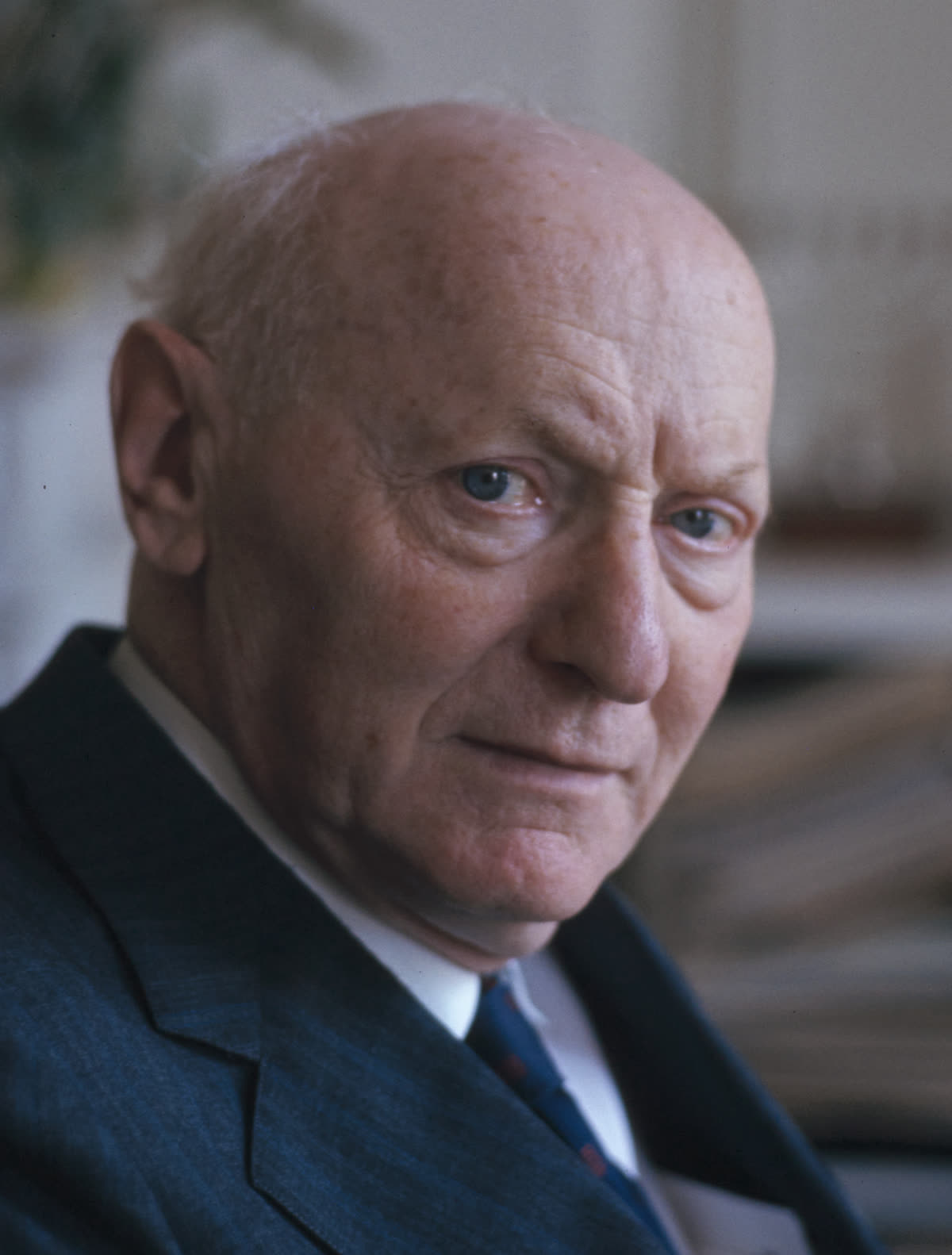
Image context: the cover photograph is not a symbolic books-and-candle placeholder. It is a real archival author photograph from the Bernard Gotfryd collection at the Library of Congress, echoed through the Commons file record. That matters here because the article is about public voice, not abstract "literary mood." The face, the lecture, and the institution all belong to the same afterlife of Singer as a writer heard across languages.[3]
The embedded video below is the 92NY recording of Singer's 1975 talk.[1][2] Watch it not as a theological statement to accept or reject, but as a lesson in how a novelist keeps incompatible explanations alive long enough for a story to breathe.
What The Archive Preserves
The talk preserves Singer in the act of refusing a clean modern bargain. A simpler twentieth-century story says that modernity defeats superstition, that science clears the room, and that literature can keep old beliefs only as local color. Singer's fiction does something more unstable. It lets modern doubt enter the room, but it does not let doubt become the only intelligent voice there. Characters can be shrewd, vain, erotic, pious, ridiculous, learned, greedy, frightened, and metaphysically porous at once.
That doubleness is central to reading him. Britannica's overview describes Singer's fiction as blending irony, wit, wisdom, the occult, and the grotesque.[6] The useful word there is "blending." In weak supernatural fiction, the occult arrives as a special effect. In Singer, it often behaves like an interpretive climate. A person may explain an event psychologically, socially, religiously, erotically, or comically, and the story refuses to close all but one door. The pressure of the unresolved is the point.
This is why "Mysticism and Modern Man" helps clarify the short stories even when the talk is not about any single story. Singer's modern person is not simply secular. He is haunted by appetites, inherited languages, family obligations, ancestral memory, bodily decay, historical catastrophe, and the possibility that material explanations may be incomplete. The fiction does not require readers to become believers. It asks them to notice how impoverished a purely managerial view of human beings can become.
The Yiddish question deepens that problem. The Yiddish Book Center notes Singer as the only primarily Yiddish writer to win the Nobel Prize and points to his defense of Yiddish as a living, humanly capacious language.[4] In the Nobel orbit, that point can sound ceremonial. In the fiction, it is more technical. Yiddish is not only a heritage badge. It carries rhythms of argument, jokes, curses, rabbinic dispute, domestic tenderness, market speech, and old-world metaphysical habits into modern narrative. When Singer's fiction moves into English, the translation problem is not just vocabulary. It is the problem of carrying a world of assumptions into another literary market.
Mysticism As A Form Problem
The recording's best use is to make readers less embarrassed by the metaphysical surface of Singer's stories. Modern readers sometimes try to rescue Singer by treating demons and wonders as metaphors for psychology or trauma. That approach can be helpful up to a point, but it becomes reductive when it decides too early that the story's stranger explanations are only disguises for respectable secular meanings. Singer is more interesting because he lets the disguise remain active.
Think of mysticism here as a form problem. A realist sentence usually promises that the world can be described by observed cause and effect. A fable promises moral compression. A ghost story promises breach. A religious tale promises invisible order. Singer's stories often borrow from all four without letting any one form govern completely. That mixture is why they can feel comic and terrifying in quick succession. The comic voice notices vanity and appetite; the mystical frame refuses to say that vanity and appetite exhaust reality.
The 1975 lecture therefore acts like a key to Singer's pacing. He does not need to rush toward proof. He can let contradiction accumulate. A character may mock belief and then behave as if fate has touched him. A skeptic may become superstitious when desire is strong enough. A pious figure may be foolish, and a foolish figure may stumble into moral truth. The point is not to rank the characters by doctrine. The point is to make fiction capacious enough to hold the disorder of belief as it is actually lived.
That is also why Singer's humor matters. Mysticism without humor can become solemn vapor. Humor without metaphysical risk can become cleverness. Singer's comic pressure keeps the mystical material embodied: food, marriage, money, lust, aging, gossip, rooms, streets, contracts, and arguments. The uncanny does not float above life; it enters through life. A demon is more alarming when it arrives in a world of rent, hunger, jealousy, and family disgrace.
Why The 1975 Talk Still Helps
The archive helps correct another common mistake: treating Singer as a custodian of a vanished world rather than as a modern writer whose materials include vanishing. His Polish-Jewish settings are not museum rooms. They are dramatic engines. The destroyed world matters because its loss changes the moral acoustics of the stories. After immigration and after the Holocaust, old beliefs do not return innocently. They return as memory, as stubborn language, as guilt, as temptation, as comedy, and sometimes as accusation.
Nobel's bibliography makes the scale of that late-career movement visible: the English-language publication path runs through Gimpel the Fool, The Magician of Lublin, The Spinoza of Market Street, A Crown of Feathers, memoir, children's stories, and the Nobel lecture itself.[5][7] That list matters because Singer's mysticism is not confined to one genre. It changes shape across parable, urban tale, shtetl story, immigrant fiction, memoir, and public lecture. The 92NY recording catches the author explaining the climate in which those forms remain connected.
There is also an ethical reason to keep this footage in circulation. A strictly rationalist reading of modernity can mistake disenchantment for seriousness. Singer's work pushes back without becoming anti-modern propaganda. He knew newspapers, translation, prizes, immigration paperwork, literary markets, and urban American life. He was not writing from outside modernity. He was writing from a life in which modernity had not erased older questions about soul, sin, destiny, possession, storytelling, and judgment. The fiction's power comes from the friction.
So the best question to bring back from the video is not "Did Singer believe this?" The better question is "What does fiction gain when belief remains unsettled?" It gains moral suspense. It gains comic instability. It gains access to fears that ordinary explanation cannot quite domesticate. It gains a way to make language remember more than the present moment allows. For Singer, mysticism is not an escape from modern man. It is one of the ways modern man reveals how little he understands himself.
Sources
- The 92nd Street Y, New York, "Mysticism and Modern Man: Isaac Bashevis Singer (1975)," official YouTube video.
- 92NY Archives, "Isaac Bashevis Singer on Mysticism and Modern Man" (archive page for the 1975 talk).
- Wikimedia Commons, "File:Isaac Bashevis Singer (Gotfryd).jpg" (source page for the Bernard Gotfryd / Library of Congress photograph used as the lead image).
- Yiddish Book Center, "Isaac Bashevis Singer" (biographical exhibit page on Warsaw, New York, Forverts, translation, and the Nobel context).
- NobelPrize.org, "Isaac Bashevis Singer - Bibliography" (Yiddish and English publication record through the Nobel period).
- Encyclopaedia Britannica, "Isaac Bashevis Singer" (biographical and literary overview).
- NobelPrize.org, "Isaac Bashevis Singer - Nobel Lecture" (December 8, 1978 lecture page).