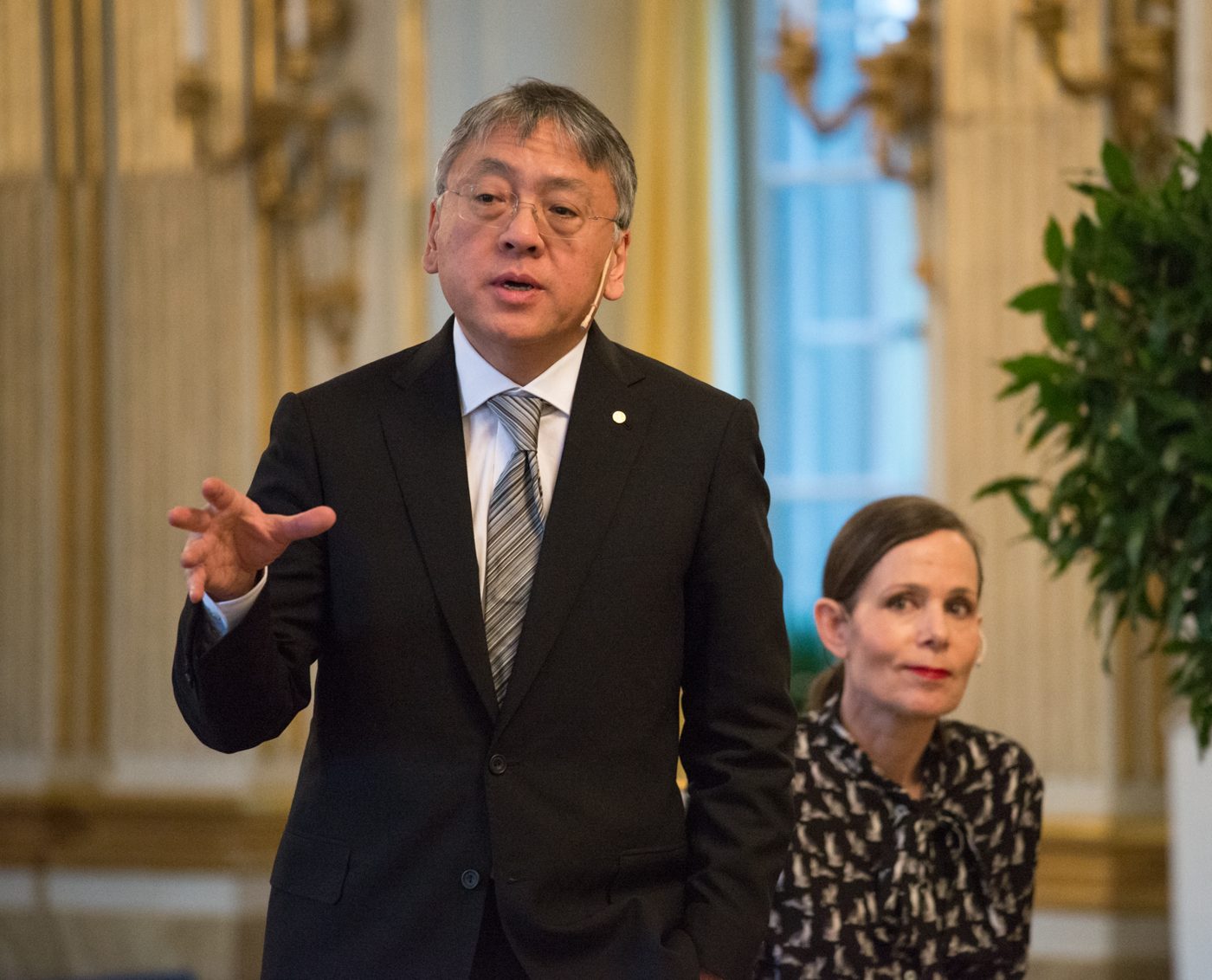
When the Nobel Prize interviewed Kazuo Ishiguro in Stockholm on December 6, 2017, two days before the award ceremony, the setting looked ceremonial enough to invite the wrong kind of reading.[1][2] One could treat the clip as a laureate's tidy retrospective: early success, mature authority, a few generous lessons for younger writers. What makes the video worth revisiting is almost the opposite. Ishiguro keeps draining grandeur out of authorship. He talks less like a sage laying down a system than like a builder explaining how unstable the parts pile often looks before a book finds its shape.[1][2]
That matters because his fiction can feel uncannily composed on the page. The narrators in The Remains of the Day, Never Let Me Go, and The Buried Giant sound as though they were always destined to speak in exactly those cadences.[4][5] In the interview, Ishiguro gives a rougher account of how such control is made. He says a project often begins with "an abstract, emotional kind of question," and only later starts attracting the setting, conventions, and narrative machinery that can carry it.[2] The statement is small, but it reorganizes how the novels look. Genre, in his telling, is not a home. It is a temporary instrument.
That practical language also belongs to a larger autobiographical frame. Ishiguro's Nobel lecture returns to displacement, inherited memory, and the stories that migrated with his family from Nagasaki to Britain when he was a child.[4] Britannica's biography is useful for the same reason: it reminds us that his career has always moved between national locations, historical scales, and borrowed forms without settling into one stable literary identity.[5] The 2017 interview distills that career into workshop speech. Instead of announcing a doctrine, it lets you hear a writer testing how much structure a difficult feeling needs before it can become a novel.
Image context: the cover uses a real Stockholm photograph from Nobel week rather than a jacket image or a synthetic portrait. It fits this article because the interview's tension lies in that contrast: public dignity on the outside, improvisatory craft talk underneath.[6]
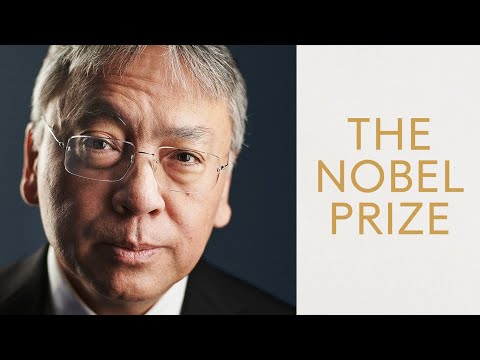
The official Nobel Prize video below is the same Stockholm interview discussed in the transcript. It is worth watching whole, but the most revealing stretches come when Ishiguro starts describing what he borrows from history, genre, and memory in order to make a book hold together.[1][2]
Around 10:10, he demotes genre on purpose
One of the interview's clearest craft claims arrives when Ishiguro is asked about influences on his writing style.[2] He does not answer by naming a school, a lineage, or a permanent formal allegiance. He answers with process. Each book, he says, begins with a pressure point he cannot yet fully articulate, and the eventual genre shape grows around that pressure.[2] That way of speaking helps explain why his novels so often feel at once classical and estranging.
Take The Remains of the Day. On one level it borrows the decorum of the English country-house novel; on another, it uses that borrowed decorum to expose how professional dignity can become a technology of self-erasure.[4][5] Never Let Me Go does something equally sly with dystopian premises. The speculative architecture is there from the beginning, but the book's emotional force comes from how long the narration keeps sounding like a school-memory novel about manners, friendship, and deferred disappointment.[5] The point is larger than a label. Ishiguro uses genre the way an engineer uses a material: for stress-bearing capacity.
That is why the interview is so clarifying for literary readers. It blocks an easy critical habit, the habit of treating Ishiguro as if each new book merely "entered" a genre from outside.[2][5] In his own account, the movement runs the other way. A difficult moral or emotional puzzle draws whatever frame can hold it. Genre is not sovereign over the book's meaning. It is drafted into service.
Around 12:00, the flying-machine metaphor explains the calm surfaces
The interview becomes most memorable when Ishiguro says he often feels like a "crazy person trying to build a flying machine," pulling in parts from wherever they might help.[2] It is an unusually humble metaphor for a novelist so often described in terms of polish and restraint. Yet it may be the best single description of why the books feel so original without advertising originality at the sentence level.
The phrase suggests bricolage rather than purity.[2] Ishiguro does not imagine the novel arriving as an essence that must be protected from contamination. He imagines a contraption assembled under pressure: memory from one direction, historical atmosphere from another, genre expectation from a third, and then a voice calibrated so carefully that the machinery becomes almost invisible.[2][4] Readers often experience the finished result as inevitability. The interview restores the hidden awkwardness of the build.
That awkwardness also belongs to his Nobel lecture, whose title, My Twentieth Century Evening and Other Small Breakthroughs, is already suspicious of grand claims.[4] A breakthrough in Ishiguro's vocabulary is often local and makeshift: one shift of person, one new distance between narrator and truth, one formal permission that lets an older emotional question find a fresh vehicle. Once you hear the flying-machine metaphor, the serenity of the prose looks less like inherited poise and more like the after-effect of many concealed adjustments.
Around 6:30, the private voice opens onto historical weather
Earlier in the interview, Ishiguro describes the movement from his early fiction toward books that address societies and nations living with buried memory.[2] That remark becomes sharper when set beside the Nobel Prize's October interview page, where he speaks about the tension between "small worlds and big worlds."[3] The phrase is compact, but it names one of his deepest formal habits. His novels almost always begin in a bounded chamber: a household, a school, an institution, a road journey, a village under a spell of forgetting.[3][4][5] Then the chamber starts leaking history.
This is one reason his first-person narrators matter so much. They do not shrink the books down to private confession.[2][3] They serve as acoustic chambers in which public history can be heard entering a person slowly, belatedly, and often through self-protective language. Stevens's loyalty, Kathy H.'s gentleness, and Axl and Beatrice's drifting recall are all styles of partial knowing before they are styles of personality.[4][5] The voice is intimate so that the eventual pressure from war, science, empire, or national forgetting can be felt as intrusion rather than announced as thesis.
Here the interview and the lecture lock together. In the lecture, Ishiguro recounts how childhood inheritance, migration, and twentieth-century violence shaped the horizon of what he could imagine writing about.[4] In the interview, he turns that history into a compositional rule: start close, but build for weather. The "small world" is where trust is earned. The "big world" is what eventually disturbs the room.
Around 24:38, ambition is separated from performance
Near the end, when asked what advice he would give young people, Ishiguro offers a question rather than a slogan: do you want to write, or do you mainly want to occupy the social identity of being a writer?[2] The distinction is severe in exactly the right way. It does not romanticize suffering or preach purity. It asks whether the attraction lies in the labor of making forms, or in the prestige aura that sometimes gathers around the finished object.
This final turn helps explain the tonal ethics of Ishiguro's fiction.[2][5] His narrators are rarely showy. Even when the structures are intricate, the prose tends to sound delayed, courteous, and faintly provisional. The interview suggests that this is not a matter of modesty as branding. It grows from the same craft posture as the flying-machine metaphor. If the task is to discover what kind of apparatus a difficult feeling needs, then performance for its own sake is a distraction. The work has to serve the question.
That is why the 2017 Nobel clip keeps paying rereading dividends.[1][2][3][4] It offers a public version of Ishiguro's workshop logic: begin with an emotional problem, borrow what you need, let intimate voices carry historical pressure, and distrust any literary identity that becomes too pleased with itself. For a writer so often praised for understatement, the interview is unexpectedly explicit. It makes the method audible without making the fiction smaller.
Sources
- Nobel Prize, "Kazuo Ishiguro Interview" official YouTube upload (December 6, 2017).
- Nobel Prize, "Kazuo Ishiguro interview transcript" (December 6, 2017).
- Nobel Prize, "Kazuo Ishiguro Interview" (October 12, 2017; Nobel Prize interview page).
- Kazuo Ishiguro, "My Twentieth Century Evening and Other Small Breakthroughs" (Nobel Lecture, December 7, 2017).
- Encyclopaedia Britannica, "Kazuo Ishiguro."
- Wikimedia Commons, "File:Kazuo Ishiguro in Stockholm 2017 06.jpg" (photographic source page).