Many readings of The Death of Ivan Ilyich begin with mortality in the abstract. Tolstoy's novella certainly is about death, but its cruelty lands elsewhere first. The book studies a social order that can tolerate ambition, upholstery, bridge, promotion, and small hypocrisies far more easily than it can tolerate a dying body in the middle of the drawing room. What makes Ivan Ilyich's collapse so shattering is not only that he will die. It is that his whole way of living has trained him to treat whatever is awkward, painful, or unruly as a breach of form.[1][2]
That is why the novella still bites so hard in 2026. Tolstoy does not attack success with romantic simplicity. He goes after something more ordinary and therefore more durable: the wish to keep life "pleasantly and properly," to organize one's world so that unpleasant facts arrive only in controlled doses.[1] Ivan's error is not spectacular evil. It is a long education in convenience.
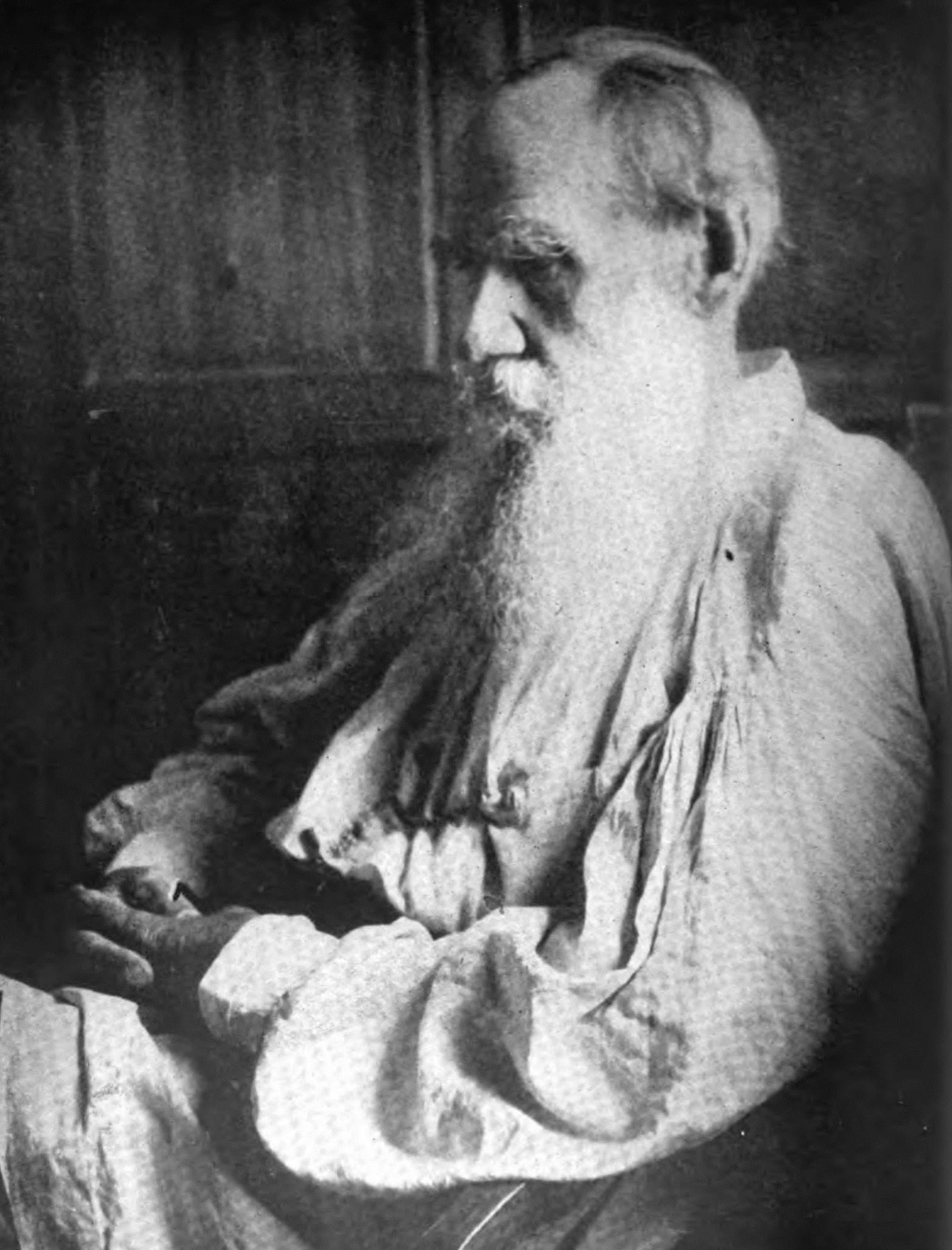
Image context: the lead image is a real 1908 photograph of Tolstoy at Yasnaya Polyana. It belongs here as author-context because this novella's authority comes from late-style compression: a writer who can take careerism, domestic etiquette, medical procedure, and final terror, then show how they fit into one enclosed moral system.[5]
1) Ivan's life is built as an etiquette machine
Tolstoy announces the method with ruthless speed. Ivan Ilyich's life, he writes, had been "most simple and most ordinary and therefore most terrible."[1] The sentence matters because it refuses melodrama. Ivan is not singled out as a monster. He is exemplary. His habits are those of a man who learns, from youth onward, to calibrate himself toward what people above him regard as correct.[1][2]
The novella keeps attaching moral weight to seemingly harmless adverbs. Ivan amuses himself "pleasantly and decorously"; later his life continues, as he sees it, "pleasantly and properly."[1] That vocabulary is the real trap. "Properly" sounds like an ethical category, but in Ivan's world it mostly means friction-free. A good dinner, the right acquaintances, professional advancement, well-managed interiors, and emotional life kept within accepted boundaries all begin to merge into one thing: a style of existence designed to prevent embarrassment.
This is why the book's domestic chapters matter so much. Marriage becomes difficult not because Tolstoy opposes marriage itself, but because pregnancy, childcare, illness, and resentment all refuse decorative management.[1] Ivan's response is to retreat deeper into office life, procedure, and official dignity. He does not solve the disorder; he builds a fence around it. Gerald Lang's philosophical reading is useful here because it frames the novella not as a vague death parable but as a question of what, exactly, Ivan needs rescue from.[2] The answer is larger than pain. He needs rescue from a whole grammar of life in which inconvenience counts as the chief evil.
2) Illness becomes scandal because it cannot be made polite
Once Ivan falls ill, Tolstoy shows what this grammar costs. The people around him do not merely fail to understand him. They instinctively translate dying into social nuisance. Chapter 7 states the point almost obscenely clearly: the "whole interest" Ivan now has for others is whether he will soon vacate his place and release the living from discomfort.[1]
That sentence is devastating because it does not describe villainy in a melodramatic sense. It describes ordinary social self-protection. Others keep eating dinner, arranging visits, talking curtains and doctors, maintaining schedules. The dying man becomes one more awkward fact to route around. Tolstoy's brilliance is to show that this reduction is not an interruption of Ivan's values. It is their fulfillment. The same decorum he spent his life serving now reduces his death to what the novella calls an "almost indecorous incident."[1]
This is where the book feels unnervingly modern. Institutions are better at handling cases than presences. They can assign treatment, discuss symptoms, and preserve routine, yet still fail at the basic human task of admitting what is happening in the room. Ivan suffers physically, but the book insists that the deeper torment is the lie: everyone knows he is dying, everyone behaves as if he is merely passing through an unpleasant but manageable episode, and he is forced to collaborate in that falsification.[1][2]
3) Gerasim matters because he refuses the lie
The novella's moral center is therefore not a doctrine but a relation. Gerasim matters because he never aestheticizes the situation and never translates it into etiquette. He lifts Ivan, empties the basin, holds his legs, and speaks without disguise. "We shall all of us die," he says, so why grudge a little trouble?[1]
Readers sometimes treat Gerasim as a symbolic peasant truth-teller, but Tolstoy gives him more practical importance than that. He is the one person who does not require Ivan to pretend. In Gerasim's presence, death can exist as fact rather than social contamination. That is why his vitality soothes instead of humiliates Ivan. Everyone else embodies the normal world Ivan built and desired; Gerasim offers a world in which pity is not a breach of rank and bodily need is not an offense against good form.[1]
The difference is philosophical as well as emotional. Tolstoy is separating correctness from rightness. Ivan has lived "correctly" in the social sense for decades. Gerasim behaves rightly in the human sense almost without theory. That split runs through the entire novella and explains why the book keeps surviving outside purely literary discussion. Penguin keeps it in active circulation, and NEA public-literary programming has continued to use it as a durable way into questions of status, suffering, and moral attention.[3][4]
4) The final revelation is about falsehood before it is about death
By the end, Ivan's insight is mercilessly specific. Looking at his wife, he realizes that "all you have lived for and still live for is falsehood and deception, hiding life and death from you."[1] Tolstoy is not saying that every comfort is wicked or that civilization itself is fraud. He is saying that a life organized too fully around convenience will eventually become unable to meet reality except as insult.
That is why the novella's final pressure is larger than fear of extinction. Ivan begins to suspect that what he took for life was, in moral terms, a managed avoidance of life: ambition without intimacy, propriety without tenderness, medicine without candor, family without shared truth. Death exposes this structure because it cannot be fenced off like a difficult dinner guest or a querulous spouse. It abolishes the distance on which decorum depends.[1][2]
The book's severity lies here. Tolstoy does not offer redemption through argument. He narrows the world until one question remains: if the forms that protected you from awkwardness also protected you from reality, what exactly have they preserved?
Why the novella still feels contemporary
The Death of Ivan Ilyich stays current because modern life remains full of polished evasions. Career language, wellness language, professional bedside language, and family politeness all still know how to soften the fact of mortality until the dying person starts to sound like a scheduling problem.[1][2][4] Tolstoy's novella remains so teachable because it refuses to let that softening pass as kindness.
Its lasting force comes from precision. It does not merely say that we die. It says that entire social worlds are built to make dying seem tasteless, badly timed, and faintly embarrassing. Once Tolstoy shows that mechanism, the novella can no longer be read as a distant nineteenth-century moral lesson. It becomes a close study of how comfort turns into falsity, and how one honest witness can break the spell.
Sources
- Leo Tolstoy, The Death of Ivan Ilyich (Marxists Internet Archive index; cited for chapters 2, 7, and 11).
- Gerald Lang, "What Does Ivan Ilyich Need To Be Rescued From?" Philosophy (Cambridge Core abstract page).
- Leo Tolstoy, The Death of Ivan Ilyich and Other Stories (Penguin Random House edition page, translated by Anthony Briggs).
- National Endowment for the Arts, "Ivan Ilyich Is Dead!" (public-literary program transcript and documentary context).
- Wikimedia Commons, "File:Photo of Leo Tolstoy.jpg" (lead image source).