Jude the Obscure is often remembered in one compressed sentence: the book was scandalous, a bishop burned it, and Thomas Hardy never wrote another novel.[2][3] The memory is accurate but too flat. What made the scandal endure was not simply that Hardy wrote about sex or unhappy love. He built one of the nineteenth century's most abrasive collision points, where class exclusion, educational desire, church discipline, marriage law, and bodily need all keep injuring one another inside the same plot.[1][2][3] The reception story matters because the novel itself is built to produce that pressure.
That pressure appears early, before the plot has even gathered speed. Jude first sees Christminster as a distant shimmer, a place whose vanes and windows gleam through mist until the whole city feels half-real and half-religious.[1] Hardy then spends the rest of the novel proving how expensive that dream will be. The book's notoriety came from the fact that it refused to isolate any one problem. Jude the Obscure is a university novel, a marriage novel, a crisis-of-belief novel, and a sex-and-law novel all at once.[2][3][4] Readers who could have tolerated one provocation at a time found themselves confronting all four.
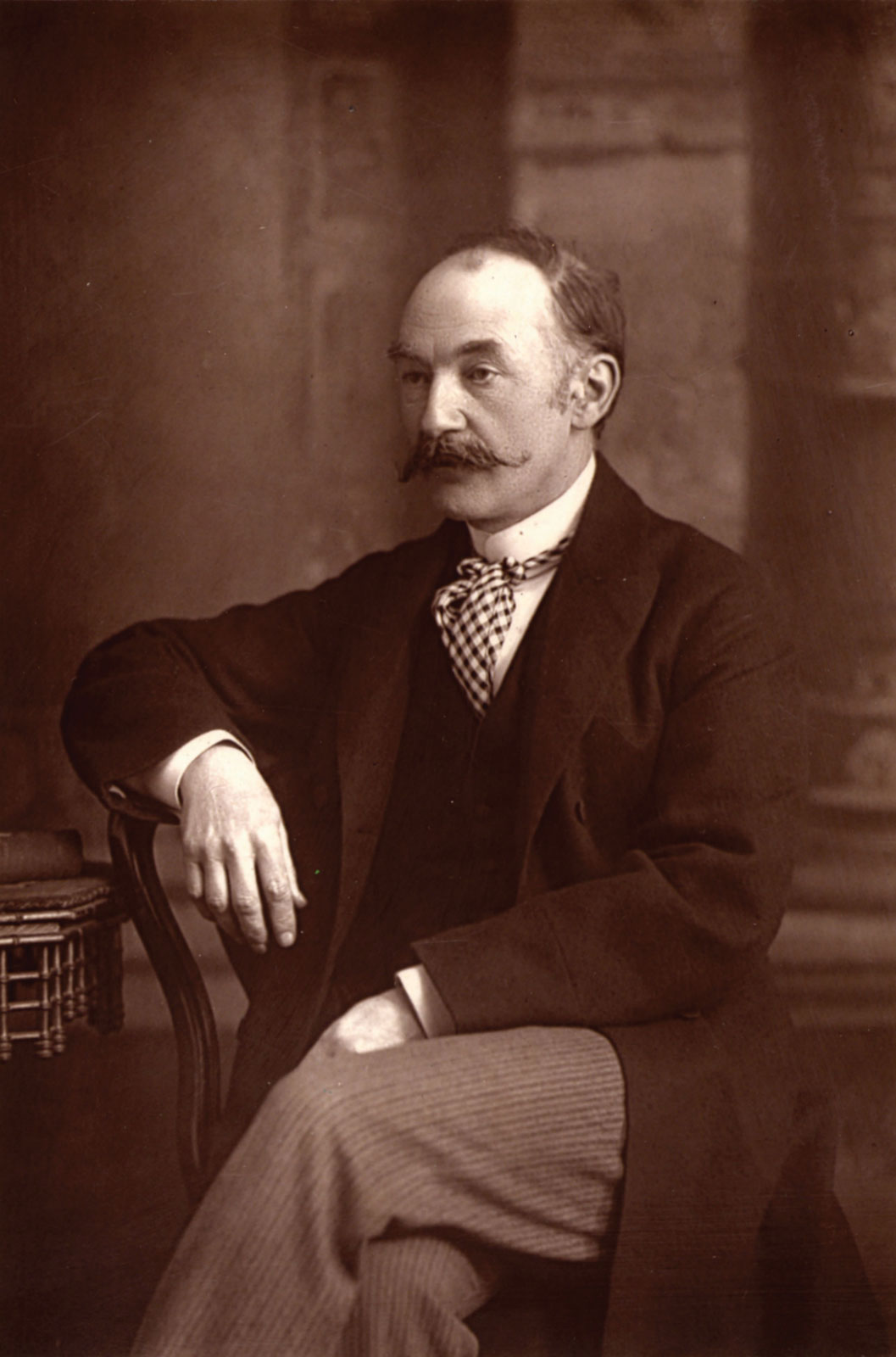
Image context: the cover uses a real photographic portrait of Hardy from Wikimedia Commons, sourced to the National Portrait Gallery in London. It belongs here because this novel's afterlife remains tied to Hardy's own late-career threshold: a writer still working in fiction, but already close to the point where criticism, censorship, and exhaustion would push him toward poetry instead.[5]
1) Publication context: the novel arrived in mutilated form before it arrived in full
One reason the reception history is unusually revealing is that the text reached readers in stages. Britannica notes that the novel first appeared in 1894-95 in abridged form in Harper's New Monthly as Hearts Insurgent, before appearing in book form in 1895.[2] The Thomas Hardy Society fills in the editorial pressure behind that fact: the serial version began under the title The Simpletons, shifted to Hearts Insurgent, and was bowdlerized because the magazine's editor feared offending readers.[3] Victorian Web is even more explicit, noting that controversial passages were omitted or altered, including key sexual and domestic material involving Jude, Sue, and Arabella.[4]
That publication path matters because scandal was not an accidental side effect of a stable text. The novel was already being negotiated, softened, and strategically renamed before it reached the public in its fuller form.[3][4] Hardy knew he was pushing into dangerous ground. In the 1895 preface preserved by Project Gutenberg, he frames the book not as a tidy thesis but as an attempt to give "shape and coherence" to a mass of impressions.[1] That is a cautious description for a novel that would be read as an assault on several pillars of Victorian social order.
2) Christminster turns educational longing into a class wound
The first pillar is education. Jude's vision of Christminster gives the novel its most durable structure: aspiration directed toward an institution that glitters from a distance and closes itself at close range.[1][2] Hardy Society commentary is useful here because it stresses that Jude is a self-educated young stonemason and that Christminster is the fictionalized Oxford from which he remains excluded.[3] The book's social bitterness begins there. Jude is not indifferent to learning and then denied status afterward; the denial is built into the very form of his desire.
This is why the early chapters feel so charged. Christminster is not merely a backdrop for ambition. It is a machine for producing aspiration without admission. Project Gutenberg's text makes the boy's first sight of the city almost visionary, and Hardy lets the image hang long enough that the eventual refusal feels structural rather than personal.[1] By the time Sue later mocks the stale medievalism of Christminster, the novel has already taught the reader that the place is both intellectually radiant and institutionally ungenerous.[1][3]
Late-Victorian readers could have accepted class sadness in the abstract. What sharpened the wound was Hardy's insistence that the educational system itself helped produce it. Britannica's summary puts the point plainly: the novel shocked readers not only through sexual frankness but through its criticisms of the university system.[2] In other words, Christminster was not just scenery. It was one of the scandal objects.
3) Marriage is the second target, and Sue Bridehead makes the attack impossible to ignore
If Jude's blocked education wounds the book from one side, Sue Bridehead wounds it from the other. Victorian Web notes that reviewers were scandalized not only by Hardy's portrayal of the university and the church, but by his treatment of marriage and female sexuality.[4] Sue is the key reason why those complaints fused together. Hardy Society commentary describes her as educated, daring, and sexually fastidious, a figure caught in direct conflict with the forms of domestic life available to her.[3]
The novel's most explosive scenes do not simply show bad marriages; they attack the idea that legality guarantees moral truth. When Sue asks, "What is the use of thinking of laws and ordinances" if they make people miserable, the novel ceases to sound like a melancholy romance and starts sounding like a frontal challenge to Victorian domestic doctrine.[1] Her later insistence on living with Jude "as I choose" turns that challenge from complaint into principle.[1] Those lines still sting because Hardy does not hand them to a villain or a fool. He gives them to the novel's most intellectually restless consciousness.
This helps explain why contemporary attacks sounded so overheated. Victorian Web records the notorious review culture around the book: The Pall Mall Gazette called it "Jude the Obscene," Margaret Oliphant treated it as anti-marriage writing, and the Bishop of Wakefield publicly burned his copy.[4] The outrage was not only about impropriety. It came from the sense that Hardy had allowed a woman character to criticize the structure of marriage from within the novel's own moral center.
4) Reception panic was real, but so was the book's immediate prestige
The scandal did not produce silence; it produced argument. Victorian Web notes that within three months the book had sold 20,000 copies, even as reviewers denounced it for indecency and blasphemy.[4] The same source also records the counter-current of strong praise from Havelock Ellis, W. D. Howells, H. G. Wells, and Swinburne.[4] That split is crucial. Jude the Obscure was not a book everyone agreed was filthy and then politely canonized later. It was divisive from the start because many serious readers recognized its scale at the same time others wanted it quarantined.
Hardy Society commentary captures the same contradiction in compressed form: the novel provoked "a storm of protest" over indecency, yet the storm itself proved how directly Hardy had touched late-century anxieties about sex, conscience, and social permission.[3] Readers were not panicking over one scene. They were reacting to a whole arrangement in which marriage no longer protected dignity, religion no longer guaranteed coherence, and education no longer promised mobility.[2][3][4]
That is also why the book's title now feels perfectly chosen. Obscurity in Hardy's novel is not simple mystery. It is social dimness produced by structures that refuse to clarify a life. Jude's capacities remain half-seen; Sue's desires remain misread; Christminster shines and withholds; the law names bonds it cannot humanize.[1][2] The reception struggle belongs to that same pattern. The culture could see the book's offense faster than it could see the diagnosis creating it.
5) Why the novel ended Hardy's fiction and why it still matters
Britannica states the blunt outcome: Hardy was so distressed by the reception that he wrote no more fiction and turned to poetry.[2] Victorian Web says much the same, linking the harsh response to Jude and Tess with Hardy's decision to abandon novels in 1896.[4] Hardy Society commentary, drawing on Hardy's later preface, adds the memorable phrase that the uproar cured him of further interest in novel-writing.[3] Few books carry such an immediate consequence in an author's career.
Yet the afterlife should not be framed only as martyrdom. Jude the Obscure lasts because the scandal and the art are inseparable. Remove the educational wound of Christminster, and the book loses its class ache. Remove Sue's attack on legal marriage, and it loses its conceptual heat. Remove the public uproar, and you miss how clearly Victorian readers recognized that Hardy had found a live wire.[1][2][3][4]
That is why the novel still reads as more than a sad case history. It is a dossier on what happens when institutions outlive their moral credibility but keep their coercive force. The school gates remain selective, the church language remains available, the marriage law remains binding, and individual feeling keeps crashing against all three. Hardy did not become unpublishable because he wrote one indecent book. He wrote a novel that made the respectable architecture of his moment look fragile, and readers answered with the kind of panic that only real recognition can produce.
Sources
- Thomas Hardy, Jude the Obscure (Project Gutenberg HTML text, including the 1895 preface and full novel).
- Encyclopaedia Britannica, "Jude the Obscure" (publication history, summary, and reception overview).
- The Thomas Hardy Society, "Jude the Obscure" (serial-publication context, thematic summary, scandal note, and later afterlife).
- Andrzej Diniejko, "The Genesis, Early Publication History, and Reception of Thomas Hardy's Jude the Obscure." Victorian Web.
- Wikimedia Commons, "File:Thomas-Hardy.jpg" (lead-image source page, National Portrait Gallery photograph of Thomas Hardy).