Many readers approach Bel-Ami as if it were mainly a slick seduction novel: an attractive opportunist arrives in Paris, climbs by way of newspaper work and bedchambers, and ends in triumph at the Madeleine.[1][2] That outline is accurate, but it is too flat to explain the book's peculiar bite. The cleaner way in is to read the novel as one circulation system. Hunger on the boulevard becomes access to the newsroom; access to the newsroom becomes access to salons, ministries, and speculation; women do not merely decorate that ascent but repeatedly make it legible, profitable, and possible.[1][2][4]
That route matters because Maupassant keeps refusing the consolations readers often bring to a rise novel. Georges Duroy does not deepen into a hero, and the book does not secretly admire merit discovering its chance. Britannica's overview gets the mechanism into focus: Duroy learns how journalism, sexual calculation, and political opportunism can be made to reinforce one another inside Belle Epoque Paris.[2] The BnF's Bel-Ami dossier sharpens the same point from another angle by calling the novel both a "roman de la presse" and a record of social ascent powered in large part by women.[4][5] Once those two ideas are held together, the novel starts opening fast.
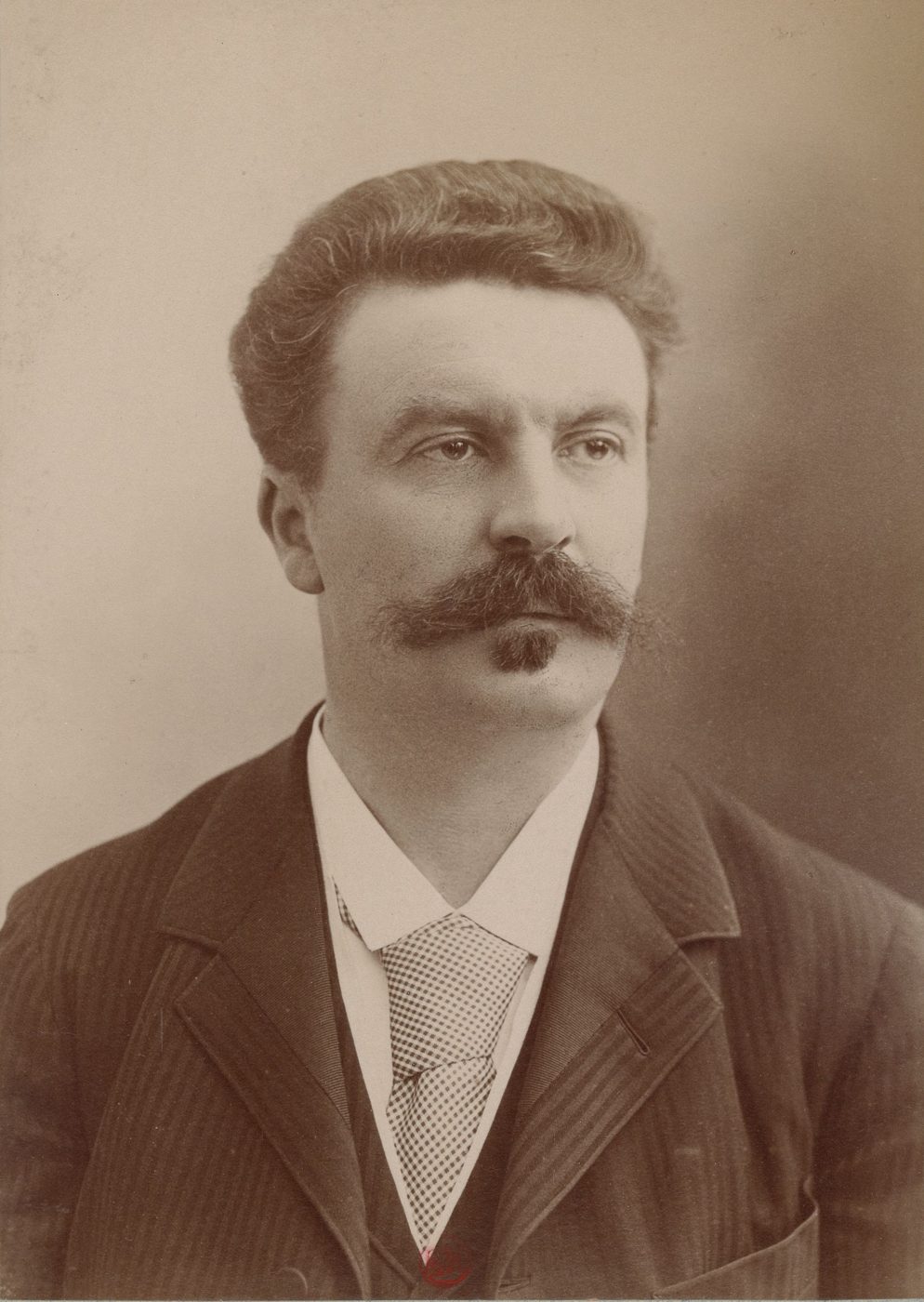
Image context: the cover uses a real archival photograph of Maupassant rather than a postcard of the Madeleine or a generic Paris street. That choice fits this guide because Bel-Ami is a novel of converted surfaces. A face, a pose, a name, a byline, a marriage, even a political article can all become exchangeable forms of entry.[3][6]
1) Start with appetite, not glamour
The novel opens with money trouble before it opens with romance. "After changing his five-franc piece Georges Duroy left the restaurant," and almost immediately we learn he has only three francs left for the rest of the month.[1] That beginning gives the book its true engine. Duroy is not first of all an erotic legend. He is a man organized by appetite, humiliation, and resentment, walking through Paris with the bearing of someone who believes he was meant for more than he can presently afford.[1]
This is why the boulevard material matters so much. Maupassant does not drop Duroy into Paris as a neutral backdrop. He places him amid cafes, restaurant smells, crowds, and visible money, so that the city itself feels like a menu from which he is excluded.[1] Read that way, his charm becomes easier to interpret. It is not mysterious charisma descending from nowhere. It is a survival instrument sharpened by scarcity.
So the first reading instruction is simple: do not let later polish erase the opening lack. Duroy keeps moving with the memory of being unable to pay for dinner. The social aggression of the novel begins there.[1][2]
2) Treat journalism as an access technology, not a profession of ideas
The decisive turn in the first chapter is not a love scene. It is the chance meeting with Forestier, who has become a journalist and brings Duroy toward La Vie Francaise.[1] The book is very exact about what this profession means. Forestier does not present journalism as noble truth-telling. He presents it as a place where assurance, improvisation, contacts, and usable prose can be converted into standing.[1]
That is one reason the novel still feels modern. The newsroom is not just where articles get written. It is where influence gets routed. Gallica's serialization note is useful here because it ties Bel-Ami directly to the press world in which it first appeared, serialized in Gil Blas between April 6 and May 30, 1885.[5] Maupassant had lived inside that world himself, and Britannica's author profile helps place the novel inside a career shaped by journalism, modern Paris, and naturalist observation.[3] The result is a novel in which the newspaper functions as switchboard, not shrine.
If you enter the book expecting a satire of "bad journalists" only, you miss the point. The sharper reading is that journalism gives Duroy a machine for multiplying whatever he already has: a presentable body, sham confidence, quick mimicry, and a willingness to let others supply the intelligence.[1][2][4]
3) Watch the women as the novel's intelligence network
New readers often summarize Bel-Ami as a story about a seducer using women. That is true, but it is not enough. The women are also the novel's infrastructure. Madeleine Forestier, Clotilde de Marelle, Mme. Walter, and Suzanne Walter do not merely provide erotic episodes; they provide writing help, social translation, emotional cover, money, legitimacy, and routes upward.[1][4]
The BnF's Bel-Ami page makes this unusually plain when it describes the novel as a homage to women who, although mistreated by Duroy, remain singular presences within the book's design.[4] That is a strong way to read the middle of the novel. Madeleine especially matters because she understands that information can be staged, revised, and circulated before Duroy fully does.[1][4] If you watch her closely, the novel stops being a simple rake's progress and becomes a study in borrowed competence.
This does not clean up the book's ugliness. Britannica is right to note both Duroy's calculation and the novel's casual prejudices.[2] But a good first reading should still refuse the lazy version in which women exist only as rungs on a ladder. They are also the minds, atmospheres, and tactical environments through which the ladder is assembled.[1][4]
4) Keep politics and colonial money in the same frame as desire
Another useful correction for first-time readers is to stop isolating the love plot from the political plot. In Bel-Ami, they are continuous. Britannica's summary notes that the paper is modeled on real publications backing French expansion in North Africa.[2] That matters because it places Duroy's rise inside a world where journalism does not simply report power; it helps excite and rationalize it.
The novel's atmosphere of speculation, maneuver, and ministerial gossip therefore belongs to the same system as seduction. Duroy is not alternating between public ambition and private appetite. He is learning that both can be managed through the same circulation of rumor, proximity, and opportunism.[1][2][5] Once that connection is visible, the book begins to read less like a morality tale about one scoundrel and more like a broader anatomy of a city in which publicity, politics, and desire have become mutually convertible.
This is one reason Maupassant remains harder than mere cynicism. He does not only say that Paris is corrupt. He shows how corruption acquires elegance, convenience, and ordinary rhythm.[1][2]
5) Read the ending as apotheosis without inward growth
By the time Duroy reaches the Madeleine to marry Suzanne Walter, the novel has made its argument with almost liturgical boldness.[1] The public scene looks like culmination, but the inner substance has not deepened. Duroy has acquired title, editorial power, and a more resonant name, yet he has not achieved anything like moral enlargement.[1][2]
That is why the closing social perspective matters. Even inside the spectacle, observers can still see what he is: "sharpers always succeed," Norbert de Varenne says.[1] A reader's guide should keep that line close, because it prevents the ending from turning into triumphant myth. Maupassant gives Duroy an apotheosis, but he refuses him dignity.
So the final reading instruction is this: do not ask whether Duroy deserves his success. The novel has already answered that. Ask instead what kind of society can turn such a man into its ideal surface. That question keeps the book alive after the plot is over.[1][2][4]
6) A practical route through the book now
If you want a clean first route through Bel-Ami, use this one:
- Read the opening boulevard scenes for hunger, posture, and exclusion before you make any judgment about charm.[1]
- Track every moment when journalism functions as access rather than as thought: introductions, proofs, invitations, gossip, political placement.[1][5]
- Watch Madeleine Forestier as carefully as Duroy. Ask who is really supplying form, language, and strategic intelligence in each step upward.[1][4]
- Read the women as a network of social translation rather than as a series of repeated conquests.[1][4]
- Keep the colonial and ministerial background active in your mind, because the paper's political role explains why sexual and financial opportunism carry such public yield.[2][5]
- Read the Madeleine ending against the opening three-franc poverty scene, and notice how much has changed in rank while how little has changed in substance.[1]
That route keeps Bel-Ami from shrinking into either a "timeless seducer" novel or a simple anti-press satire. Maupassant built something more exact. He wrote a book in which social ascent is assembled from visibility, borrowed skill, erotic leverage, and political weather, then gave that machine a hero whose emptiness is part of his efficiency. That is the best way into the novel now: not as a scandal with literary prestige added later, but as a pressure system that still feels uncomfortably current.[1][2][4]
Sources
- Guy de Maupassant, Bel Ami; Or, The History of a Scoundrel (Project Gutenberg HTML text).
- Encyclopaedia Britannica, "Bel-Ami" (novel overview, journalism context, and reception note).
- Encyclopaedia Britannica, "Guy de Maupassant" (biographical context, apprenticeship with Flaubert, and naturalist career).
- BnF Gallica Essentiels, "Bel-Ami" (work overview, Paris setting, journalism focus, and women in the novel).
- Gallica, "Bel-Ami en feuilleton" (serialization context in Gil Blas, dates, and press framing).
- Wikimedia Commons, "File:Maupassant par Nadar.jpg" (source page for the archival photographic portrait used as the article image).