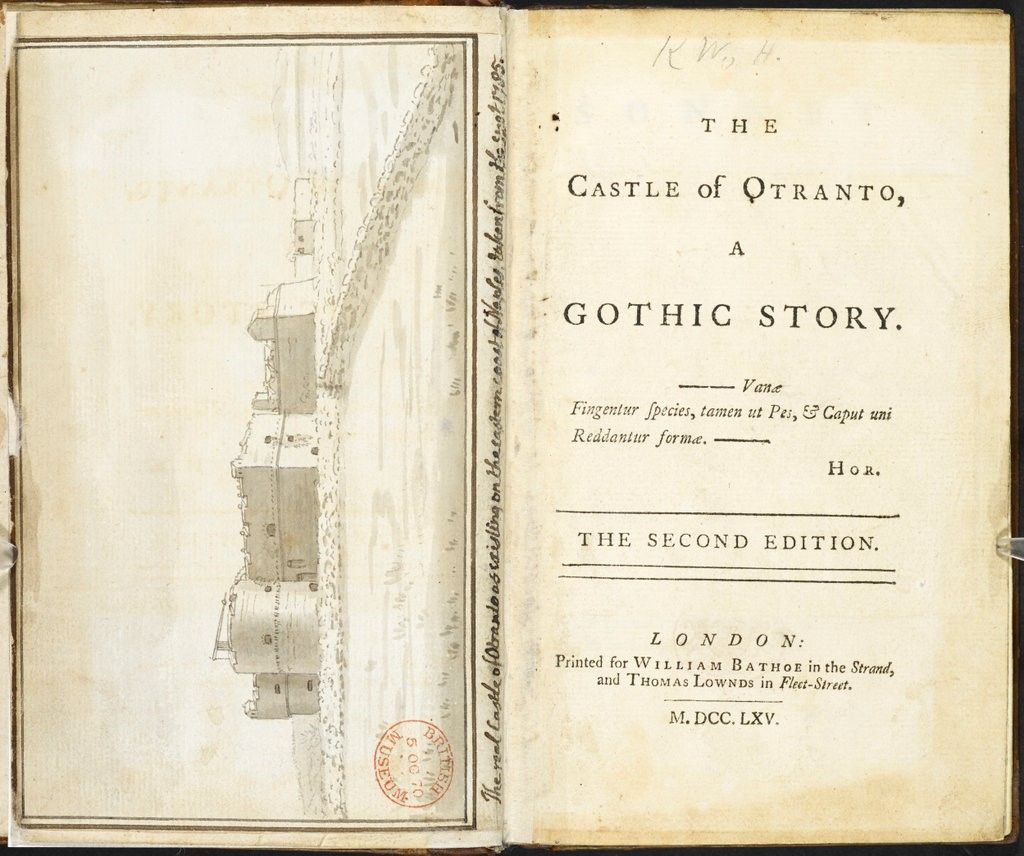
The first person to die in The Castle of Otranto is Conrad, a sickly fifteen-year-old dressed for his wedding. An enormous helmet falls into the courtyard and crushes him. Horace Walpole gives Manfred, Conrad's father and the castle's prince, every reason to break down: the dead boy was his favorite child, his only son, and the planned carrier of his name. Yet Manfred studies the helmet more intently than the body beneath it. Before the day is over, he has begun replacing the marriage that failed. He will discard his wife, Hippolita, and marry Conrad's intended bride himself.[1]
That turn is grotesque, but it is not random. Manfred's defining habit is to treat reality as a badly managed succession plan. A child becomes an heir, a bride becomes reproductive capacity, a wife becomes an obstacle, a witness becomes a traitor, and a castle becomes proof of ownership. When any of those roles stops working, he tries to rename the person or issue a stronger command.
The supernatural does not merely frighten this man. It exposes the limit of his grammar. Manfred can order servants, lock gates, invent charges, and dictate marriages. He cannot make a helmet human-sized, keep a portrait in its frame, or stop his house from disclosing the history buried inside its title.
Walpole first published the novel anonymously on Christmas Eve 1764, presenting it as a translation of a much older Italian manuscript. The second edition acknowledged his authorship and called the book “A Gothic Story.”[1][2] That counterfeit antiquity matters to Manfred's character. The novel itself arrives wearing a borrowed pedigree, while its prince spends three frantic days defending one. What looks like an improvised chain of shocks is also an exact study of a ruler who mistakes possession for legitimacy.
Before the helmet falls, he is already managing the future
Manfred's panic predates Conrad's death. The boy is visibly frail, but his father accelerates the wedding rather than reconsidering it. Hippolita's concern about marrying him so young receives an accusation about her failure to produce more sons. Meanwhile, tenants connect the haste to a prophecy: Otranto will leave the present family when the “real owner should be grown too large to inhabit it.”[1]
The prophecy is comic in its literalism and serious in its pressure. Manfred hears that his title has an expiration condition, then responds as though speed can outrun it. The wedding is not chiefly a relation between Conrad and Isabella. It is a hurried repair to the future.
When the helmet destroys that repair, Manfred converts grief into logistics. His attention fixes on the impossible object. He orders Theodore—the young stranger who notices that the helmet resembles the one on Alfonso's funerary statue—to be detained beneath it. Then he summons Isabella and reframes Conrad as a weak foundation on which he was foolish to depend.[1]
This does not prove that Manfred feels nothing. Walpole gives him stunned silence, obsessive looking, rage, and eventually ruinous remorse. The sharper point is that feeling reaches him through dynasty. Conrad's death is unbearable because it is a loss and because it breaks a line. Manfred cannot separate the child he favored from the office the child was meant to fill.
Every person becomes an office
Manfred's cruelty works by reassignment. Isabella has just ceased to be his son's bride, so he tries to make her his own. Hippolita has been wife and princess, but he now describes their marriage as invalid and her fertility as a curse. Matilda approaches to comfort him and is dismissed because, in the emergency he has defined, a daughter is not the child he needs.[1]
Theodore undergoes the same conversion by accusation. His observation about the helmet is awkwardly accurate: the object does resemble Alfonso's missing armor. Manfred calls the statement treason, then sorcery. The charge is useful because it makes evidence look like conspiracy and lets punishment arrive before explanation. Soon the crowd repeats its ruler's story. Command does not have to make the story plausible; it only has to make other people behave as if it were settled.
That habit gives Manfred his most revealing line. When Isabella points to the helmet's plumes as a warning against his proposed marriage, he answers, “Heaven nor hell shall impede my designs.”[1] The sentence is often read as pure Gothic bluster. It is also a compact theory of government. Manfred divides the world into his design and whatever impedes it. Conscience, kinship, law, omen, and another person's refusal all land in the second category.
This is why he is more interesting than a villain who simply disbelieves in ghosts. Manfred believes the signs immediately. He is frightened by them, understands that they concern his family, and still treats each one as a delay to be managed. His failure is not an absence of perception. It is the decision to subordinate what he perceives to the outcome he has already chosen.
The ancestor will not stay framed
The most elegant refusal occurs in the gallery. While Manfred advances on Isabella, a portrait of his grandfather Ricardo sighs, moves, and appears to “quit its pannel.”[1] Manfred stops his pursuit and follows. The painted ancestor leads him into the gallery, turns into a chamber, and shuts the door between them. Manfred tries to force it open, fails, then returns to what he calls the human means of preserving his race.[1]
The scene turns a family portrait against the work family portraits usually perform. Ricardo's image should stabilize lineage: the ancestor composed, framed, and available as visual proof that Manfred belongs where he stands. Instead, the picture leaves its assigned place. It will neither remain a credential nor give its descendant the usable private counsel he wants.
Manfred's response repeats his larger mistake. He recognizes the figure as his grandfather but asks why the ancestor is conspiring against him. Kinship, in his mind, should guarantee support even when the family claim is fraudulent. When the specter refuses access, Manfred does not reconsider the claim. He downgrades the event from revelation to obstruction and resumes the marriage scheme.
The Cambridge history of Walpole's Gothic places Otranto, the play The Mysterious Mother, and Strawberry Hill—Walpole's Gothic Revival house—inside the same taste for suggestive profusion, managed scale, and historically informed invention.[3] Yet Peter Lindfield's study of John Carter's later Otranto illustrations cautions against turning Strawberry Hill into a literal blueprint for the fictional castle.[4] That distinction improves the scene. Otranto is not a portrait of one house. It is a house behaving like a portrait that refuses to stay still.
Isabella knows a different castle
Manfred knows Otranto as a chain of vertical authority. He locks its gates, posts guards, sends servants, confines Theodore, and assumes that ownership gives him complete knowledge of movement inside the walls. Isabella knows it as a body with another circulation. She remembers a subterranean route from the vaults to the church of St. Nicholas, feels through darkness for the hidden mechanism of a trapdoor, and uses sanctuary as the boundary Manfred may not openly cross.[1]
Her escape does not make the castle liberating. The passage is frightening, her safety depends on a religious institution, and the wider plot still lets fathers and husbands bargain over women. But it reveals a kind of knowledge Manfred lacks. The person made vulnerable by the official plan has learned doors, hinges, shadows, and alternate exits. The ruler who claims the whole structure mostly knows how to seal its obvious gates.
Theodore enters through this counter-geography. First misrecognized as a peasant and magician, he helps Isabella find the spring, moves between castle and sanctuary, and eventually emerges as Alfonso's heir. Manfred repeatedly sees him and repeatedly assigns the wrong role. The mistake is political before it is genealogical: Manfred cannot imagine that a person beneath his notice might carry a claim larger than his own.
The body keeps getting bigger
The supernatural fragments arrive in a deliberate sequence. Conrad disappears beneath an ancestral helmet. Servants report a gigantic armored foot and leg in an upstairs room. A mailed hand appears where no human body could fit. At the climax, after Manfred has mistaken Matilda for Isabella and fatally stabbed his own daughter, the castle walls fall and the immense figure of Alfonso rises from the ruins to identify Theodore.[1]
The joke in the prophecy has become architecture. The rightful owner is literally too large for the stolen house. More importantly, the scale reverses Manfred's method. He has spent the novel shrinking people into functions he can move. The helmet reduces Conrad from son to failed succession. The divorce reduces Hippolita from partner to impediment. The forced marriage reduces Isabella from person to replacement. The sorcery charge reduces Theodore from witness to disposable culprit. Alfonso's expanding body makes reduction impossible.
Only then does the history of Manfred's title become fully speakable. His grandfather Ricardo poisoned Alfonso and used a false will to take Otranto. A vow to St. Nicholas postponed judgment for Ricardo's descendants, but never converted theft into right.[1] The apparently irrational hauntings therefore follow a severe documentary logic. A forged paper founded the dynasty; animated images and impossible armor reopen the record.
Manfred's last act of violence completes the exposure. Trying to prevent Isabella's union with Theodore, he kills Matilda—the final child of the line he meant to preserve. This is not fate operating without his participation. The prophecy supplies pressure, but his habit supplies the weapon. He has become so practiced at treating people as positions in a plan that, in the dark, one young woman can be substituted for another with fatal ease.
The castle corrects a title; it does not abolish one
It would be comforting to call the collapse simple justice. The book does not earn that comfort. Otranto rejects a usurper, but it does not reject hereditary rule. Alfonso names Theodore the true heir, Manfred yields the principality, and the surviving marriage plot carries property into a corrected line. Hippolita retreats to religious life; Isabella survives repeated attempts to exchange her between men; Matilda pays for her father's recognition with her life.[1]
The castle's moral intelligence is therefore narrower than its visual grandeur. It can distinguish false title from true title. It cannot imagine a world in which the women endangered by both claims should decide what the castle is for. Walpole's early Gothic patriarch became durable partly because later Gothic fiction could keep revising that imbalance: the gloomy house, pursued woman, predatory ruler, and disputed past proved portable far beyond this short novel.[2][3]
Manfred does finally confess the origin of his power and accept exile. His remorse matters; without it he would be a mechanism, not a character. But recognition comes only after every material support for denial has been removed—son, daughter, portrait, walls, and title. He tells the truth when command has nothing left to command.
That is why the book's most memorable character may be inseparable from its architecture. Manfred calls Otranto his house, yet he never learns to read it. He mistakes locked gates for knowledge, inheritance for legitimacy, and an imperative sentence for control. All the while, the building is enlarging the evidence around him until ownership becomes the one claim it can no longer contain.
Sources
- Horace Walpole, The Castle of Otranto (1765 text with editorial introduction and page images), University of Virginia, Literature in Context—prefaces and Chapters I–V used for textual quotation, scene order, and publication framing.
- British Library, “‘Spine-tingling’ stories in the ‘blood-curdling’ British Library” (29 October 2025)—publication history and photographed opening of Walpole's annotated 1765 copy, shelfmark C.40.c.24.
- Stephen Clarke, “Horace Walpole and the Gothic,” in The Cambridge History of the Gothic, vol. 1 (Cambridge University Press, 2020)—Walpole's fiction, Strawberry Hill, and the early Gothic's literary afterlife.
- Peter Lindfield, “Heraldry and the Architectural Imagination: John Carter's Visualisation of The Castle of Otranto,” The Antiquaries Journal 96 (2016)—the novel's architectural imagination, heraldry, illustrations, and the limits of a literal Strawberry Hill–Otranto link.