Many readers remember Jane Eyre through its largest plot devices: the red-room, the governess romance, the attic secret, the interrupted wedding, the moorland collapse, the final return.[1][2] Those events matter, but they can also make the novel seem more sensational than it really is. Charlotte Brontë's deeper method is repetitive and exact. She keeps sending Jane through the same small set of objects and spaces until they become a moral grammar. Fire, windows, and roads are the clearest part of that grammar. Each one appears early, then returns with altered weight, so that Jane's development can be felt not as abstract "growth" but as a changing relation to heat, outlook, and movement.[1][4]
That pattern helps explain why the book felt new in 1847. Britannica's summary of the novel's first publication still gets the essential point right: Brontë gave the Victorian novel unusual truthfulness by making a woman's inner life structurally central rather than decorative.[2] The motifs matter because they are one way Brontë binds that inward life to the material world. Jane Eyre is not only narrated in the first person; it is arranged so that rooms, weather, corridors, hearths, panes of glass, and strips of road keep taking the pressure of thought.[1][2][4]
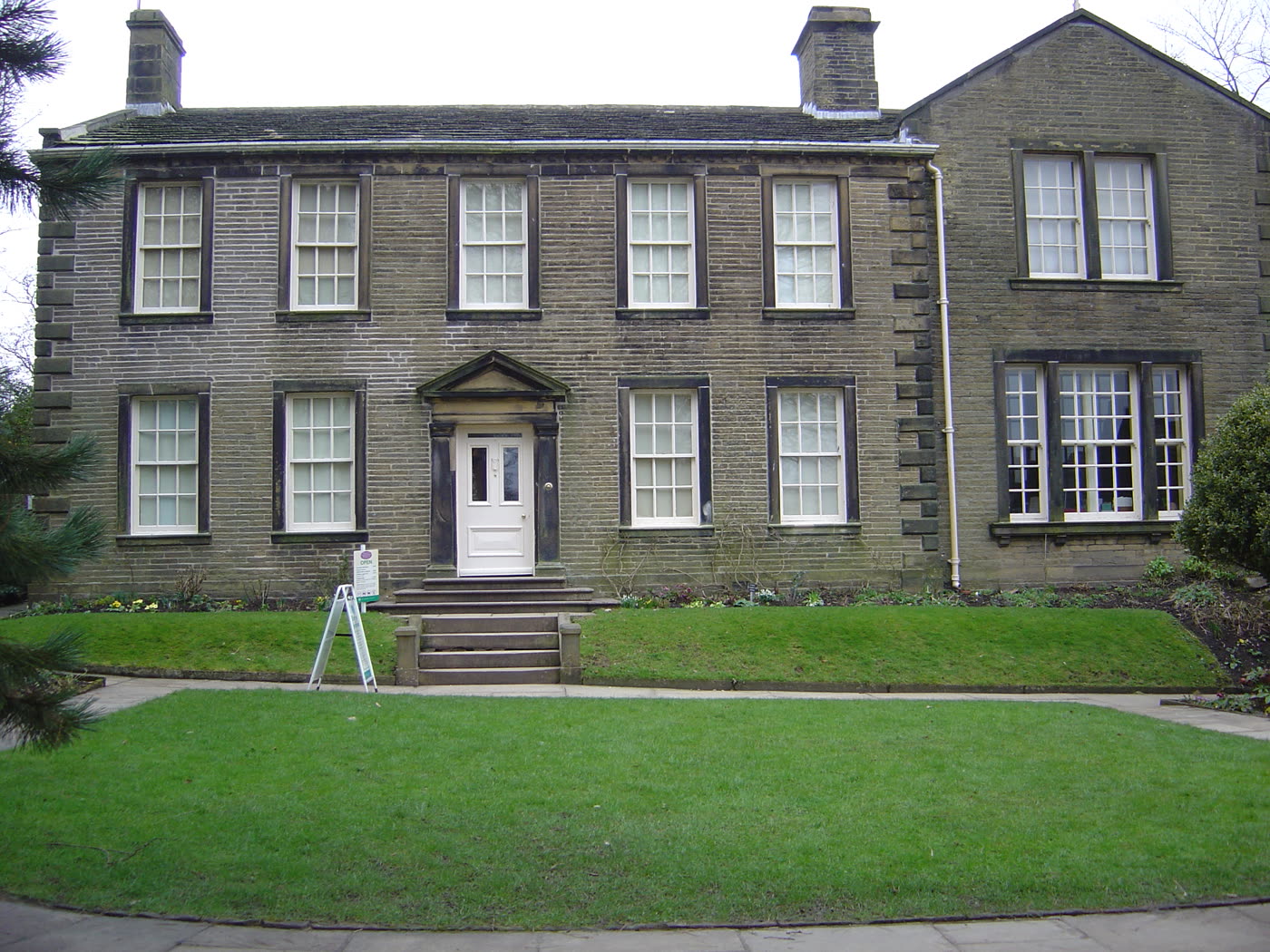
Image context: the cover uses a real photograph of the Brontë Parsonage Museum in Haworth rather than an illustration from an adaptation. That choice fits this essay because the novel's symbolic system is architectural from the start. The Brontë family's house and Haworth setting belong to the book's imagination of inward rooms pressed against open moorland, an opposition the museum still foregrounds when presenting the family's life and work.[3][5]
1) Fire is the novel's most unstable measure of feeling
The first great chamber in the book is memorable not because it is merely red, but because it is cold. Jane tells us of the red-room, "This room was chill, because it seldom had a fire," and that detail matters as much as the curtains and carpet.[1] Brontë makes punishment feel physical by separating color from warmth. The room glows visually while denying comfort. Fire is therefore introduced not as simple domestic refuge, but as a missing permission: the child is surrounded by the signs of grandeur and shut out from the heat that would make the space human.[1]
That logic returns throughout the novel. Firesides can create brief shelter, as they do in Lowood's kinder intervals or in scenes where Jane is admitted to temporary conversation.[1] But Brontë keeps refusing to let fire settle into a purely cozy symbol. At Thornfield, flame belongs equally to intimacy and danger. Rochester's magnetism is repeatedly figured as warmth, force, or dangerous energy, and the house's hidden crisis eventually breaks out through literal burning. Before that final catastrophe, Rochester himself gives the image away when he says, "To live, for me, Jane, is to stand on a crater-crust which may crack and spue fire any day."[1] The line turns passion into geology. The house is already a volcano before the flames appear.
This is why fire in Jane Eyre is never only romantic. It can warm, expose, tempt, threaten, or destroy, often within the same chapter. Brontë uses it to ask what kind of heat Jane can live beside without being consumed by it.[1][4] The answer is not abstinence. Jane is not written as a heroine of emotional refrigeration. But she refuses forms of warmth that require self-erasure. Fire must become inhabitable, not merely exciting.
2) Windows teach Jane how to convert enclosure into vision
If fire measures temperature, windows measure distance. The book opens with Jane in a window-seat, folded into a curtained edge-space with a book, already half inside and half outside the Reed household.[1] That is a model for the novel's whole technique. Jane is often enclosed, but Brontë gives her a line of sight before she gives her freedom of action. Windows become the places where desire is clarified into form.
Lowood offers the cleanest example. Looking outward, Jane sees the "hilly horizon," traces "the white road," and decides that everything within the boundary seems "prison-ground, exile limits."[1] The important point is not just that she longs to leave. It is that longing becomes legible through framing. The window does not free her; it teaches her what freedom would have to look like. Brontë repeatedly stages consciousness this way. Glass creates a visible border, and Jane learns to read borders before she crosses them.[1][4]
Windows also prevent the novel from collapsing into pure inwardness. At Thornfield, mirrors and window-lines multiply snow, candlelight, and hall-space into reflective surfaces, so that perception itself feels staged.[1] Jane is frequently looking from edges: doorways, stair landings, school windows, garden outlooks. She is a watcher long before she can become an actor. That matters because Brontë's first-person method depends on disciplined observation rather than emotional spillage alone. Cambridge's chapter on Jane Eyre's style captures part of this balance in its keywords: rhetoric, control, passion.[4] Windows are one of the novel's devices for holding those forces together. They allow feeling to intensify without yet spending itself in action.
Even the famous declaration "I am no bird; and no net ensnares me" comes after this training in outlook.[1] Jane can say it with force because the novel has already taught her how nets, bars, blinds, curtains, and panes organize her field of vision. The line lands not as a sudden slogan of freedom, but as the verbal culmination of many earlier framed scenes.
3) Roads appear when inward judgment hardens into action
Roads in Jane Eyre are different from windows because they require consequence. A window lets Jane imagine departure; a road makes departure costly. That is why roads arrive with such force at turning points. At Lowood, Jane sees the road first as a line of possible release.[1] Later, after she leaves Thornfield, Brontë strips movement down to a near-biblical starkness at Whitcross, "where four roads meet."[1] The signpost scene is one of the novel's hardest pieces of symbolic writing because it refuses to romanticize freedom. Four roads do not mean abundance. They mean exposure, hunger, anonymity, and the absence of instruction.[1]
This is the pattern the novel keeps insisting on: movement becomes real only after Jane has refused a compromised shelter. She leaves Gateshead, leaves Lowood, leaves Thornfield, and each departure is morally distinct.[1][2] The roads matter because they externalize judgment. By the time Jane reaches the moor, the novel has already converted interior refusal into physical displacement. She is no longer standing behind glass, but on open ground with no guarantee of rescue. The whiteness and breadth of those roads are therefore double-edged. They promise direction and make visible how alone she is.[1]
Brontë sharpens the effect by setting road against moor. The road is a human line cut through openness; the moor is a field of unbounded exposure that can briefly shelter Jane only by reducing her to bare creaturely need.[1][3] When she sleeps in the heather after Whitcross, the fantasy of free motion has emptied out into exhaustion. Yet that scene is also necessary, because it tests whether Jane's independence is merely rhetorical. She survives the road only by paying its price.
4) Why the three motifs belong together
Taken separately, each motif is memorable. Taken together, they describe Brontë's whole design. Fire asks what kind of feeling can be endured. Windows ask how desire becomes sight. Roads ask whether judgment can survive contact with the world.[1][4] The novel's plot keeps recombining them: a heated room with no safety, an outlook with no exit, a road with no provisions, a home regained only after the old fire has burned through illusion.[1]
This is also why Jane Eyre remains so readable. It is often called Gothic, romance, or bildungsroman, and all three labels fit in part.[2] But Brontë's real strength is that she never lets those large categories float free of concrete recurrence. She makes Jane's ethical life trackable through things: a blind drawn down, a hearth lit or withheld, a path seen from above, a signpost where no one waits. The novel's symbols are not ornaments laid over the action. They are the action's recurring physical terms.
Read that way, Jane Eyre does not simply tell the story of a woman finding self-respect. It teaches the reader how to notice when an interior decision has become worldly fact. First the room changes temperature. Then the horizon acquires shape. Then a road has to be taken. That sequence is one reason the novel still feels alive: Brontë makes freedom visible before she makes it available, and then charges dearly for the moment when Jane finally steps out to claim it.[1][2][4]
Sources
- Charlotte Brontë, Jane Eyre (Project Gutenberg ebook and full text).
- Encyclopaedia Britannica, "Jane Eyre" (publication history, summary, and analysis).
- The Brontë Parsonage Museum, "The lives of the Brontës" (family, Haworth, and house context).
- Cambridge University Press, "Jane Eyre's Style" in On Style in Victorian Fiction (chapter landing page and citation metadata).
- Wikimedia Commons, "File:Bronte Parsonage Museum.JPG" (photograph used as cover image, uploaded from a 2006 photo).