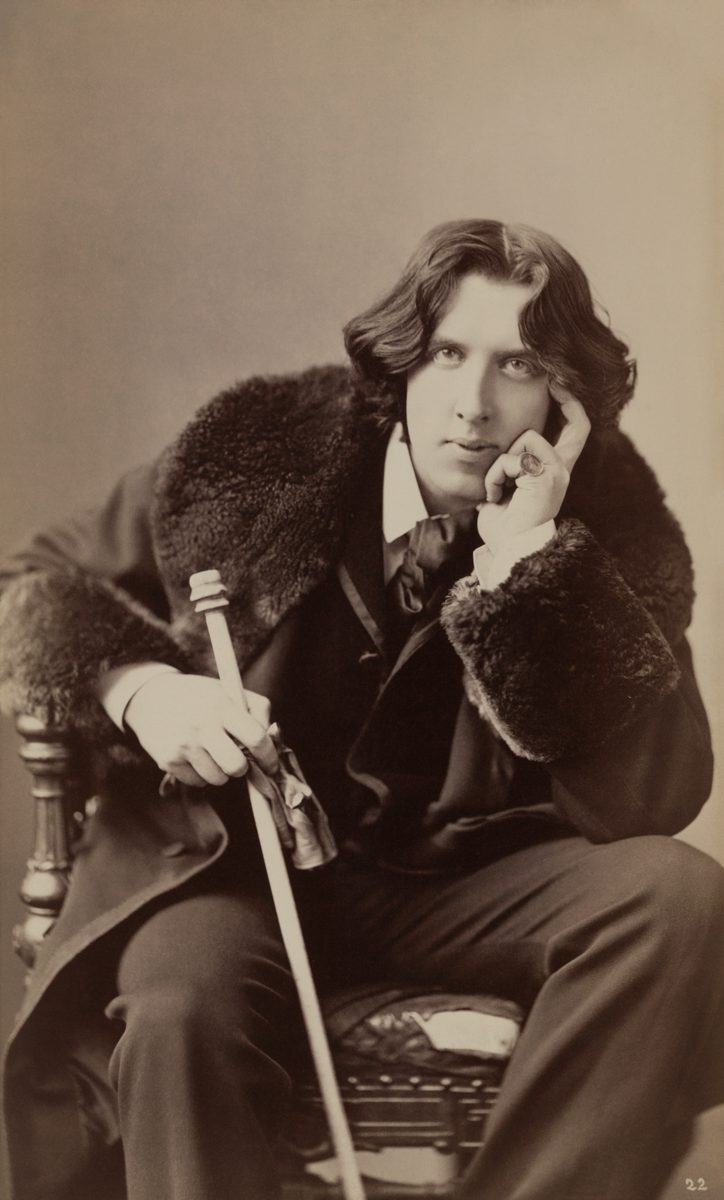
Some plays survive because they carry immortal characters. Some survive because they contain a plot flexible enough to be moved between eras. The Importance of Being Earnest survives for a narrower and more difficult reason: its real machinery is verbal speed.[1][2] Wilde built a comedy in which names, alibis, reversals, and tonal pivots matter more than scenic realism, so the piece keeps reviving whenever directors understand that language is the action, not ornament.[1][3]
That is why the play's afterlife is both rich and fragile. Earnest can tolerate different costumes, different degrees of camp, and different levels of explicit queer coding. What it does not tolerate well is drag in the engineering. Once a production begins treating the play as a genteel period property instead of a precision name-machine, the laughter slows down and the satire loses pressure.[1][4][5]
The lead image helps keep that distinction in view. A real Sarony studio portrait of Wilde is useful here because the play's reputation is so wrapped in cucumber sandwiches, handbags, and drawing rooms that the author can disappear behind his own props.[6] The point of the article is that the afterlife only works because Wilde made those props subordinate to timing.
Wilde built a plot that runs on phrases, not furniture
The text itself says so almost immediately. Algernon's paradoxes are not decorative icing on a conventional Victorian plot; they are the plot's operating system. When he declares that "The truth is rarely pure and never simple," Wilde is not merely being quotable.[1] He is announcing the play's working rule: sincerity will always arrive entangled with performance, convenience, and style.
That is why the central joke about "Ernest" travels so well across generations. The name is absurdly thin as evidence of character, yet the whole erotic and social machinery of the play keeps pretending that it is decisive.[1][2] Gwendolen and Cecily do not simply fall for men; they fall for a sound, a label, a credential made out of phonetics. Wilde turns identity into something that can be worn, borrowed, and misfiled. Adaptation loves this because it is already theatrical in the text. A production does not need to invent disguise. The script begins with disguise as a social technology.
The manuscript history makes the same point from another angle. Wilde first called the play Lady Lancing, then kept reshaping it, and in his scenario notes stressed that the "real charm" had to lie in the dialogue while the plot remained slight but sufficient.[3] That is an unusually clear instruction for later adapters. Do not overburden the mechanism. Keep the line alive, keep the reversals sharp, and let the apparent triviality generate the pressure.
The play outlived Wilde because it detached from biography without becoming empty
There is an obvious temptation to read Earnest only as the glittering preface to catastrophe: it premiered in 1895, just before the prosecution and imprisonment that shattered Wilde's public life.[2] That biographical framing matters, but it is not enough to explain the work's durability. As the British Library essay argues, the play led an "independent life" beyond Wilde's downfall and kept generating later theatrical descendants and rewritings.[2]
That independence is one sign of artistic strength. The play is historically specific, saturated with 1890s manners, but it is not trapped there. Bunburying is social code that can easily reopen inside later vocabularies of secrecy, reinvention, and doubled identity.[1][2][5] Lady Bracknell remains legible because bureaucratic absurdity never goes out of date. The lovers remain funny because desire is still embarrassingly vulnerable to branding, fantasy, and self-invention. Wilde wrote a period comedy, but he did so by building social stupidity out of reusable parts.
That is also why queer readings have remained productive without exhausting the play. The closet is not pasted onto Earnest from outside. The piece already runs on aliases, cover stories, split selves, and the unstable border between what society calls respectable and what people actually want.[1][2][5] Modern productions can foreground that structure more openly than Victorian staging could, but they are amplifying a current that was already present in the design.
Adaptation works when directors protect the tempo
The strongest test of the play's afterlife is not whether it can be modernized. It plainly can. The harder test is whether an adaptation can expand the world without diluting the velocity. Peter Bradshaw's review of Oliver Parker's 2002 film is useful precisely because it names the failure mode so cleanly: the film rises briefly, then turns heavy.[4] That judgment matters less as a verdict on one movie than as a diagnosis of the adaptation problem. Earnest is not nourished by added bustle for its own sake. It needs compression.
This is why the stage has usually remained its natural habitat. Theatre keeps words in the foreground and allows the absurdity of etiquette to emerge through rhythm rather than scenic explanation. A recent National Theatre revival, reviewed in The Guardian in November 2024, pushed the play's queer doubleness outward with contemporary playfulness, yet it still worked because the lines stayed crisp and the production preserved a balance between fidelity and mischief.[5] That balance is exactly the point. Wildness without timing becomes mugging. Fidelity without lightness becomes museum theatre.
Wilde himself planted the deeper principle in Lady Bracknell's line that "In matters of grave importance, style, not sincerity" is what counts.[1] The joke survives because the play is cruelly accurate about social performance. Respectability in Earnest is not a moral achievement. It is a costume contest conducted through phrasing, bearing, and paperwork. Later productions succeed when they keep that recognition quick enough to sting.
Why the play still feels new
The afterlife of Earnest has less to do with heritage charm than with the play's understanding of how flimsy identity can be when institutions reward surfaces. A country house, a christening plan, an invented invalid friend, a misplaced handbag, a good name: none of these should be enough to reorganize a life, yet in comedy they continually are.[1][2][3] Wilde makes that absurdity elegant instead of solemn, which is why the play can move from 1895 to 2002 to 2024 without losing its pulse.[2][4][5]
That is also why overdecorated adaptations so often miss. The work is not a porcelain object asking to be dusted. It is a trap made of polished speech. The modern test is simple. If a production lets the language cut faster than the upholstery can settle, Earnest lives. If the furniture wins, Wilde's machine starts to stall.[1][3][4][5]
Sources
- Oscar Wilde, The Importance of Being Earnest: A Trivial Comedy for Serious People. Project Gutenberg text.
- John Stokes, "An introduction to The Importance of Being Earnest." The British Library.
- Wilde Manuscripts, "The Importance of Being Earnest" manuscript and composition history.
- Peter Bradshaw, "The Importance of Being Earnest." The Guardian review of the 2002 Oliver Parker film.
- Arifa Akbar, "The Importance of Being Earnest review – Ncuti Gatwa leads a Wilde party of irresistible anarchic charm." The Guardian review of the 2024 National Theatre revival.
- Wikimedia Commons, "File: Oscar Wilde by Napoleon Sarony. Three-quarter-length photograph, seated.jpg."