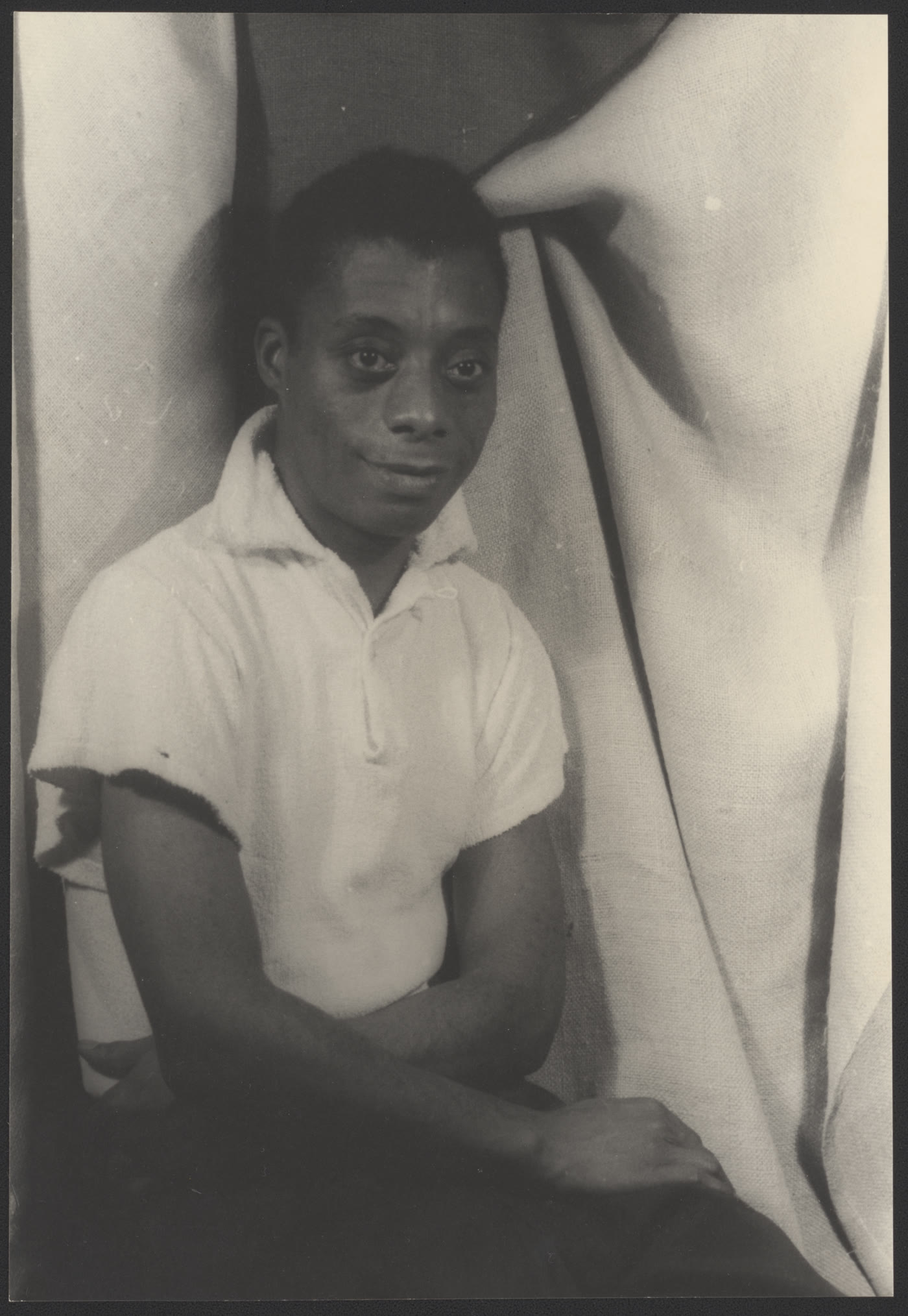
James Baldwin still feels unusually close. Many major twentieth-century writers remain authoritative at a distance: one goes to them for diagnosis, for vision, for historical range. Baldwin certainly offers all of that, but his deeper power comes from another register. He makes public argument feel like intimate address. The sentence does not merely announce a position on America, race, religion, desire, or violence. It moves toward the reader until those matters feel morally near, almost unavoidably personal.[1][2][7]
That quality helps explain why Baldwin keeps surviving reduction. He is often introduced through one role at a time: civil-rights essayist, Black witness, expatriate novelist, queer precursor, public intellectual.[1][2][7] All true, but too separable. Taken together, his novels, essays, speeches, and plays suggest a writer whose real signature lies in pressure of address. He learned early how voice could gather anguish, beauty, accusation, tenderness, and testimony into one line of movement, then spent decades making that movement usable in different forms.[2][7]
Image context: the cover uses Carl Van Vechten's real 1955 portrait photograph of Baldwin from the Library of Congress via Wikimedia Commons. That choice fits the article because Baldwin's literary force is inseparable from presence. Even on the page, he often feels less like a remote monument than like a person leaning into the conversation until evasion becomes difficult.[8]
1) The preacher never quite leaves the prose
One of the fastest ways to misread Baldwin is to treat the church only as background material. The church was also technical training. PBS's Baldwin biography notes that he became a teenage preacher and later said those years in the pulpit helped turn him into a writer.[7] That matters because the Baldwin sentence carries more than eloquence. It carries cadence learned under pressure: the rise of witness, the turn toward confession, the return of judgment, the insistence that speech must move bodies as well as minds.
This is why Baldwin's prose can sound ceremonious without becoming merely ornamental. Its biblical undertow is not there to decorate seriousness. It is there because he understood very early that language in American life had to compete with noise, fear, piety, fantasy, and self-protection.[1][7] A weaker writer might have kept the sermon and discarded the doubt, or kept the doubt and discarded the music. Baldwin keeps both. His pages often sound like someone trying to tell the truth in a room already full of evasive ritual.
That pressure also helps explain his unusual emotional range. Even when he writes with fury, the prose rarely settles for denunciation alone. The church taught him that speech can accuse and still reach toward transformation. Baldwin's greatest paragraphs therefore do two things at once: they expose damage and they keep asking whether another human arrangement remains possible.[1][2][7]
2) Go Tell It on the Mountain turns interior crisis into social weather
Baldwin's first novel remains the clearest entry into this method. Penguin Random House describes Go Tell It on the Mountain as his bestselling debut and a coming-of-age story, and that description is accurate so far as it goes.[2][3] What makes the book lasting, though, is that Baldwin never lets "coming of age" shrink into private maturation. In this novel, the soul is crowded by family history, storefront religion, erotic fear, racial hierarchy, and the wish to become someone other than the self assigned to you.[3][7]
That is the Baldwin move in concentrated form. He takes what could have been handled as autobiography and instead turns it into atmosphere. Harlem is not just where the story happens. It is the moral air the characters breathe. The church is not only doctrine or institution. It is rhythm, surveillance, promise, theater, inheritance, and hunger all at once.[3][7] Baldwin's gift is that he can make inner life feel completely exposed to social weather without flattening character into sociology.
Readers often remember the novel's intensity before they remember its structure. That is a sign of how well Baldwin fuses form and feeling. The book's inward pressure never drifts free of public conditions; every spiritual question already has a historical charge attached to it. Baldwin would keep varying that method for decades.
3) The essays make witness sound like a form of nearness
If the first novel teaches Baldwin's pressure system, the essays show how portable it was. Notes of a Native Son and The Fire Next Time remain central not simply because they say important things about America, but because they alter the distance at which those things can be said.[4][5] Penguin Random House frames The Fire Next Time as an intimate reflection on race and American nationhood.[5] "Intimate" is the crucial word. Baldwin does not write like a neutral analyst standing above the national scene. He writes from inside the wound and still refuses the comforts of local grievance alone.
That is why the essays stay so live. Baldwin can move from memoir to prophecy, from family scene to national judgment, without making the transitions feel opportunistic.[4][5][7] The reader experiences the public argument as a test of relation: how people inherit damage, how innocence gets manufactured, how love and power distort each other, how a nation arranges distance from what it has done. He keeps the scale large, but he never lets the reader hide inside abstract scale.
Taken together, these essay books show Baldwin's unusual confidence in the second-person moral field, even when he is not literally writing "you." He writes as though history is always arriving between persons. That is one reason his essays do not age into museum rhetoric. They continue to feel addressed.
4) Giovanni's Room proves Baldwin refused the assignment others preferred for him
No Baldwin profile is complete without the risk represented by Giovanni's Room. Penguin Random House describes it as a groundbreaking novel set among the bars and nightclubs of 1950s Paris, a book about love and the fear of love.[6] Its continuing shock lies partly in the fact that Baldwin wrote it at all, and partly in the clarity with which he refused a narrow mandate. He would not accept the idea that a Black American writer had only one permissible territory, one valid subject, one authorized form of seriousness.
This is where Baldwin's courage looks formally literary, not only socially admirable. Giovanni's Room widens the profile of what Baldwin could do with shame, desire, exile, and self-deception.[6][7] It also clarifies something essential about the rest of the work. Baldwin never separated race from embodiment in the tidy way institutions often prefer. He understood that fear enters language through the body, through longing, through the arrangements people make in order not to know themselves too clearly.
That does not make Giovanni's Room an outlier. It makes it diagnostic. The novel reveals that Baldwin's deepest subject was never race in isolation, or sexuality in isolation, or nationality in isolation. His deeper subject was what human beings do to one another when they cannot bear freedom, exposure, or love at close range.
5) Why Baldwin still matters
Baldwin's permanence comes from this fusion of witness and nearness. Britannica calls him one of the twentieth century's most important voices on race in America, and that judgment holds.[1] But "voice" matters here in the strongest sense. Baldwin did not merely supply opinions that later generations can agree with, disagree with, or excerpt for commemorative use. He built a prose instrument capable of keeping moral life from drifting into distance.[1][5][7]
That is why he still reads with such heat. He does not let the nation become a topic safely parked outside the self. He does not let intimacy become private escape from history. He does not let beauty exempt a sentence from responsibility. The best Baldwin writing keeps all three domains under one pressure system. Public life enters the room. Personal life loses its alibi of innocence. Language itself becomes a test of whether one can get nearer to truth without fleeing into slogan or performance.
An author profile, then, should finally begin there. Baldwin matters because he brought the sentence physically close to the reader and made that closeness carry history. The achievement is aesthetic, moral, and civic at once. Very few writers can say so much while also sounding as if the stakes have just arrived.
Sources
- Encyclopaedia Britannica, "James Baldwin."
- Penguin Random House, "James Baldwin" (author page).
- Penguin Random House, Go Tell It on the Mountain by James Baldwin.
- Penguin Random House, Notes of a Native Son by James Baldwin.
- Penguin Random House, The Fire Next Time by James Baldwin.
- Penguin Random House, Giovanni's Room by James Baldwin.
- PBS American Masters, "James Baldwin Biography and Quotes."
- Wikimedia Commons, "File:Jamesbaldwin.jpg" (source page for the lead photograph).