The Sun Also Rises is often reduced to a kit of recognizable elements: Paris cafes, drinking, bullfights, damaged love, the Lost Generation.[1][2][3] All of that is in the book, but Hemingway's deeper technical achievement lies elsewhere. He writes as if emotional expenditure has become scarce. Jake Barnes narrates through surfaces, errands, prices, train rides, bottles, hotel rooms, and clipped exchanges, while the wound governing the novel stays partly offstage.[1] The result is not emptiness. It is a prose economy in which feeling survives by becoming harder to declare.
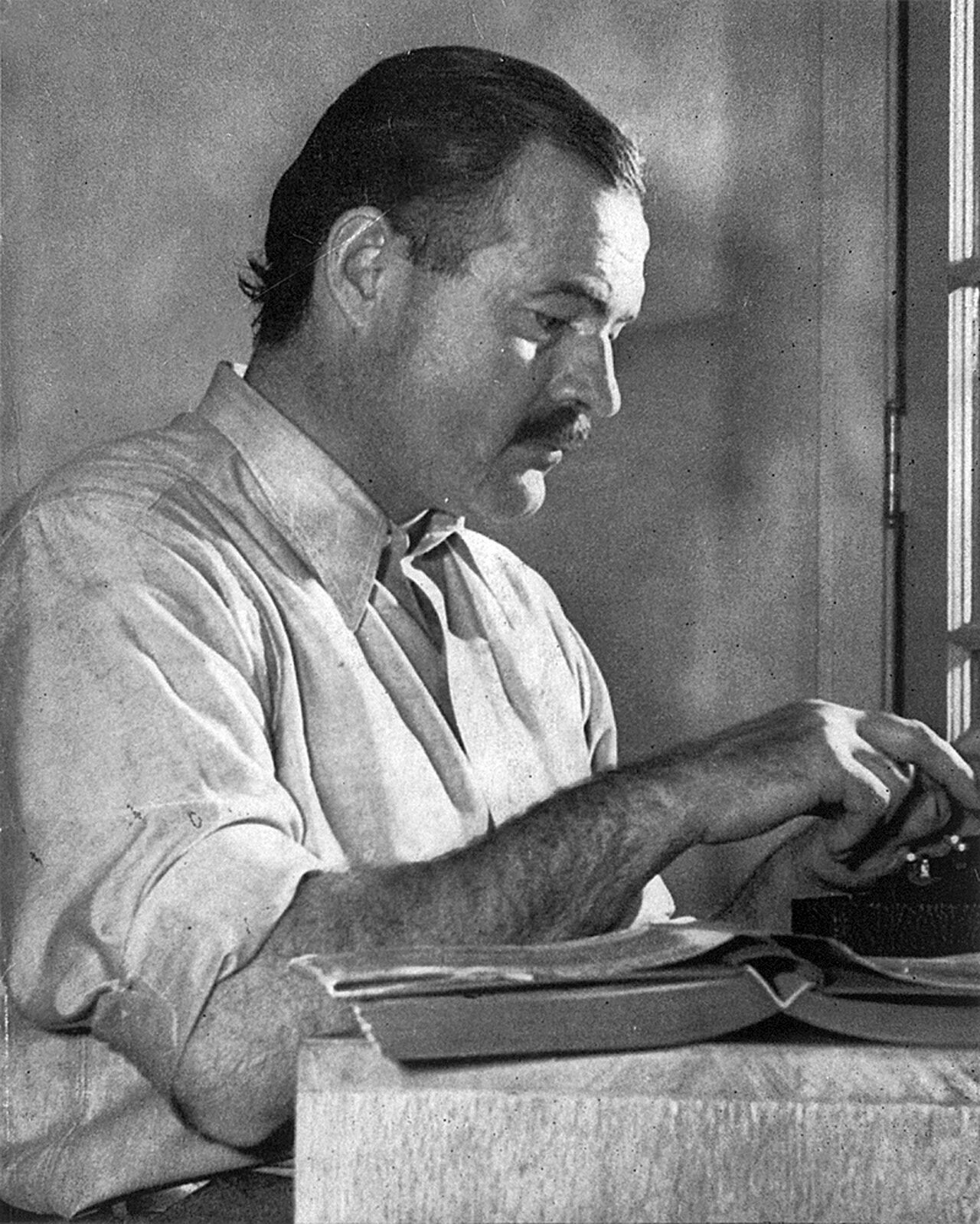
Image context: the cover uses a real archival Hemingway portrait from Wikimedia Commons. That choice suits the article because the novel has long been overshadowed by the public Hemingway legend of toughness and appetite. The book itself is more exacting than that legend. It keeps asking what happens when injury, humiliation, and desire can still organize a life even after direct statement has started to fail.[6]
1) Jake's voice begins by distrusting clean stories
The opening pages do not start with Jake's injury or with Brett. They start with Robert Cohn, and that matters.[1][2] Jake begins by summarizing Cohn in a brisk, apparently social way: boxing title, flattened nose, money, marriage, literary ambition. Yet the paragraphing keeps undercutting the very confidence it seems to display. Early on Jake says, "I mistrust all frank and simple people," and that sentence functions like a quiet manifesto for the whole novel.[1] Hemingway is telling the reader that surface coherence is already suspect.
This is one reason the style feels sharper than the later caricature of Hemingway as merely blunt. Jake's prose is plain, but it is not naive. He observes through understatement, qualification, and tonal sidestep.[1][3][4] He can sound factual while quietly poisoning the fact with irony. He can make a person visible in a few efficient details while also revealing the narrator's reluctance to let anyone, including himself, become transparent. The book's famous simplicity therefore works less like purity than like controlled leakage. Information gets through, but not in a stable or fully trustworthy form.
That method matters because The Sun Also Rises is full of people trying to narrate themselves into shapes they can bear: romantic hero, tragic lover, sporting man, modern woman, detached observer.[1][2] Jake's style never lets any of those identities settle for long. The language keeps shaving off self-dramatization while leaving pain intact.
2) The wound governs the novel by omission
The central fact of Jake's life is a war injury that has altered his relation to sex and to futurity, but Hemingway refuses to turn that fact into a speech of explanation.[1][2][3] Instead, the novel lets the wound appear as a force field. It bends dialogue, pacing, jealousy, and fantasy. Characters circle it, speak around it, test its edge, and then retreat into banter, travel, or intoxication.[1]
That is why the Paris sections matter so much. Readers who treat them as glamorous drift often miss their structural work. The repeated taxis, cafes, bottles, restaurant tables, and late-hour conversations are not decorative filler. They are the novel's method for showing how damaged people keep a social world running without ever fully mastering what has damaged them.[1][2] Jake can still arrange dinner, money, routes, tickets, introductions, and departures. He remains competent in the world of logistics. Emotional life, by contrast, arrives as interruption, recoil, or stale repetition.
In that sense Hemingway's restraint is not an aesthetic pose laid over the material. It is the material. The stripped sentence registers a postwar condition in which public movement continues while private continuity has been broken.[2][3][4] Jake does not lack feeling. He lives in a world where feeling has become difficult to spend without shame, self-deception, or collapse.
3) Pamplona is not a cure; it is a pressure chamber
When the novel moves to Spain, the prose does not open into therapeutic release. It gets harsher by staying controlled.[1][5] Pamplona supplies ritual, speed, spectacle, crowd rhythm, and a grammar of courage, but none of these things repair the emotional injuries the characters bring with them. They only make those injuries legible under stronger light.
This is where the book's reputation for "action" can be misleading. The fiesta and the bullfights certainly energize the narrative, and they mattered profoundly to Hemingway's imagination beyond the novel itself.[5] But in literary terms Pamplona functions less as escape than as concentration. Rivalries that looked manageable in Paris become undeniable. Desire stops diffusing into chatter and starts attaching itself to bodies, timing, and risk. Jake's narration stays spare through all of this, which is precisely why the escalation feels convincing.[1] If Hemingway had swollen into lyric release here, the book would have broken its own contract. Instead he lets ritual intensity meet verbal control.
That tension is the novel's real atmosphere. The world is noisy, crowded, and overfull. The sentences keep refusing excess. So the reader feels pressure without receiving full confession. Pamplona becomes a machine for exposing what the characters cannot stabilize in language.
4) Why the last line still lands
The novel's closing exchange between Brett and Jake is famous because it sounds graceful and defeated at once.[1][2] When Brett says that they "could have had such a damned good time together," Jake answers, "Isn't it pretty to think so?"[1] The line works because the whole book has prepared its exact emotional scale.
If Jake answered with bitterness, the ending would narrow into accusation. If he answered with romantic surrender, the novel would sentimentalize its own knowledge. "Pretty" does something finer. The word grants the beauty of the imagined alternative even as it keeps that alternative inside thought rather than life.[1] It is tender, but the tenderness arrives already separated from possibility.
That is the moral intelligence of the sentence. Jake does not expose Brett, absolve himself, or pretend that desire can be converted into wisdom. He simply gives the wish its proper grammatical container: not fact, not plan, not future, but thought. After a novel built from partial statements and managed surfaces, the last line feels less like a flourish than like the cleanest available measure of loss.
5) The book still feels modern because it ties style to damage
Britannica and the Nobel biography both emphasize Hemingway's lucid, succinct, stripped-down prose, and those descriptions are accurate as far as they go.[2][3][4] What The Sun Also Rises shows, however, is that style here is not a detachable brand. It is a moral adaptation to historical damage. The book discovers that after collective catastrophe, people may go on moving, desiring, joking, spending, and traveling while their language grows wary of full declaration.
That is why the novel still reads as more than period atmosphere. Its world has 1920s surfaces, but its deeper rhythm remains recognizably modern: public performance continues, private injury persists, and speech becomes most revealing at the points where it declines to say everything.[1][2] Hemingway's real accomplishment is not hard-boiled cool. It is the discipline of making omission carry weight. Jake Barnes keeps the sentence lean because the novel knows abundance of feeling does not guarantee abundance of sayable words.
Sources
- Ernest Hemingway, The Sun Also Rises. Project Gutenberg ebook 67138.
- Encyclopaedia Britannica, "The Sun Also Rises."
- Encyclopaedia Britannica, "Ernest Hemingway."
- The Nobel Prize, "Ernest Hemingway - Biographical."
- The Hemingway Society, "Hemingway's Pamplona Legacy, Part I."
- Wikimedia Commons, "File:ErnestHemingway.jpg" (source page for the lead photograph).