At the inn door, Robert Louis Stevenson has a problem his good manners cannot solve. He and his companion are wet, carrying rubber bags, and looking like men who sell things on the road. A landlady supplies the description: “These gentlemen are pedlars?” Another lodging produces the same question. By the third repetition, the travelers begin to wonder whether the village knows something they do not.[1]
The joke in An Inland Voyage depends on a gap between the person speaking and the person everyone else sees. Stevenson’s narrator can turn a muddy walk into an idyll, furnish a supper with classical references, and make the reader feel personally welcomed. None of those accomplishments guarantees him a bed. The voice becomes most interesting when its social assurance fails.
Published in 1878, the book recounts the canoe journey Stevenson made through Belgium and northern France with Walter Grindlay Simpson in 1876. They travel as the Arethusa and the Cigarette, taking their boats’ names into the narrative.[2] That playful renaming prepares a holiday from ordinary identity. The innkeepers provide a less agreeable version of the same freedom.
A correction that leaves the first word standing
In the chapter “At Pont-sur-Sambre,” the repeated question about pedlars works like a refrain. Each new speaker reduces the travelers to the same readable signs: damp clothes, portable baggage, an arrival on foot. Meanwhile, the narrator’s cultivated account keeps insisting on the distinctions those speakers cannot recognize. We hear both versions of him at once.[1]
Then supper complicates the injury. The supposed pedlars receive a better meal than the laborers beside them. Stevenson begins to explain the advantage of being a gentleman, interrupts himself with “I beg your pardon,” and substitutes the identity the inn has assigned him.[1] The correction preserves the original claim on the page. He relinquishes the word while ensuring that his reader has heard it.
That small verbal maneuver gives the scene its uncomfortable comedy. The narrator wants credit for recognizing the absurdity of class distinctions; he also wants us to know where he ordinarily belongs. An apparently casual aside can accommodate both desires. His self-mockery is persuasive because it exposes an embarrassment that a smoother account might conceal.
The steak sharpens the embarrassment. Eating better than the people at the same table does not produce the satisfaction he might have expected. He remembers the schoolboy who keeps his birthday cake to himself.[1] The comparison briefly changes his position: he becomes the unpleasant child in someone else’s memory. What began as an account of being undervalued becomes an admission that privilege can look greedy from the next chair.
Yet the correction has limits. Reflecting on the traveling merchant who joins the company, Stevenson retains little reservations about manners and trustworthiness.[1] The warmth does not erase the grading. His conversational voice lets generosity and condescension occupy the same paragraph, without quite making peace between them.
When the reader gets sent outside
At La Fère, the prose first makes a feast out of anticipation. The travelers approach a bright kitchen, imagining dinner and comfortable beds while rain falls on people outside. Stevenson recruits us into their expectations through smells, light, and the noise of dishes. Then the landlady orders them out.[1]
The change is audible. Instead of leisurely observation, the narrator turns to exclamations and questions. He challenges the reader: “Try it; try it only once.”[1] The first-person traveler suddenly needs a second person to undergo his humiliation. We are asked to leave our safe position beside the storyteller and stand at the rejected guest’s shoulder.
This is also where his sweeping moral observations become least detached. Anger at a particular woman expands into anger at society. The speed of that expansion matters. A narrator who can make an entertaining principle out of almost anything now demonstrates how readily principles follow an injured appetite. His rage gives the argument energy while making its origin impossible to overlook.
The Cigarette undergoes a similar change, veering between curses and compassion for actual pedlars.[1] The pair’s distress is real, but the distinction remains: they can eventually recover the social standing whose absence has startled them. The scene offers a temporary loss of protection, with all the insight and limitation that temporary experience carries.
The kindness the bill cannot price
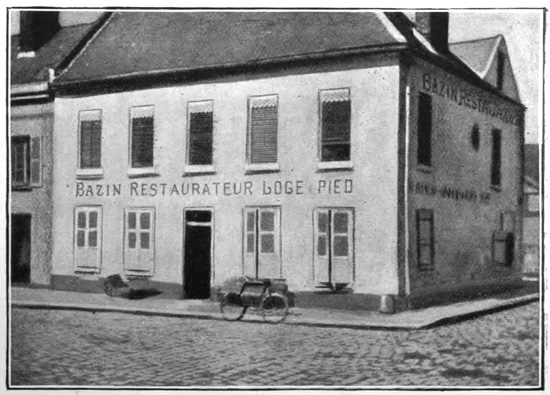
The Bazins’ welcome changes the pace again. At their inn, conversation can settle around work, museums, marriage, and fatigue. Stevenson notices the couple’s affection. The sentences have room to observe someone besides the offended traveler.[1]
Still, his gratitude contains an admission. Their courtesy restores “our position in the world.”[1] It is an extraordinarily revealing object for kindness to restore. He has gained sympathy for the excluded, but he is also relieved to feel recognizable again. Reading the voice closely means allowing both responses to remain audible.
Early readers did not agree about the value of this conspicuous personality. Frank Swinnerton’s R. L. Stevenson: A Critical Study faults the book’s vanity and effortful manner, while praising the naturalness of the companion’s portrayal.[4] The objection deserves attention: charming self-observation can become another way of keeping oneself at the center. But those visible efforts also let us notice where the charm stops working.
Hammerton’s 1907 account supplies a pleasing sequel. Following the route, he visits Madame Bazin, now widowed, and discovers that Stevenson had sent the couple his book. A young friend at college had translated their passage for them; they knew how warmly their guest had remembered the welcome.[3] The people who supplied the traveler with an episode had become readers of his account. His thanks had made a second journey.
Within Stevenson’s chapter, the voice ends by wondering whether the Bazins, too, felt repaired by his thanks.[1] The later gift lets them know his feelings; those closing questions leave their own experience open. After so much skill at telling us what an encounter means, the polished traveler pauses before someone else’s answer. The book he sent to La Fère would carry his words back through the door.
Sources
- Robert Louis Stevenson, An Inland Voyage (1878), text of the 1904 Chatto & Windus edition, Project Gutenberg — especially “At Pont-sur-Sambre” and “La Fère of Cursed Memory.”
- Robert Louis Stevenson Archive, “An Inland Voyage, 1878” — publication context, the 1876 journey, and the travelers’ boat names.
- J. A. Hammerton, In the Track of R. L. Stevenson and Elsewhere in Old France (1907), Project Gutenberg — “Along the Route of ‘An Inland Voyage,’” section XVI, and the photograph “The Bazins’ Inn at La Fère.”
- Frank Swinnerton, R. L. Stevenson: A Critical Study (Martin Secker, 1914), Project Gutenberg — “Travel Books,” pages 44–46, on the narrator’s self-consciousness and Simpson’s portrayal.