A woman is dying inside a drop of water, and the man watching her has never paid closer attention. He studies her face, follows the weakening movements of her limbs, and wishes he could shrink himself enough to reach her. Only after hours of this anguished scrutiny does he look away from the microscope. The drop on the slide has almost evaporated.[1]
The ending of Fitz-James O’Brien’s “The Diamond Lens” turns on that change of focus. Linley, its narrator, has built an instrument capable of revealing an otherwise invisible world. His achievement has enlarged what he can see without teaching him how to attend to another life. The distinction is especially cruel because the practical knowledge he needs was already his.
Published anonymously in the January 1858 Atlantic Monthly, the story helped make O’Brien’s name. Wayne R. Kime places it within the writer’s growing interest in individual consciousness and his responsiveness to contemporary enthusiasms, including spiritualism.[2] Its impossible microscope belongs to that mixture of inquiry and marvel. Its account of absorption requires no belief in the apparatus.
The discussion below includes the ending.
An appetite with instruments
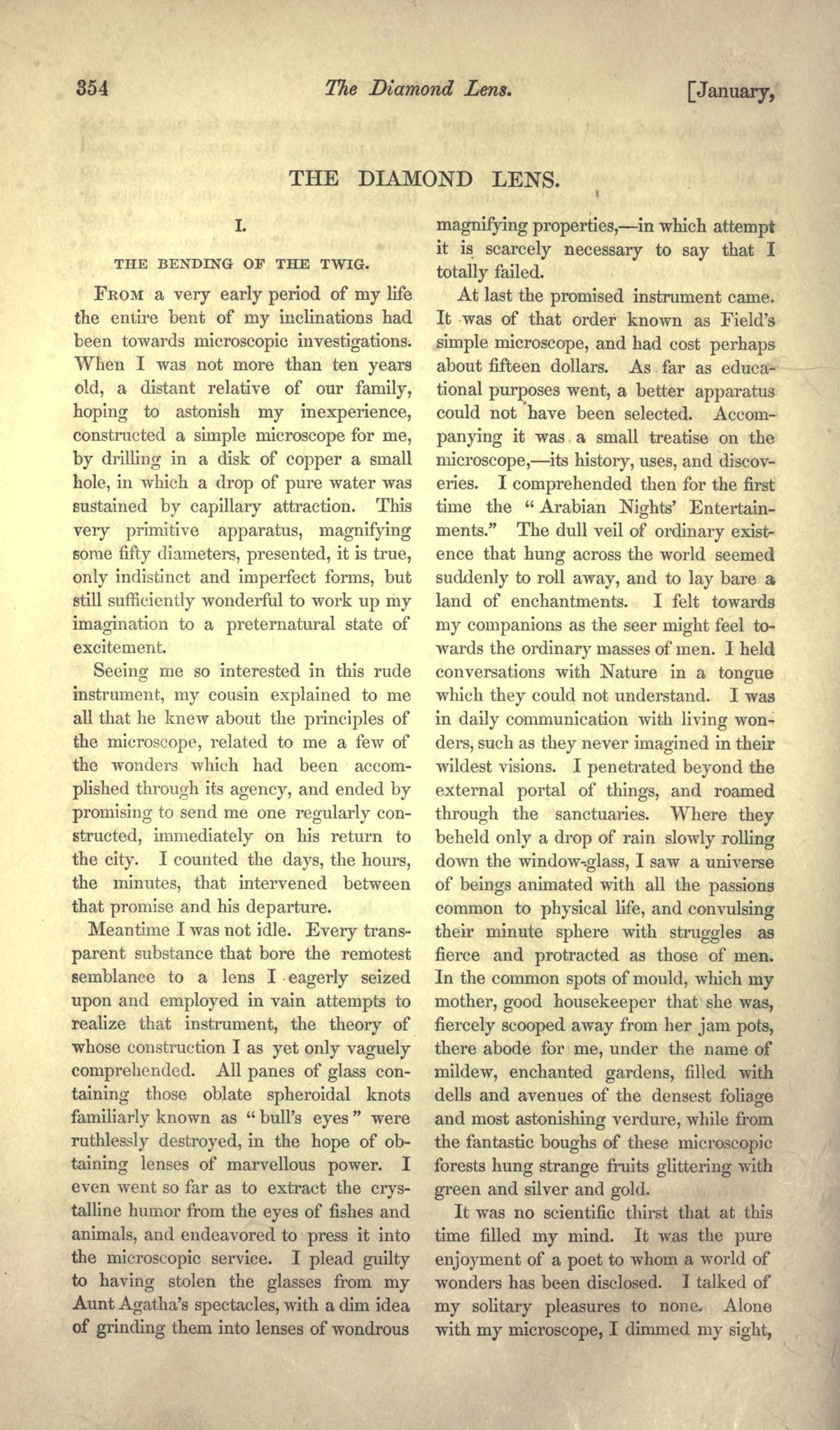
Linley’s childhood enthusiasm is wonderfully persuasive. Under magnification, the mold his mother removes from jam becomes a luxuriant landscape. Ordinary matter opens into color and movement. O’Brien gives discovery the pleasure of reading a fairy tale: another world has been waiting inside this one.[1]
Yet possession accompanies the pleasure from the beginning. The boy breaks glass in search of lenses and steals his aunt’s spectacles. He imagines keeping his discoveries entirely to himself. The aunt loses an aid to seeing so that he can extend his own sight. That small injury establishes a pattern before the story asks us to confront its much larger consequences.
Linley eventually acquires patience and technical skill. Section II records the awkwardness of owning equipment he cannot yet use, followed by sustained practice.[1] This matters to the story’s moral pressure. He has real capacities; his problem cannot be dismissed as incompetence. The discipline that makes him an accomplished observer coexists with a conviction that his wishes deserve exceptional treatment.
His visit to a medium carries that conviction into a new register. The purported spirit of Leeuwenhoek tells him how to construct a perfect lens from a large diamond. Linley asks whether he is destined to accomplish the task and receives the answer he wants.[1] The séance supplies both a method and a flattering story about himself. A difficult project becomes an appointment with greatness.
The life outside the lens
To obtain the diamond, Linley murders his acquaintance Jules Simon. His account of the decision invokes the “interests of science,” reducing another person’s life to an obstacle in the path of discovery.[1] The reasoning becomes more chilling as it becomes more orderly. He calculates how to stage the death as suicide with the same practical concentration he brings to his instruments.
The passage also relies on antisemitic dehumanization. Linley first speculates that Simon is Jewish, then uses that assigned identity contemptuously while justifying the killing. His suspicion becomes part of his permission to dispose of someone. The story gives us this reasoning through the murderer’s own voice; the prejudice is evidence of how he makes a victim seem expendable.
Simon’s account of acquiring the gem introduces another act of dispossession: he says he took it after watching an enslaved worker conceal it in a Brazilian diamond operation.[1] Linley uses Simon’s admitted wrongdoing to appoint himself judge. Nothing in that judgment acknowledges the worker’s position or challenges the violence surrounding the stone. He takes the account as a convenience.
When the next section calls the murder “Simon’s catastrophe,” the wording quietly moves responsibility away from the speaker.[1] A deliberate act has become a disaster that happened to someone else. This verbal evasion prepares the later tragedy. Linley can describe his own agency with extraordinary precision and still arrange the description around his innocence.
A gaze that cannot be returned
Through the completed lens, Linley discovers the being he names Animula. The prose slows into an extravagant inventory of light, hair, movement, and color. Its beauty is part of the trap: the reader is invited to enjoy the revelation whose cost the narrator has already disclosed.
His new attachment does not bring remorse. Watching Animula, he explicitly accepts the bloodshed that purchased the sight.[1] Admiration has made his earlier reasoning more fervent. Someone else’s life remains an acceptable price for an experience he finds incomparable.
What torments him is the one-way nature of the encounter: “she never, never could behold me!”[1] The repeated word makes recognition sound like the missing reward. He longs to become someone in her world, to leave a memory there. Meanwhile, her independent movements become material for his own story. When she disappears into the foliage, he imagines a lover calling her away, though he has heard no call.
O’Brien complicates the supposed helplessness. Linley can alter the light reaching the slide. When he dims it, he reports distress on Animula’s face; when he restores it, he reads delight.[1] He cannot converse with her, and his interpretations remain unverifiable. But he already has power over her surroundings. His inability to enter her world does not make him irrelevant to its conditions.
The fatal oversight grows from this confusion. Before the first examination, Linley coats the water drop with oil of turpentine to slow evaporation. Later, he avoids inspecting the drop itself because it reminds him of their separation: “I hated to see it.”[1] The ordinary object has become emotionally intolerable. He keeps looking through it until he forgets to look at it.
The story does not establish which intervention would certainly have saved Animula. It does establish that evaporation was a known concern and that the observer neglected the material setting of everything he adored. His grief is intense; its intensity supplies no substitute for care.
The observer becomes a spectacle
The story’s early reception included an argument about ownership of its central invention. Lehigh University’s Vault at Pfaff’s records a February 1858 newspaper exchange over the allegation that O’Brien had borrowed the plot from William North.[3] Kime describes the ensuing controversy as helping bring the previously anonymous author into public view.[2] The microscopic world was memorable enough to become the object of a literary dispute.
Its durability, however, rests on more than the ingenious premise. H. Bruce Franklin’s entry in The Encyclopedia of Science Fiction locates the story’s strength in its examination of the would-be solitary scientific genius.[4] Read from that perspective, Linley’s extraordinary instrument exposes an ordinary moral failure: he treats the value of other lives as something his own desires can determine.
The last scene adds an uncomfortable turn. Impoverished and distressed, Linley gives lectures to young men who pay him so they can laugh at him.[1] He has become someone else’s absorbing spectacle. That reversal punishes him, but it also makes the audience’s pleasure look ugly. The story leaves us watching a person who once watched another being suffer. We have seen exactly how much attention can coexist with indifference.
Sources
- Fitz-James O’Brien, “The Diamond Lens” (1858), sections I–VI — full text, Project Gutenberg; original magazine appearance and image provenance, The Atlantic Monthly, volume 1, January 1858, pp. 354–367, University of Toronto copy, Internet Archive, opening page
- Wayne R. Kime, preface and introduction to Thirteen Stories by Fitz-James O’Brien: The Realm of the Mind (University of Delaware Press, 2012), pp. xi–xvi — literary context, anonymous publication, and the authorship controversy; publisher preview PDF.
- Lehigh University, The Vault at Pfaff’s, “‘The Diamond Lens’—A Literary Controversy” — catalogue record and abstract of the New York Times exchange of February 26, 1858.
- H. Bruce Franklin, “O’Brien, Fitz-James,” The Encyclopedia of Science Fiction, updated February 17, 2025 — the story’s place in science fiction and its treatment of the solitary genius.