The first chapter of Hard Times is so famous that it can look simpler than it is. A man walks into a schoolroom, demands "Facts," and becomes the novel's emblem of educational brutality.[1] That summary is correct as far as it goes, but it misses why the passage keeps its bite. Dickens is not only saying that imagination matters. He is showing, in miniature, how a whole social order begins by deciding what kind of description counts as knowledge, who gets to speak, and which human qualities will be treated as waste.[1][2][3]
That is why the opening still feels larger than a topical satire on Victorian pedagogy. Britannica's account of the novel emphasizes industrial dehumanization and the damage done by a strictly pragmatic upbringing.[2] Victorian Web's introductions sharpen the same point by placing Gradgrind inside the utilitarian and industrial logic Dickens wanted to expose.[3][4] But the opening chapter is more precise than a general attack on "mechanical education." It stages a struggle over naming. Before Coketown's mills darken the horizon, before Louisa and Tom carry the damage into adult life, the novel shows a classroom where language itself has been put under discipline.[1]
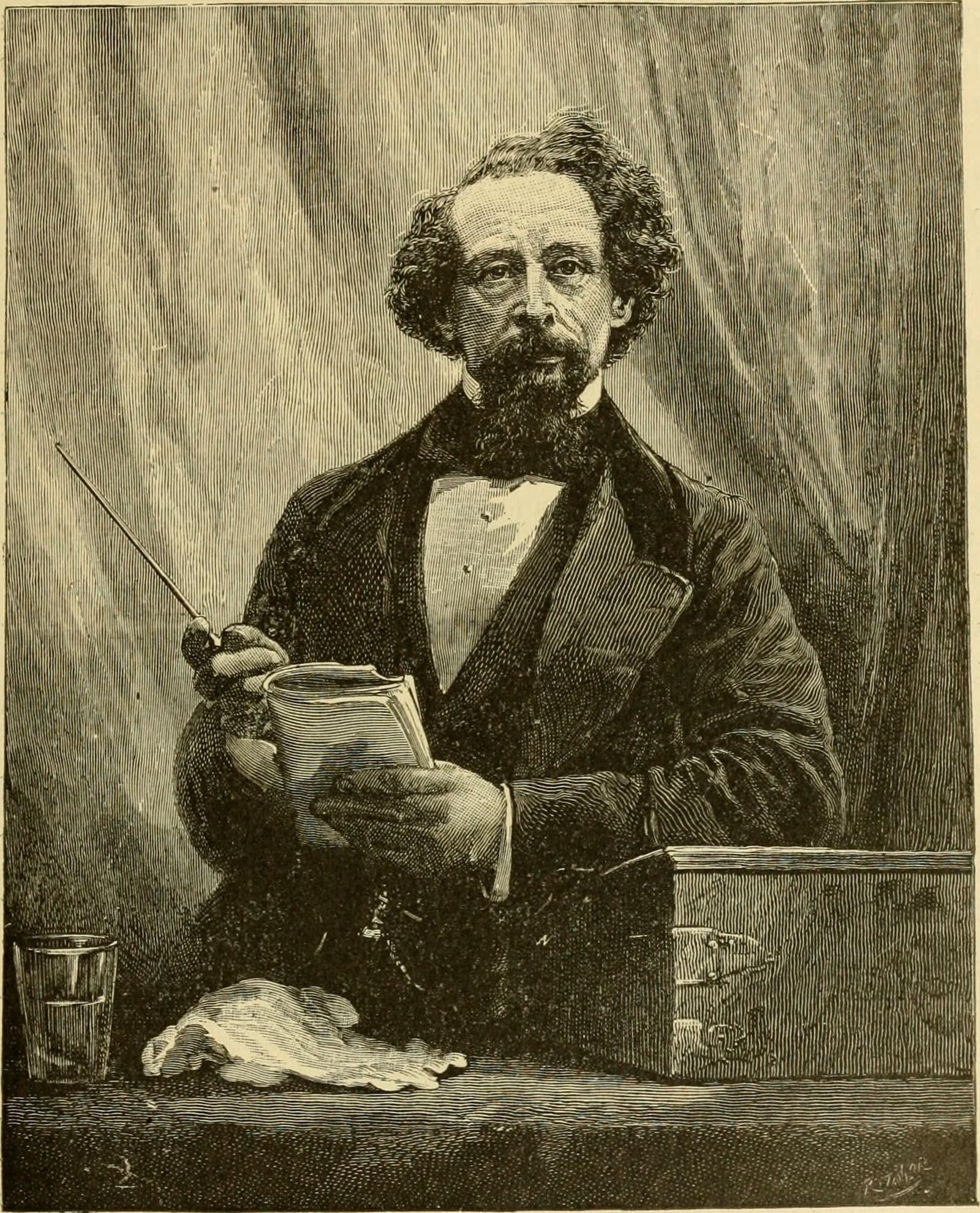
Image context: the cover uses a real archival photograph of Dickens rather than a generic schoolroom prop or a decorative stack of Victorian books. That choice keeps the emphasis on the writer's observational authority, which matters here because the passage is a battle over who has the right to describe the world and what kind of seeing gets called intelligence.[5]
1) Gradgrind begins by turning children into categories
The violence of the passage begins before anyone answers a question. Dickens gives us a room stripped into hardness: plainness, measured lines, an atmosphere of pressure rather than curiosity.[1] Then Gradgrind speaks, and the key move is not merely that he prefers facts. It is that he treats children as containers for preselected content. Knowledge is imagined as insertion, not encounter. The classroom becomes a delivery system.
That is why the command "Facts" lands so hard.[1] It is not just a preference for accuracy. It is a refusal of any mental activity that cannot be standardized in advance. Dickens makes the demand sound like a factory order because he wants the reader to feel a continuity between the schoolroom and the industrial order outside it.[1][3] The children are being prepared for a world in which utility will be defined from above, and the first lesson is grammatical before it is economic: the powerful decide which nouns, which descriptions, and which tones are legitimate.
Gradgrind's manner reinforces the point. Victorian Web's reading of him as a figure of nineteenth-century utilitarian confidence is useful here, but in the passage itself he is even more chilling because he behaves like a man who thinks he has already abolished ambiguity.[4] He does not enter the room to discover what these children know. He enters to close the range of permissible knowing.
2) Sissy Jupe's horse matters because it reveals a fight over who may describe the world
The famous horse exchange is often summarized as a contest between wrong feeling and right definition. Dickens is after something sharper. Sissy Jupe is the circus child, the girl whose knowledge comes from handling, watching, naming, and living among performing animals.[1] Yet when she is asked to define a horse, that kind of lived familiarity is treated as disqualification rather than competence. The problem is not that she lacks contact with reality. The problem is that her reality does not arrive in the approved register.
Dickens makes this cruelty visible by renaming her. She becomes "Girl number twenty."[1] That reduction is one of the opening's essential strokes. A child with a family, a trade background, a history, and a texture of speech is converted into an index position. Once that happens, the later demand for an abstract definition stops being a neutral classroom exercise. It becomes the proof that the system first empties the person, then calls the result objectivity.
Bitzer's answer, by contrast, is correct in the approved sense because it is bloodless. He can supply taxonomic properties and anatomical inventory; he knows how to produce the sort of statement the room rewards.[1] Dickens does not deny that the details are factual. What he exposes is the social fantasy that such language is therefore sufficient. A horse can be broken into features and still not have been imaginatively or humanly understood. The novel's complaint is not against fact. It is against the shrinking of fact into a form that flatters administrative power.
3) The anti-fancy lesson is itself staged like a piece of bad theatre
One of Dickens's slyest decisions is that the opening condemns spectacle by becoming a spectacle. Gradgrind is all emphasis, posture, pointing, arrangement.[1] The schoolroom runs on staging: the ordered benches, the inspection of bodies, the public test, the demonstration of correct method. Dickens does not give us dry argument against anti-imaginative education; he dramatizes its rituals until they begin to look absurdly theatrical.
That is why Hard Times opens with more comedy than many first readings admit. The prose is clipped and emphatic, but it is also performative, full of exaggerated confidence and carefully exposed pomposity.[1][4] Dickens lets the rhetoric of utility overplay itself. The result is that Gradgrind's regime appears as a kind of counterfeit realism. It prides itself on banishing fancy, yet it depends on a fantasy of its own: the fantasy that measurement, enumeration, and approved vocabulary can produce complete human knowledge.
Victorian Web's contextual material on the novel's background helps here because it shows how closely Dickens linked industrial modernity to a degraded account of education and social value.[3] But the passage does not read like a tract. It reads like a scene in which the novel discovers that abstraction can itself become a melodrama. The classroom is supposedly dedicated to plain truths, yet everything in it is overdetermined, ceremonial, and coercively staged.
4) Why this little scene still governs the whole novel
The opening lasts in memory because it contains the book's largest argument in compressed form. Hard Times will go on to show damaged adulthood, instrumental marriage, managerial callousness, labor conflict, and the narrowing of sympathy under industrial pressure.[1][2][3] But the schoolroom matters because it shows where that damage begins. It begins with a pedagogy that mistakes domination for clarity.
Sissy Jupe survives in the novel not because Dickens proves her factually superior, but because he makes her the bearer of an unflattened relation to the world.[1] She stands for memory, responsiveness, and forms of intelligence that do not arrive pre-stripped for administrative use. Bitzer, Gradgrind, and M'Choakumchild are more than satirical names. They are guardians of a linguistic regime in which people become legible only when they become thinner.
That is why the passage still feels modern. Every age produces institutions that praise evidence while quietly narrowing what may count as experience. Dickens saw that the danger begins very early, at the level of naming and description. Whoever gets to define the horse will soon define the child. Whoever defines the child will eventually define the worker, the citizen, and the limits of pity. The opening of Hard Times survives because it understands that the coldest social systems are built sentence by sentence.[1][2][3][4]
Sources
- Charles Dickens, Hard Times (Project Gutenberg HTML text).
- Encyclopaedia Britannica, "Hard Times" (publication context, industrial critique, and plot overview).
- Philip V. Allingham, "An Introduction Charles Dickens's Hard Times for These Times (1854): Background to the Novel." Victorian Web.
- Philip V. Allingham, "Who Is Thomas Gradgrind in Dickens's Hard Times for These Times?" Victorian Web.
- Wikimedia Commons, "File:Charles Dickens portrait.jpg" (source page for the archival photograph used as the article image).