Virgil's opening line is so famous that English can start hearing it as a solved phrase: "arms and the man."[1][2][3] Yet the line keeps its force because it is not only a label for the Aeneid. It is a compact piece of ordering. War comes first. The human figure comes second. The singer arrives only at the end. In six Latin words, the poem announces scale, inheritance, and burden before Aeneas has even reached Italy.[1][4][5]
That order matters more than many loose paraphrases allow. The Aeneid is often summarized as Rome's founding epic, and Britannica is right to stress that the poem joins Aeneas to Roman greatness and organizes itself across wandering and war.[4][5] But Virgil does not begin by saying "I sing of Aeneas" or "I sing of Rome." He begins with arma, then virum, and only then cano.[1] Translation lives or dies on how much of that sequence it can keep audible.
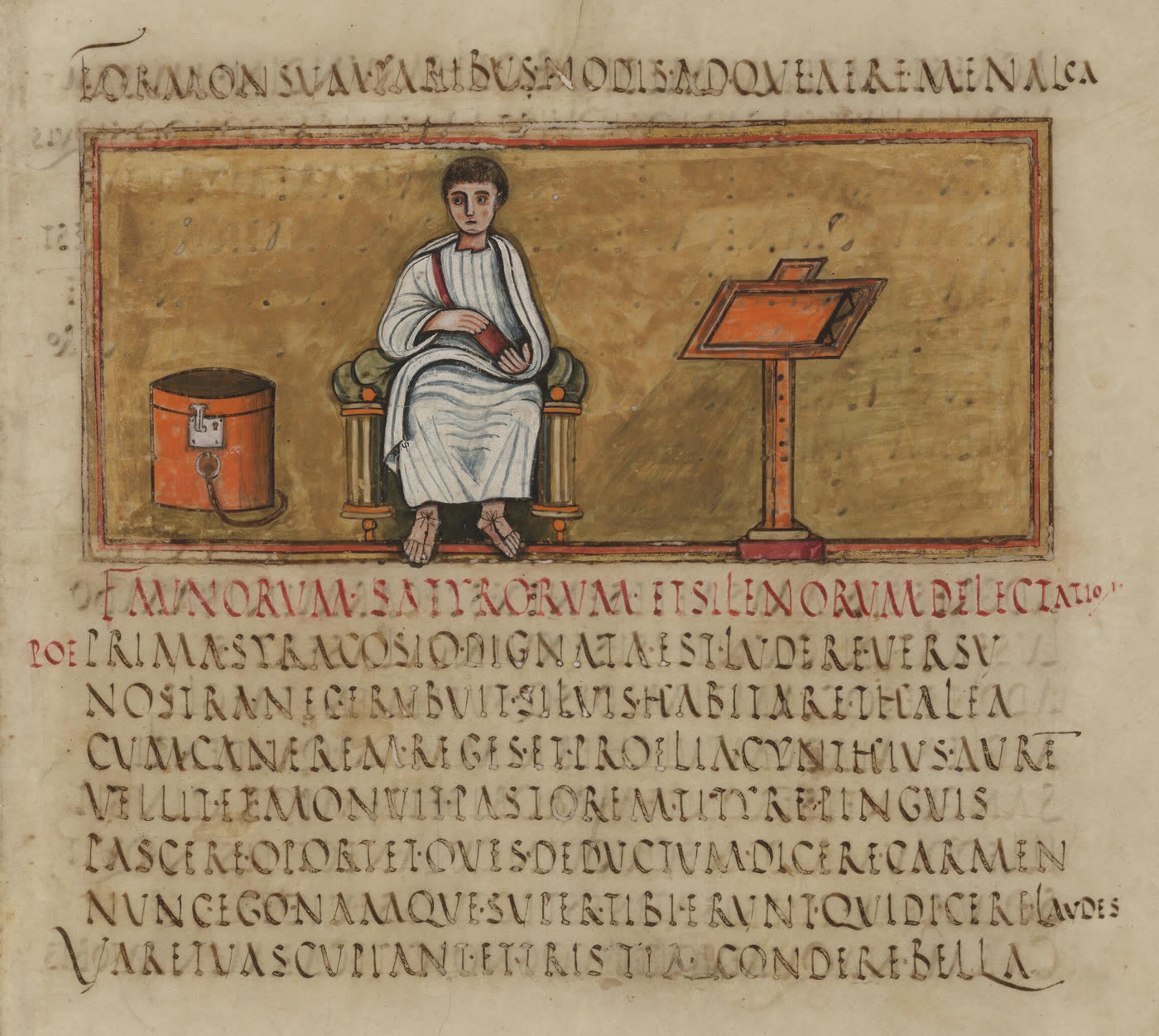
Image context: the cover uses a real photographic reproduction of the Virgil author portrait in the fifth-century Vergilius Romanus. That choice fits a translation-notes essay because the line has reached modern readers through a long material history of copying, commentary, and re-voicing. The portrait gives the article a real archival object rather than a generic battlefield scene, and it keeps attention on authorship, transmission, and poetic ordering.[6]
The line announces two epic inheritances at once
Dickinson College Commentaries makes a concise but crucial point about line 1: arma gestures toward the Iliad, while virumque invites comparison with the Odyssey.[4] That observation helps explain why the line's order should not be treated as ornamental. Virgil is not merely saying that battle and a protagonist will appear somewhere in the poem. He is declaring, at the threshold, that his Roman epic will carry both Homeric weights: war and wandering, martial scale and one man under pressure.[1][4][5]
The larger architecture of the poem confirms the opening's design. Britannica's overview of the Aeneid divides the work into twelve books that move from Aeneas's journeying to the later Italian war.[5] The first word already leans toward the second half. The second word already leans back toward the first six books. Virgil thus gives the poem a doubled horizon before the syntax has fully unfolded. A translation that blunts either term can still be readable, but it narrows the line's epic intelligence.
This is one reason the old phrase "arms and the man" has lasted so long in English.[2][3] It preserves the pairing. It also preserves the fact that the poem's first pressure is not psychological inwardness. The line opens in public matter: weapons, conflict, and the historical violence through which cities get founded.[1][5]
Why the delayed cano matters
English usually wants the sentence to begin with the speaker. David Farry's modern version does exactly that: "I sing of arms and the man whom fate had sent."[2] It is lucid and strong, and it lets a contemporary reader enter the line without syntactic hesitation. But it also redistributes emphasis. The voice appears immediately, before arms, before the man, before fate has started to work on the syntax.
Dryden's "Arms, and the man I sing" keeps closer to Virgil's staging.[3] The phrase sounds ceremonious partly because it withholds the singer until the end of the clause. That delay matters. Virgil does not stride in announcing himself as personality first. He lets the poem's subjects arrive before the act of singing does.[1][3] The effect is political as much as musical. The epic voice serves a matter already larger than the voice.
That is a genuine translation tradeoff, not a simple right-or-wrong test. Farry gains idiomatic fluency and immediate narrative momentum.[2] Dryden gains public gravity and a better echo of the Latin line's arrangement.[3] What a translator cannot afford to lose is the sense that cano comes after the burden has already been placed in view. The singer is present, but he is not the line's first event.
Why arma should stay concrete
The opening word is easy to flatten into generic conflict. Yet arma is more concrete than "struggle" and more martial than a softened word like "warfare."[1][4] The poem begins with arms because its founding story will have to pass through actual force: shipwreck, siege memory, alliance, and the Italian battles that occupy the latter half of the epic.[5] The first word therefore places steel and public violence at the head of Rome's poetic origin.
That concreteness also sharpens the line's relation to Aeneas. The man enters the poem already preceded by arms. He does not generate history by sheer personality. He carries a mission shaped by collective ruin, divine hostility, and future state formation.[1][5] If a translation makes the opening too inward or too generalized, Aeneas starts to sound like a solitary hero setting out on an adventure. Virgil's line gives him a harsher frame. Before he is a character, he is the human figure inside a war-shaped destiny.
This is where the line's severity begins to show. Many famous epic openings foreground rage, a muse, or a named protagonist. Virgil begins with armament. That choice keeps the poem's beauty from floating free of cost.[1][4][5]
Why "the man" still matters
If arma gives the opening public scale, virum prevents that scale from turning abstract. The poem is about a people-to-be, an imperial future, and a sequence of wars, but it still moves through one mortal figure.[1][5] Farry's "the man whom fate had sent" is useful here because it keeps both singularity and compulsion in view.[2] Aeneas is not just any man. He is the man through whom this history must pass.
That singularity helps explain why the opening line remains memorable even apart from the full poem. The order does not simply move from topic to example. It moves from public violence to human endurance. Aeneas stands at the crossing point between the two.[1][2][4] Later in the proem, as Dickinson's notes emphasize, he becomes the virum marked by pietas, duty toward gods, kin, and country.[4] The opening line does not yet name that virtue, but it clears the space in which the poem will test it.
This is also why "the man" tends to work better than "a man" in English. The definite article can sound slightly elevated, yet the elevation is earned. Virgil is introducing an emblematic human bearer, not merely any traveler caught in mythic weather.[1][2][3]
The line lasts because its order thinks
The opening of the Aeneid survives centuries of translation because its power is structural before it is slogan-like.[1][2][3][4] Good English versions can differ in music, diction, and idiom. What they must preserve is the line's sequence of thought: war first, then the man, then the poet's act of singing. That order tells readers that Rome's story will involve violence before glory, burden before identity, and a human carrier before an achieved empire.[1][4][5]
Read that way, arma virumque cano becomes more than a famous tag. It is a miniature theory of Virgil's poem. The epic will be public and personal at once. It will inherit Homer but redirect him toward Roman fate. And it will ask translation to keep all of that alive without letting the line harden into a museum plaque. The best versions do not merely repeat the opening. They make its ordering felt again.
Sources
- Scaife Viewer / Perseus, Aeneid 1.1-1.30 (Latin text).
- Virgil, Aeneid, translated by David Farry, Book 1 opening lines (Manifold at CUNY).
- Virgil, The Aeneid, translated by John Dryden (Project Gutenberg).
- Dickinson College Commentaries, "Vergil, Aeneid I 1-11" (opening-line commentary and notes).
- Encyclopaedia Britannica, "Aeneid" (structure, founding myth, and Roman context).
- Wikimedia Commons, "File:RomanVirgilFolio014rVergilPortrait.jpg" (source page for the archival manuscript portrait used as the article image).