Hori wants so little that his wish sounds almost impossible to deny. “We want neither rule nor luxury,” he tells his brother in Chapter 17 of Premchand's Godaan, “only coarse clothes, coarse food, and to live with marjād. Even that cannot be managed.”[1]
The difficult word is marjād, a vernacular form of maryādā: honor, propriety, standing, the boundary that lets a person remain recognizable to family and community. For Hori, it is not a gentleman's polish. It means keeping land under his feet, a cow at his door, daughters married, brothers protected, caste fellows willing to attend a wedding or funeral. It is the right to remain poor without becoming socially disposable.
That right is ruinously expensive. Every structure around Hori learns to turn recognition into a charge. The landlord expects attendance and gifts. Moneylenders make old principal reproduce as interest. The village council converts sexual respectability into grain. A priest makes debt sound like cosmic law. Hori usually sees the mechanism. He pays anyway, because he cannot imagine a viable self outside the relationships doing the billing.
This is what makes him more troubling than a simple victim and more moving than a symbol of “the peasant.” His patience can become tenderness, cowardice, practical intelligence, domestic tyranny, or moral courage—sometimes within the same scene. Godaan, first published in Hindi in 1936, was Premchand's last completed novel; its afterlife includes Gordon C. Roadarmel's widely used English translation and a place among the Hindi classics translated through a UNESCO-Sahitya Akademi cooperation program.[1][2][4] The readings below follow the 36-chapter Hindi text. All English renderings of its brief quotations are mine.
The foot on the neck
The first chapter gives Hori no innocent beginning. He feeds his bullocks, skips refreshment, and hurries to pay court to Rai Sahib, the local zamindar. Dhania asks why a tenant who already tills the landlord's fields must also flatter him. Hori's answer is brutally exact: “Our necks are under other people's feet; one cannot survive by standing stiff.”[1]
He has evidence. Around him, tenants face eviction and seizure. Rai Sahib's public reputation as a nationalist does not stop rent, forced labor, fines, or ceremonial collections from moving through his estate. Hori's visits are therefore not proof that he has mistaken domination for kindness. They are an insurance practice: appear loyal, remain memorable, hope that the next blow lands elsewhere.
Shashi Bhushan Upadhyay argues that Premchand's peasant writing contains a “moral economy” distinct from both open rebellion and mere passivity—a set of cultural claims about subsistence, reciprocity, obligation, and what powerful people owe those below them.[3] Hori lives inside that moral economy. His error is not believing that reciprocity should exist. It is repeatedly treating the powerful as if his correct behavior can make them honor it.
Premchand makes the trap audible in Hori's language. He describes a foot on his neck, yet imagines safety in stroking the foot. The sentence contains diagnosis and surrender at once. His intelligence measures the danger without opening an exit from it.
The cow makes a house visible
Hori's desire for a cow is often reduced to piety or economics. The novel gives it a more intimate social scale. A cow means milk for children, dung for fuel and fields, future calves, and a living presence at the threshold. In Chapter 3, Hori imagines it as “the beauty of his doorway” and “the glory of his house.” He wants passersby to ask whose prosperous-looking home they have reached.[1] The publisher of Roadarmel's translation similarly describes the cow as Hori's measure of wealth and well-being, while noting its ritual importance as a deathbed gift.[2]
When the animal finally arrives, the family does not behave like investors receiving equipment. The children divide future rights to milk and dung. Hori embraces the cow; Dhania ties a strip of black cloth around its neck against the evil eye. The narration says Hori looks at it as if a goddess has entered the house.[1] The scene matters because the cow does not merely increase value. It makes the household feel complete and publicly visible.
That is why its poisoning by Hori's jealous brother Hira produces more than a lost asset. Hori lies under oath to shield his brother and, in Chapter 9, is prepared to borrow thirty rupees for a police bribe that might prevent a search. Dhania hears the absurdity immediately: he is carrying borrowed money, she says, to “save honor.”[1]
The episode refuses to make kin loyalty pretty. Hori's wish to protect Hira enlarges the family's financial danger. When Dhania makes the concealed truth public, Hori beats her. Premchand does not let us rename that violence as endurance. The same habit that makes Hori absorb a brother's wrongdoing also makes him enforce silence on the person who sees the household account most clearly. His marjād preserves the male kinship line by sending its cost inward.
The village charges him for mercy
The novel's sharpest test comes when Gobar leaves the pregnant Jhuniya at his parents' house and runs away. Hori and Dhania could protect their caste standing by expelling her. Instead, the household shelters her. Dhania supplies the decisive language: family prestige is not dear enough to purchase with a life.[1]
The village council answers compassion with a penalty. Hori begins carrying grain from his threshing floor to the elders until almost nothing remains. Premchand's narration says the fear of the biradari—the caste community—sits on him like a demon. Marriage, birth, death, and ordinary recognition all seem to depend on it. He cannot picture separation as freedom; he pictures his life torn thread from thread.[1]
Dhania sees a more immediate body politic: the people who weeded, watered, guarded, and harvested the crop. When she asks whether their children must starve so the council can feast, Hori finally puts down the basket. “You are right,” he says. “I have no claim on another's share.”[1] The concession is small but important. It shows that his submission is not a fixed essence. He can revise an inherited duty when Dhania makes its hidden payer visible.
The aftermath proves her arithmetic. The household runs out of grain; little Rupa goes to an aunt's house and maneuvers shyly toward a meal. The family accepts seed and food from Datadin on terms that give the priest half the next crop. A punishment supposedly imposed to defend social order has made Hori more dependent on the men who speak for it.[1]
Dhania changes the meaning of honor
Dhania is not simply the brave opposite of a timid husband. She too values household standing, fears what exclusion will do to her daughters, and can turn harshly on Jhuniya later. What distinguishes her is a different order of claims. Food before display. A vulnerable person before family reputation. Shared labor before a male head's right to dispose of it.
That counter-ethic allows the novel to separate honor from spectatorship. Late in Chapter 17, Hori has no coin to place on an ārti tray. His first impulse is to stay away rather than be seen receiving a blessing empty-handed. Then he asks himself, “Why be a slave to maryādā?” and goes.[1] For one walk across the village, religious feeling no longer needs a public payment.
It would be too neat to call this liberation. Hori soon returns to the older pattern. But the moment establishes a boundary the character can recognize: dignity is not identical to what other people witness. Dhania has been forcing that distinction throughout the novel. Her influence does not convert him into a rebel; it gives his conscience somewhere to stand when custom and care split apart.
The land turns duty into sin
By the final chapters, Hori's attachment to ancestral land has absorbed nearly every other obligation. Debt threatens the plot. Rupa needs a marriage. Datadin brokers a match with Ramsevak, a prosperous widower much older than she is, and two hundred rupees become entangled with the arrangement. Hori keeps the land, but hides during the wedding as though his face has been blackened.[1]
The scene is the moral reverse of the cow's arrival. That earlier threshold made the whole family rush outward in delight. Rupa's departure sends Hori into concealment. Land was supposed to secure continuity between generations; preserving it has helped move the cost into his daughter's future.
He knows it. In Chapter 36 he tells Gobar, “Out of attachment to this land, I loaded a bundle of sin onto my head.”[1] The confession prevents us from treating him as merely duped. Hori has long understood individual prices. Only now does he name the shape they form together.
Yet Premchand grants him one return that money cannot explain. Hira comes home after years away, ruined and remorseful. Hori does not present an account for the poisoned cow, the bribe, or the labor he gave Hira's abandoned household. He sees the younger brother he once raised, embraces him, and says a person makes mistakes. Hira's gratitude makes Hori feel, briefly, that his defeats were victories.[1]
The feeling is not foolish. Kinship has finally answered care with recognition. It is also terribly late, and it cannot restore the bodies or choices spent to keep that relationship available.
Twenty annas and no cow
The novel closes by bringing Hori's two great desires—cow and family—into the same exhausted body. He takes roadwork in brutal heat and spins twine at night, hoping to buy a cow so his grandson can have milk. After Hira's return, Hori goes back to the quarry already depleted, collapses, and dies.[1]
The title's ritual arrives only then. There is no cow or calf in the house. Dhania brings the twenty annas earned by selling their twine, places the coins in Hori's cold hand, and tells the priest: “These coins are his godaan.”[1] She—not Hori—performs the final gift, and the substitute is the product of her labor as much as his.
Critics have disagreed over whether this ending empties the rite or preserves its meaning. Upadhyay records both the reading of the final piety as hollow and the argument that, within Hori's moral world, the substituted gift remains deeply consequential.[3] The scene is strongest when neither side cancels the other. It is savage that a religious intermediary can still receive money from a house with no cow. It is equally important that Dhania refuses to let poverty make Hori's last wish unintelligible. Her sentence performs the rite and exposes its material truth at once: here is the cow, and here is its absence.
Hori therefore ends neither as a saint of suffering nor as a fool cured too late. He is a man who correctly understands that human life depends on obligations, then lives where nearly every obligation has been captured by someone able to collect. His finest acts—sheltering Jhuniya, supporting Punia after Hira disappears, forgiving Hira—come from refusing to treat relationship as a cash account. His worst decisions let priests, elders, landlords, and patriarchal custom turn that refusal against his own household.
The tragedy of Godaan is not that Hori wants honor instead of freedom. It is that the available forms of honor keep charging him for membership while withholding the security membership promises. He spends a life buying the right to belong and dies with twenty annas in his hand: enough to name the gift, not enough to make the cow appear.
Sources
- Premchand, Godaan, Hindi Wikisource scan-backed text of the 1936 novel—primary text for Chapters 1, 3, 4, 9, 11–14, 17, 35, and 36.
- Orient BlackSwan, The Gift of a Cow: A Translation of the Classic Hindi Novel Godaan, translated by Gordon C. Roadarmel, Permanent Black edition (2002)—edition, translation, cow symbolism, and publication context.
- Shashi Bhushan Upadhyay, “Premchand and the Moral Economy of Peasantry in Colonial North India,” Modern Asian Studies 45, no. 5 (2011)—peasant moral economy, critical reception, and the interpretive debate over the ending.
- Sahitya Akademi, “Cooperation with UNESCO”—institutional record of Godan among the Hindi classics translated through the two organizations' cooperation program.
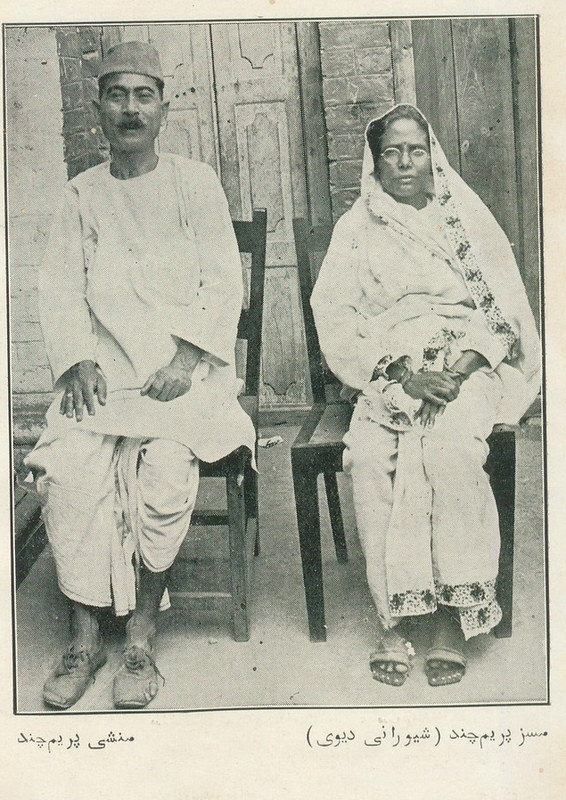
- Wikimedia Commons, “Munshi Premchand with wife Shivrani Devi”—catalog and provenance page for the photograph published in the October 1936 issue of Zamana.