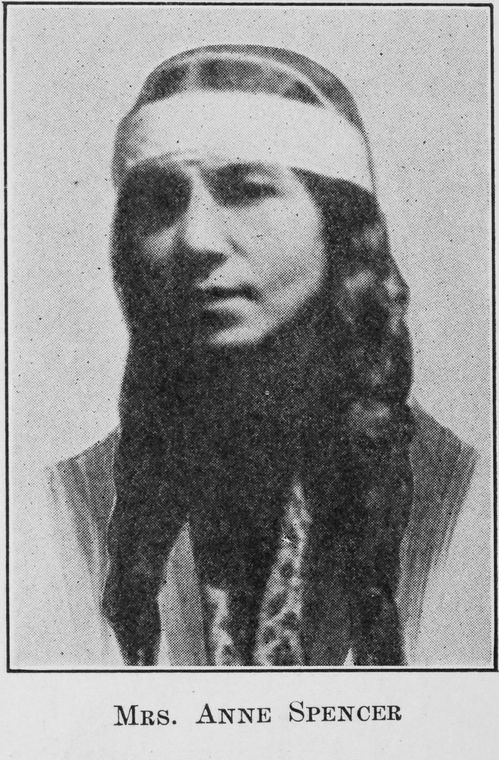
Anne Spencer's “White Things” begins with a fact so broad it sounds almost childlike: “Most things are colorful things.” Sky, earth, and sea establish color as the world's ordinary condition. The next sentence changes the scale from nature to power: “Black men are most men; but the white are free!”[1] In two lines, abundance and liberty separate. What is common does not govern; what is rare has arranged the world around itself.
The poem's most unsettling move comes next. Whiteness does not remain a color. For most of the poem, it acquires a plural agent—“They”—and a sequence of active verbs: “stole,” “strewed,” “blanched,” “turned,” “pyred,” “burned,” and “claimed.” At the end, “this ghoul” proposes “to swing” the skull and “swear” at God.[1] White supremacy no longer resembles a fixed trait or a neutral description. It behaves like work performed on landscapes, flowers, bodies, and even the creator. Spencer makes whiteness a verb.
That grammatical pressure is why this compact poem is more than a statement of protest. Its rhymes, color changes, repetitions, and abrupt shifts show a system manufacturing the evidence it later calls natural. Read closely, “White Things” does not ask why a white world exists. It shows how one is made.[1]
Content note: the poem and this essay discuss racist lynching and human remains.
Color is the baseline, not the decoration
The opening line does not say that some beautiful things happen to be colorful. It makes color the rule: sky, earth, sea. Spencer's doubled noun—colorful things—gives the observation the bluntness of classification. The world is materially various before people sort it into ranks.[1]
The second line is equally compressed but less stable. “Black men are most men” can be heard demographically: the white population is not humanity's default. It can also be heard grammatically. The line gives Black men the unmarked human noun, men, before isolating “the white” as a smaller category. Then the conjunction but reveals the category that counts politically. Numerical or natural commonness offers no protection when freedom has been monopolized.[1]
Spencer intensifies the inversion with “White things are rare things; so rare, so rare.”[1] Rarity might ordinarily increase value. Here it produces anxiety and expansion. The repetition sounds like wonder for a beat, but it also sounds like a story power tells about its own specialness. Whiteness will not remain one rare color among many. It will make the rest of the world resemble itself.
Even the next verb is slippery. “They stole from out a silvered world—somewhere” uses stole first in the older sense of moving secretly.[1] Yet theft remains audible inside the word. The white agents enter by stealth, and the poem soon shows them taking color from everything they cross. Spencer lets a verb carry arrival and appropriation at once.
The wand does not reveal whiteness; it applies it
The white agents find plains that are “fair” except for being “greenly grassed.”[1] Fair briefly holds several meanings—beautiful, just, pale—before the grass supplies a color their system cannot leave alone. They pass by scattering “white feathers of cowardice,” an image that turns purity's traditional plumage into a trail of fear.[1] The feathers do not grow from the land. They are strewn over it.
Then Spencer inventories what the agents alter: golden stars, red hills, dark pine, the blood inside a ruby rose. These are not random bright objects. Stars, terrain, trees, blood, and flower form a small cosmos. The agents “blanched” the first group with a “wand of power” and “turned” the rose into “a poor white poppy-flower.”[1] The wand borrows the ease of a fairy tale, but the verbs make its politics plain. This is not revelation. It is processing.
Blanch is particularly exact. It can mean whitening by removing color; it can also describe a face paling under fear. The verb therefore records both the visible result and the terror of the act. Nothing becomes more fully itself. Each object is made to lose something.
The rose-to-poppy change completes that impoverishment. The original flower holds blood in a jewel-like red; the altered flower is “poor.”[1] Spencer does not argue that white flowers are intrinsically empty. She shows power taking a living palette and treating depletion as improvement. The poppy may bring associations of sleep, forgetting, or death, but the adjective has already done the essential work: the transformation reduces the world it claims to perfect.
The paired rhymes make the procedure more disturbing. Grassed/passed, fine/pine, and power/flower give each alteration a neat acoustic closure.[1] Violence moves with a song's efficiency. One surface is whitened, the rhyme clicks shut, and the agents proceed to the next.
“Pyred” turns an object into an action
At the poem's midpoint, botanical destruction becomes bodily destruction: “They pyred a race of black, black men, / And burned them to ashes white.”[1] Spencer makes a noun, pyre, into a verb. The coinage denies readers the distance of calling the fire a thing that simply exists. Someone builds it; someone uses it; someone makes people into its objects.
The doubled “black, black” answers the earlier “so rare, so rare.”[1] The first repetition makes whiteness sound scarce and self-enchanted. The second makes Blackness sound numerous and marked for destruction. Between the two echoes lies the poem's political mechanism: rarity claims authority, then authority attacks abundance.
White ash is the system's grimmest manufactured product. The burning creates the color used to justify the burning. That is the poem's central accusation. Supremacy does not discover a naturally white order. It destroys colored life until the remains appear to confirm whiteness as the final state.
Historical context matters here, but it must not flatten the poem into a coded news report. Spencer said that “White Things” answered a lynching she had read about. Biographical accounts identify the 1918 murder of Mary Turner, a pregnant Black woman in Georgia, as a possible—rather than certain—specific catalyst.[2][3] The distinction is important. The poem's racial terror is concrete; the exact event behind it remains qualified in the surviving record.
That context also sharpens the word pyred. The poem presents lynching not merely as killing but as spectacle: the destruction and display of a body. Spencer's grammar refuses the fiction that such terror was spontaneous. A race is “pyred” because people choose to convert murder into ceremony.[1]
The skull defeats the color line and becomes a trophy
After the burning, “a young one” claims a skull. It is white because a Black person's skull is white. The discovery could undo racial classification: beneath imposed color, the body exposes the category's absurdity. Instead, the young ghoul turns the skull into proof of possession, a “glistening awful thing” to swing before God.[1]
The sequence matters. First the agents whiten the world. Then they whiten human remains through fire. Finally one of them holds up the result as though he had found it rather than made it. Spencer compresses an entire ideology into that fraudulent chain: produce the evidence, erase the production, display the evidence as nature.
“Awful” preserves two pressures. The skull is horrifying, but it is also placed in an encounter with divine awe. The ghoul swings it “in the face of God,” replacing reverence with challenge.[1] His gesture is not only racist triumph. It is an attempt to make violence outrank creation.
The poem's final command completes the blasphemy: “Man-maker, make white!”[1] The phrase addresses the creator by function, then orders that function to change. Its compact repetition—maker, make—sounds like a factory instruction. Humanity is no longer enough; the ghoul demands a product specification.
This is why the ending cannot be reduced to the claim that whiteness is powerful. The command reveals its panic. If whiteness were the self-evident law of creation, no one would need to command the creator to manufacture it. The exclamation mark announces dominance and betrays dependence at the same time.
A protest poem that refuses to become a slogan
“White Things” appeared in the March 1923 issue of The Crisis, the NAACP journal. According to Encyclopedia Virginia, its editors found the poem unnerving and asked Spencer to revise it; she refused.[1][2] That refusal suits a poem built against euphemism. Its color scheme is symbolic, but its ashes and skull will not stay safely symbolic.
Spencer's career makes the poem's severity still more striking. She was a poet, teacher, librarian, gardener, and civil-rights organizer in Lynchburg, Virginia. Her home offered Black travelers and major writers hospitality in a segregated city, while her work at the Dunbar High School library expanded access to books for Black residents.[3][4] Much of her poetry attends to gardens, myth, domestic space, and the natural world; relatively little addresses racial violence this directly.[2][3]
That range should prevent “White Things” from becoming the one angry poem used to summarize her. It should also prevent readers from treating its flowers as decorative relief. Spencer knew how color lives in gardens. Here that knowledge becomes forensic. A green plain, dark pine, ruby rose, white poppy, black body, white ash, and glistening skull record successive stages in a forced conversion.
The poem begins by restoring color to the world's baseline and ends with a command to eliminate that plurality at its source. Between those points, its verbs reveal every step. White supremacy enters quietly, scatters its signs, drains the landscape, burns the body, claims the remains, and calls the result creation. “White Things” is devastating because it refuses that last false name. Whiteness, in Spencer's poem, is not what the world was. It is what power keeps doing to the world.
Sources
- Academy of American Poets, Anne Spencer, “White Things”—public-domain text and note on its March 1923 publication in The Crisis.
- Nina Salmon, “Anne Spencer (1882–1975),” Encyclopedia Virginia, Virginia Humanities—biography, publication history, editorial response, and qualified account of the poem's lynching context.
- Nora Pehrson, “This Small Garden Is Half My World,” Virginia Humanities—Spencer's Lynchburg life, literary afterlife, natural-world poetics, and the cautiously stated Mary Turner connection.
- Anne Spencer House & Garden Museum, “Who Is Anne Spencer?”—official museum biography covering Spencer's writing, civil-rights work, library career, home, and garden.
- Wikimedia Commons, “File: Anne Spencer poet Lynchburg.jpeg”—source and provenance page for the circa 1923 New York Public Library archival portrait used as the article image.