T. S. Eliot's poem is famous enough to suffer from selective memory. Many readers keep a few isolated fragments: the patient on the table, the women talking of Michelangelo, the peach, the mermaids, the drowning.[1] That is understandable; The Love Song of J. Alfred Prufrock has more quotable lines than many whole careers. But the poem weakens whenever translation treats those lines as detachable mood pieces. Its real force lies in sequence. The invitation at the start already sounds strained, the city streets develop that strain into social pressure, and the ending refuses to let dream count as rescue.[1][2]
That is part of why the poem mattered so quickly. Poetry Foundation's centenary essay calls "Prufrock" one of the first unavoidable encounters with modern poetry in English, while both Britannica and the Academy of American Poets place it at the beginning of Eliot's avant-garde authority in London and in Poetry magazine in 1915.[2][3][4] Translation matters because the poem's modernity is not just a matter of subject. It is a matter of nerve: speech that wants contact and dreads exposure at the same time. If a translation smooths that nerve into elegance, Prufrock becomes merely refined and sad. Eliot made him much more alarming than that.[1][2]
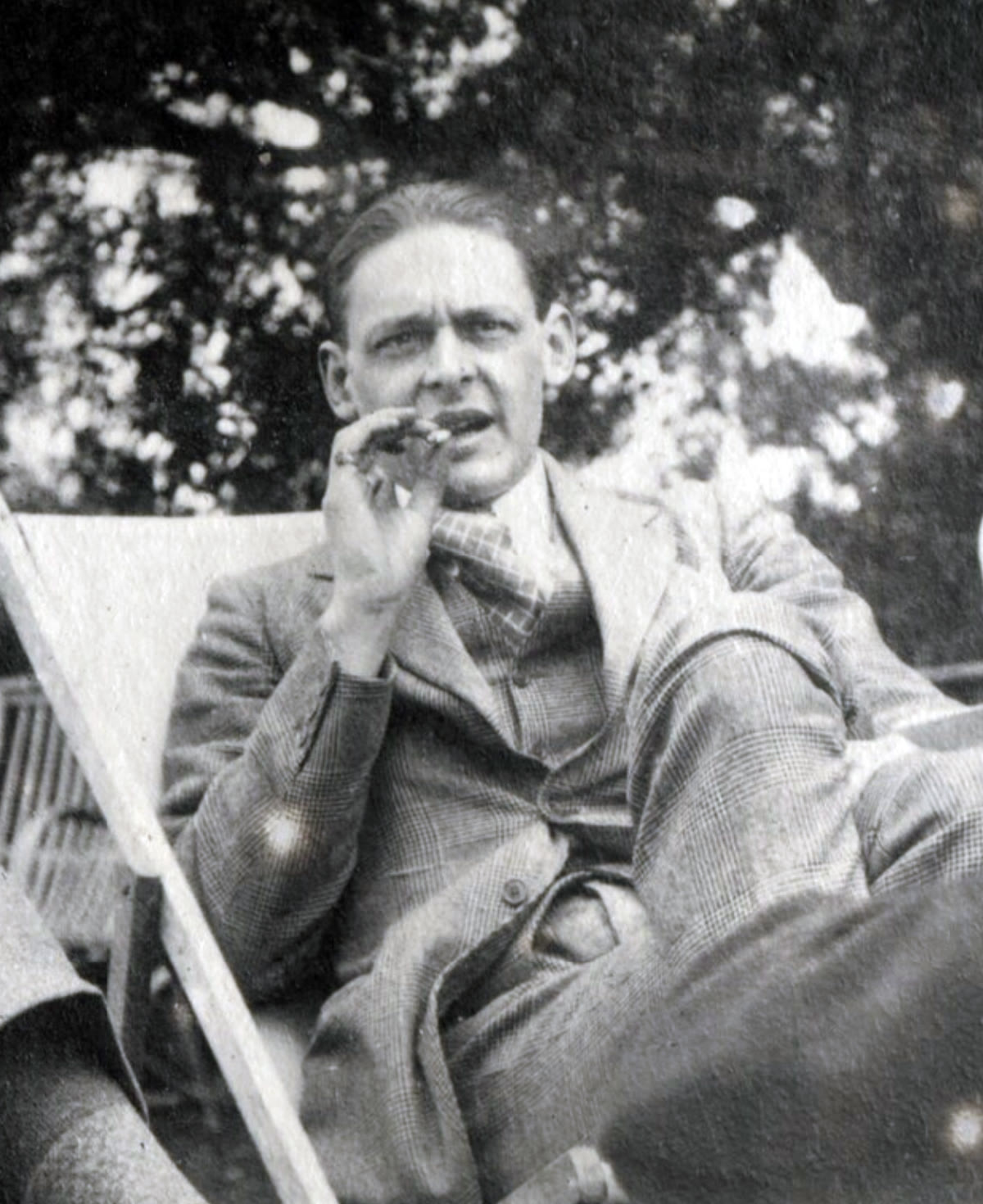
Image context: the cover uses Lady Ottoline Morrell's real 1923 photographic portrait of Eliot from Wikimedia Commons. That choice suits this essay because the poem is all surface discipline under inner strain. A documentary portrait keeps the emphasis on formal control, self-conscious poise, and the pressure of being seen.[5]
1) "Let us go then" is an invitation already dragging its feet
The first line looks simple until one tries to move it into another language: "Let us go then, you and I."[1] A flat translation can make it sound courtly, romantic, or merely functional. But the line already hesitates. "Then" implies belatedness, as if the sentence has started after an argument the reader has not heard. "Let us" sounds collective, yet the pair it proposes never feels stable. The address may be to a companion, to the self split into speaker and listener, or to a listener who will soon be abandoned by the monologue's inward drift.[1][2]
That instability is why the title matters so much. Eliot calls the poem a "love song," then opens with a walk that does not advance toward intimacy with any confidence at all.[1] The voice sounds ceremonious for a moment, and almost immediately the ceremony begins to sag. A translation that turns the opening into a smooth invitation loses the poem's first technical achievement: before the reader even reaches the streets, the sentence has already admitted awkwardness. Prufrock does not stride into the poem. He eases himself into it with visible effort.
This is one place where Eliot's early modernism feels exact rather than merely difficult. The line is memorable because it offers movement while withholding assurance. It promises company, but the speaker already sounds unable to govern the emotional weather of the walk he proposes.[1][2]
2) The ether image has to remain clinical
The third line is one of the great anti-romantic shocks in English: the evening is "spread out against the sky / Like a patient etherized upon a table."[1] Translators often feel pressure to soften it. If the evening becomes numbed, exhausted, drifting, or vaguely anesthetized, the line retains some morbidity but loses its cruelty. "Etherized" is not decorative decadence. It is medical and procedural. The body is immobilized, exposed, and prepared for intervention.[1]
That precision matters because the simile abolishes any expectation that the city walk will unfold under lyrical twilight. Eliot gives the reader sky, then instantly drags the sky indoors, into a room of instruments and helplessness.[1][2] The move is violent in exactly the way Prufrock's consciousness is violent: he can hardly begin a social evening without imagining it as a scene of inspection. The line is not memorable because it is strange in isolation. It is memorable because it rewrites atmosphere into diagnosis.
This is where weak translations go prettiest and fail hardest. Once the medical table disappears, Prufrock starts sounding like a melancholy stroller in a beautiful city. Eliot did not write that poem. He wrote a poem in which even the sky has already been laid out under institutional light.[1][3]
3) The streets are syntax before they are scenery
After the opening shock, Eliot sends us through "half-deserted streets," "muttering retreats," cheap hotels, and sawdust restaurants.[1] It is tempting to translate these details as noir atmosphere or urban bohemia. But the most important phrase in the passage is grammatical, not visual: the streets "follow like a tedious argument / Of insidious intent / To lead you to an overwhelming question."[1] The walk is built like a sentence that keeps pressing toward what it cannot yet say.
That means the city is doing more than furnishing mood. It is externalizing Prufrock's habits of mind. The muttering streets are not background to anxiety; they are anxiety given pavement and direction.[1][2] A good translation therefore has to keep two textures at once. It needs the grime of one-night hotels and oyster-shell restaurants, but it also needs the argumentative pressure of "tedious" and "insidious." If that pressure gets diluted into merely wandering through a modern city, the whole stanza loses its coercive logic.
The withheld "overwhelming question" sharpens the problem. Eliot never states it outright. That omission is structural, not ornamental. Prufrock's consciousness is organized around approach, recoil, and substitution.[1] Translation should preserve that suspension. Once the question starts sounding explicit or melodramatic, the poem's delicate embarrassment collapses into declaration.
4) "There will be time" is a rhythm of postponement
The middle of the poem is full of repetition that sounds consoling until one listens to its function. "There will be time, there will be time" is usually read as a soothing refrain.[1] In performance, though, it behaves more like self-delay. Prufrock keeps manufacturing temporal surplus so he can postpone exposure a little longer: time to prepare a face, time to meet other faces, time for decisions and revisions that do not quite become decisions at all.[1]
That is why the social room matters. "In the room the women come and go / Talking of Michelangelo" is often remembered as an emblem of cultivated chatter, and it is that.[1] It also works as a loop. The line keeps returning because Prufrock keeps returning to the same threshold, unable to convert observation into entry. The world of conversation, taste, and visits is not grand tragedy. It is more humiliating than that. It is ordinary sociability experienced as ordeal.
Translations can miss the point by making the "time" passages sound wise or philosophically spacious. Eliot gives them a shrinking rather than an opening force. Each repetition buys a few more seconds of evasion; each echo makes the evasion easier to notice. By the time Prufrock asks "Do I dare?" the question is not heroic.[1] It belongs to a man for whom the smallest social movement has become acoustically enormous inside his own head.
5) The poem ends by making waking fatal
The closing sea-fantasy is often handled as if Prufrock finally escapes into lyric beauty.[1] He imagines mermaids, sea-girls, white and black water, chambers of the sea. Yet the final movement only works if translation preserves its brutality: "Till human voices wake us, and we drown."[1] A softened version, where dream simply breaks or reverie fades, ruins the ending. Eliot makes waking the moment of submersion.
That ending completes the poem's logic. From the opening onward, contact with the ordinary world has never been neutral. Streets press, rooms measure, time stalls, voices judge.[1][2] The sea vision offers temporary distance from those pressures, but Eliot does not let fantasy mature into salvation. Human voices return, and the return is lethal because ordinary social reality is exactly what Prufrock cannot master.
This is why Prufrock survives quotation culture even when quotation culture keeps trying to trim it into elegant fragments.[2] The poem is harsher in full than its famous lines suggest. Translation has to keep that harshness by preserving sequence: uneasy invitation, clinical exposure, argumentative streets, repetitive postponement, and a final waking that drowns rather than restores.[1] Once that order stays intact, Eliot's monologue regains its sting. It ceases to be a museum piece of urban sadness and becomes, again, a terrifyingly precise study of self-consciousness in motion.
Sources
- T. S. Eliot, "The Love Song of J. Alfred Prufrock." Poetry / Poetry Foundation text page.
- Peter O'Leary, "T.S. Eliot: 'The Love Song of J. Alfred Prufrock'." Poetry Foundation.
- Encyclopaedia Britannica, "T.S. Eliot."
- Academy of American Poets, "About T. S. Eliot."
- Wikimedia Commons, "File:T.S. Eliot, 1923.JPG" (lead-image source page).