Richard Cory has scarcely appeared before the town begins dressing him in royalty. He is “imperially slim,” then “richer than a king.” The people watching him have inspected his clothes, his manners, his easy progress down the street. They are sure they know what his life must feel like. Edwin Arlington Robinson needs only four stanzas to make that certainty unbearable.[1]
Robinson's short portraits repeatedly ask how much of a person an observer can possess. Sometimes a community speaks; sometimes a narrator exposes a man's excuses; sometimes a lonely figure supplies both sides of a conversation. These differences matter as much as the characters' disappointments. Read “Richard Cory,” “Miniver Cheevy,” and “Mr. Flood's Party” together, and the familiar label of a poet of failure begins to feel inadequate. His subject is also the authority to describe another life—and the point at which that authority gives out.[1][3][4]
A career larger than the miniature
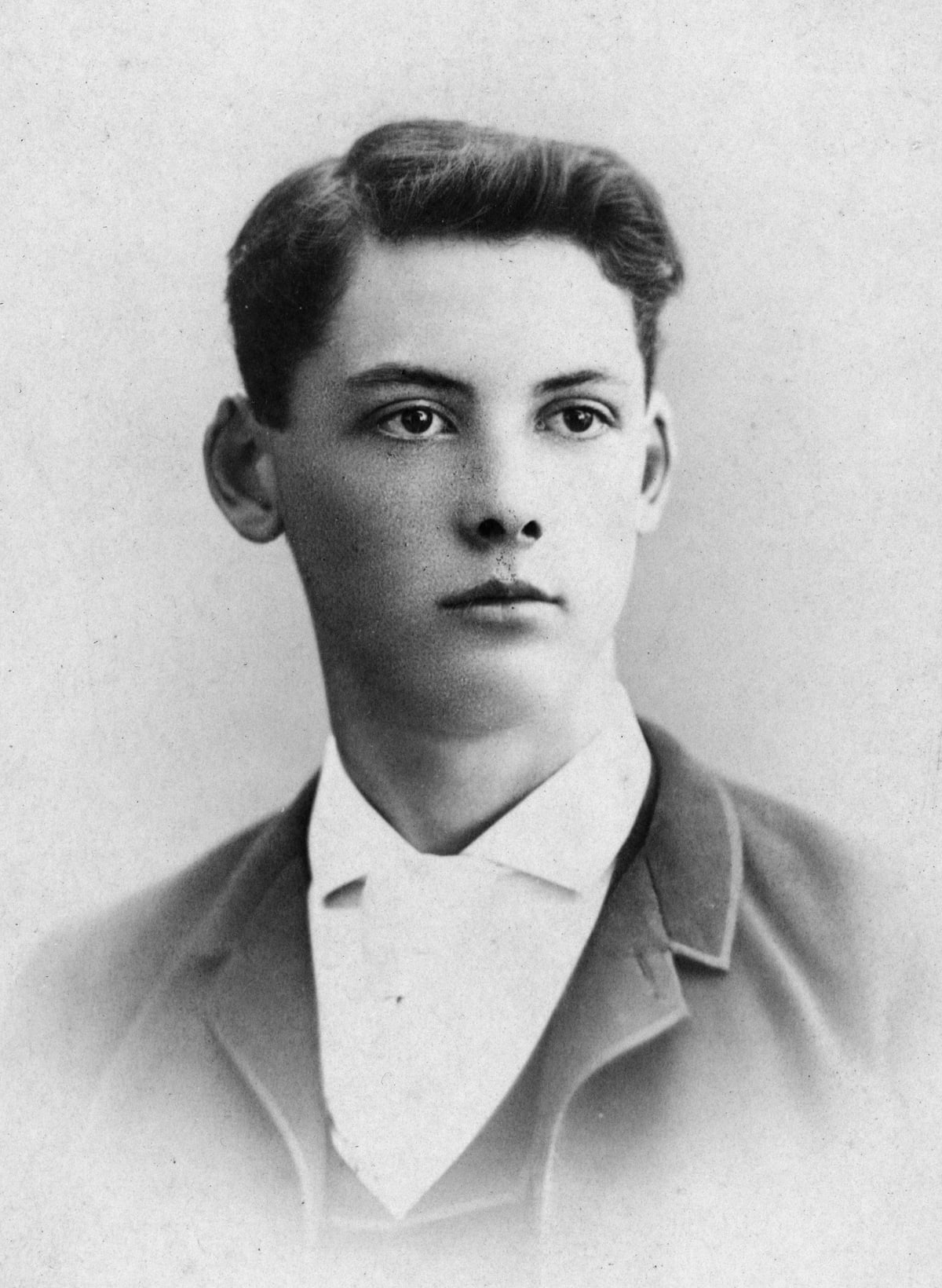
Born in Maine in 1869, Robinson grew up in Gardiner, the place he transformed into the recurring fictional setting of Tilbury Town. He paid to print his first collection in 1896, then substantially revised it as The Children of the Night the following year. Recognition took time. Theodore Roosevelt's support eventually brought him a Customs House position, held from 1905 to 1910, that eased the financial difficulty of writing poetry.[2]
The career that followed was more expansive than a handful of anthology favorites suggests. Robinson wrote long Arthurian poems as well as compressed character sketches; Collected Poems, The Man Who Died Twice, and Tristram each won a Pulitzer Prize. The writer who could puncture a dream of Camelot also devoted a book to Merlin.[2] That range is a useful restraint on our reading. We should be wary of making the satirical voice in one poem the whole of Robinson's imagination.
His small poems are particularly good at making that warning felt. They give us a person quickly, then make us reconsider what the apparent speed of recognition has left out.
The town that mistakes looking for knowing
“Richard Cory” opens with a collective speaker: the people on the pavement. Cory is the object of their attention, and for almost the entire poem their voice controls his portrait. Its regular, alternating rhymes make the report easy to follow. Its vocabulary turns admiration into a kind of public ceremony.[1]
Yet there are disturbances inside the praise. In the second stanza, Cory is described as “always human” when he speaks. It is a curious reassurance to require of an ordinary man. His neighbors have elevated him so far that even a greeting arrives as a gracious descent. The poem lets us hear how social distance can survive politeness: he says good morning, but they hear a superior being acknowledge them.[1]
The crucial qualification comes in the third stanza: “we thought.” Everything that Cory supposedly possesses as an inward condition—ease, completeness, a life worth exchanging for one's own—depends on an inference. His wealth and their hunger are real within the poem. Their knowledge of his happiness is something else.[1]
Then Cory dies by suicide. Robinson gives no explanatory monologue and no final access to his thoughts. The event destroys the town's confident picture without replacing it with a complete psychological account. We cannot responsibly extract a single cause from what the poem withholds.
That makes the ending more difficult than a tidy lesson about money failing to buy happiness. The speakers' material deprivation does not disappear; neither does Cory become fully knowable through his death. My reading is that the poem leaves both problems standing. To imagine oneself in another person's place is still to do the imagining oneself.
The man who makes the past his excuse
In “Miniver Cheevy,” Robinson gives a narrator much greater apparent command. Miniver longs for vanished splendor, resents contemporary life, and admires historical worlds he has never encountered. The narrator can name both his desires and their contradictions.[3]
The poem's short fourth lines are wonderfully deflating. Three longer lines allow Miniver's grand feeling to gather; the last often brings it down to size. In stanza six, his distaste for a khaki suit leads to a longing for medieval armor, reduced by the closing phrase to “iron clothing.” A heroic costume has become an awkward item of dress. The phrase makes his taste look faintly ridiculous without requiring an explicit lecture.[3]
The next stanza catches a more ordinary contradiction: Miniver despises the money he nevertheless wants. Then thinking becomes a repeated verb that produces no movement. By the final stanza, he has “called it fate” and “kept on drinking.” The explanation sounds elevated; the action remains a habit.[3]
There is bite here, but it is worth hearing the small hesitation near the beginning. After announcing Miniver's distress at having been born, the narrator adds, “And he had reasons.” Those reasons are never fully inventoried. The line can sound like a dry joke, a brief concession, or both. It keeps the satire from becoming quite as comfortable as a verdict delivered from a safe distance.
Robinson's own Arthurian writing sharpens the distinction. An attraction to old stories need not disable a life; for this poet, it could generate sustained work.[2] Miniver's particular difficulty, as the poem stages it, is what he makes nostalgia permit. The imagined past becomes a reason to excuse the present from effort.
A conversation that nobody else can hear
“Mr. Flood's Party” changes the terms again. Old Eben Flood stands on a road above Tilbury Town, with a jug and memories of friends. Instead of giving him a hostile audience, Robinson allows him to invent a courteous one. Eben offers a drink to himself, accepts it, and negotiates another round. “Convivially returning with himself” makes the impossible social arrangement briefly sound like good manners.[4]
The opening has already told us that nobody else is near. There is no trick to uncover. We watch an improvisation whose failure is known in advance, and that knowledge changes the laughter. Each polite exchange is also evidence of how thoroughly the rituals of companionship have outlived the companions.
At the poem's center, Eben sets down his jug with the care of a mother laying down a sleeping child. The narrator widens the gesture with the phrase “knowing that most things break.” A practical precaution becomes a measure of accumulated loss. Robinson does not need to provide Eben's whole history: the delicacy of his movement lets us feel what experience has taught him.[4]
The final stanza returns to the town's doors. Strangers would now close the entrances that friends once opened. That conditional matters. The poem does not stage a fresh rejection at a particular doorstep; it presents a social world Eben no longer expects to welcome him. His private party temporarily supplies the welcome he anticipates missing.[4]
Across these portraits, Robinson varies the distance from which a life can be seen. Cory remains inaccessible behind public admiration. Miniver is exposed by a narrator whose mockery still leaves a sliver of room for pain. Eben is allowed to perform his own company while the poem acknowledges its limits. These are different acts of attention, not interchangeable examples of unhappiness.
The pleasure of Robinson's craft lies in how little noise the adjustments make. A qualified verb, a shortened line, a courteous answer addressed to oneself: each changes our permission to judge. His portraits are memorable because they give us recognizable people. They remain unsettling because recognition is only the beginning of knowing them.
Sources
- Edwin Arlington Robinson, “Richard Cory,” lines 1–16. University of Toronto Libraries, Representative Poetry Online; text from Collected Poems (Cecil Palmer, 1922), p. 82.
- Academy of American Poets, “About Edwin Arlington Robinson” — biographical background, early publication, Roosevelt's support, Arthurian poems, and Pulitzer recognition.
- Edwin Arlington Robinson, “Miniver Cheevy,” especially stanzas 1 and 6–8. University of Toronto Libraries, Representative Poetry Online; text from Collected Poems (Cecil Palmer, 1922), pp. 347–348.
- Edwin Arlington Robinson, “Mr. Flood's Party,” especially lines 25–56. University of Toronto Libraries, Representative Poetry Online; text from Collected Poems (Cecil Palmer, 1922), pp. 573–575.
- Wikimedia Commons, “Edwin Arlington Robinson 1888.jpg” — archival photograph by George F. McIntosh, sourced to the Maine Historical Society; image provenance and original scan.