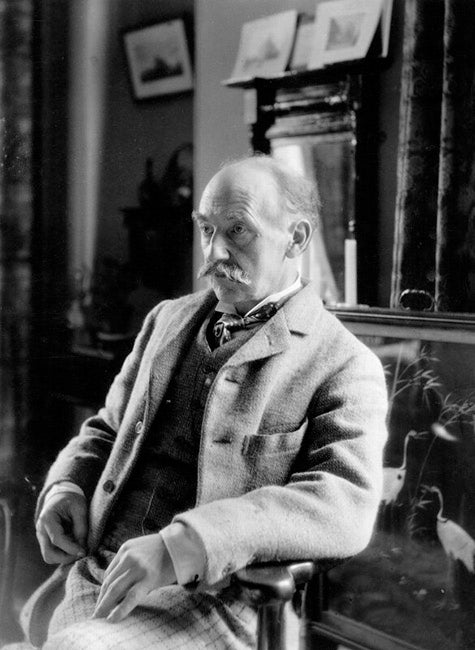
A bird sings into the cold. A man wonders whether it knows something he does not. Fifteen years later, in another Thomas Hardy poem, a remembered voice offers to lead a doubter out into Christmas darkness. Neither poem gives its speaker the evidence that would settle the matter. But between “The Darkling Thrush” and “The Oxen,” hope acquires a different possibility: someone to go with.[1][2]
These are unusually tender poems about the limits of conviction. Their speakers can imagine consolation without being able to certify it. Read them together and the interesting question becomes what remains possible in that interval. Hearing a song, remembering a story, accepting an invitation: Hardy makes these small acts carry feelings that an outright declaration of faith would simplify.
There is a historical distance between the scenes. “The Darkling Thrush” appeared in Poems of the Past and the Present in 1901; its landscape turns the departing century into a corpse. “The Oxen” appeared in The Times on Christmas Eve 1915, during the First World War.[1][3] The later poem never names the war. Its publication moment gives the longing for childhood assurance an additional pressure, without turning every detail into an allegory of the trenches.
At the beginning of “The Darkling Thrush,” almost everything appears exhausted. Daylight is weakening; tangled stems resemble the broken strings of instruments. The speaker leans on a gate while nearby people have withdrawn to their fires. Before the bird arrives, the landscape already looks like something that can no longer make music.[1]
But Hardy quietly marks this account as a perception. The land seems to have become a dead century; the second stanza ends with the qualification “Seemed fervourless as I.” The speaker has made his own condition a measure of every living thing. That final pronoun is revealing. We have heard a diagnosis of the world that also happens to be a self-portrait.[1]
The thrush interrupts that equivalence. It is old, frail, and battered by the weather, so its song cannot easily be dismissed as the confidence of a creature untouched by the conditions around it. Nor does the weather improve when it sings. The bird occupies the same bleak scene and produces a radically different response. Its presence makes the speaker’s generalization about universal exhaustion harder to sustain.
The poem calls the song an “evensong,” borrowing the language of worship. Yet the bird delivers no intelligible message. In the final stanza, the speaker looks around for something that could explain such joy and finds very little. Only then comes the delicate phrase “I could think”: the possibility of an interpretation, held at a slight distance from a claim.[1]
The last two lines imagine:
Some blessed Hope, whereof he knew
And I was unaware.[1]
The distinction between the bird’s knowledge and the speaker’s ignorance is contained within that tentative thought. We cannot step outside it and announce that the thrush really possesses a revelation. We can say that the song has made the speaker entertain the possibility of knowledge beyond his own. The earlier confidence that everything shares his desolation has loosened. The poem ends with an admitted limit to his understanding.
“The Oxen” starts from the other side of that limit. Its opening remembers a group gathered comfortably by a fire. An elder says that the cattle are kneeling at midnight on Christmas Eve, and those listening accept the claim. Hardy gives the adults and children no excursion to the barn, no glimpse of bent animal legs. The decisive phrase is “We pictured.” The scene of worship takes shape in their imaginations while they stay indoors.[2]
This matters because the adult speaker has not lost an experience he once witnessed. He has lost the ease of receiving a story as true. Childhood certainty belonged to a social scene: a trusted voice, a group, a warm place to sit. The poem can remember that scene with precision while leaving the animals’ behavior unverified.
Halfway through, the recollection gives way to the present. The speaker thinks few people would now weave such a lovely fancy. He seems ready to leave it there. Then “Yet, I feel” interrupts the judgment, and a conditional invitation begins: “If someone said.” The elder’s confident announcement has become an imagined offer to come and look.[2]
Hardy lets this offer cross from the third stanza into the fourth. The voice continues describing the old farm setting after the stanza break, keeping the invitation open. The speaker finally answers:
I should go with him in the gloom,
Hoping it might be so.[2]
Everything depends on the scale of that answer. He says he would go; he does not say that he would find kneeling cattle. Even the invitation remains hypothetical. The poem ends before a journey begins, preserving the gap between readiness and action as carefully as the gap between hope and belief.
Yet companionship has entered that gap. The imagined caller knows the place from their shared childhood. An adult return could therefore recover something real even if it recovered no miracle: company, a remembered route, the act of looking together. That is a possibility suggested by the poem’s grammar, rather than an event Hardy narrates. The companion is precisely what the solitary listener in “The Darkling Thrush” lacks.
The poems also make a curious exchange of positions around the fire. In the earlier one, other people have sought shelter and the speaker remains outside. In the later one, the remembered group is already warm indoors, but the adult imagines being willing to enter the darkness.[1][2] Comfort changes its location. The place worth approaching may lie beyond the hearth, because an invitation has made the journey desirable.
Hardy’s formal steadiness helps these hesitations register. Both poems use recurring alternate rhymes and a movement between longer and shorter lines. “The Darkling Thrush” holds its scene in four eight-line stanzas; “The Oxen” uses four quatrains.[1][2] The audible order continues while the speaker’s certainty weakens. A poem can reach a satisfying final rhyme without resolving the question that brought us to it. Here, the finish of the verse makes the unfinished thought more palpable.
This is a useful complication of Hardy’s reputation. The Academy of American Poets places his fatalism alongside his inventive handling of traditional forms and notes his influence on poets including Auden and Larkin.[4] These two lyrics show how much can happen inside an apparently bleak outlook. Doubt affects the verbs, the pronouns, the distance between a sound and its explanation. It gives the ending something to do beyond confirming that the world is sad.
Read the last sentences once more. The thrush leaves its listener considering whether another creature might know more. The oxen remain unseen, but the speaker has imagined saying yes to another person. Neither ending supplies a revelation. One makes room for an unanswered song; the other makes room for a walk in the dark.
Sources
- Thomas Hardy, “The Darkling Thrush,” Academy of American Poets. Complete poem and collection note identifying its appearance in Poems of the Past and the Present (1901); stanza references follow the four-stanza text.
- Thomas Hardy, “The Oxen,” Academy of American Poets. Complete public-domain text; stanza references follow its four quatrains.
- The Thomas Hardy Society, “The Oxen.” Commentary PDF, especially pp. 1–2, documenting publication in The Times on December 24, 1915, and discussing the wartime setting.
- Academy of American Poets, “About Thomas Hardy.” Biographical and critical overview, including his verse technique and influence on later poets.
- William B. Ashworth Jr., “Thomas Hardy,” Linda Hall Library, June 2, 2021. Source of the Clive Holland photographic portrait, dated to the 1900s and credited to the National Portrait Gallery.