The quickest way to make Dream of the Red Chamber feel smaller than it is would be to treat its symbols as a decorative key: stone means origin, jade means Baoyu, garden means youth, dream means illusion. Those equations are useful for a first pass, but Cao Xueqin's novel works at a higher pressure. Its motifs do not sit beside the plot. They teach the reader how to move through a world where family decline, erotic tact, poetry, rank, illness, domestic labor, and metaphysical memory keep translating into one another.[1][2][5]
The novel is often introduced as the great Chinese novel of manners, a large work about the rise and decline of the Jia family and the fated attachment between Baoyu and Lin Daiyu.[2][5] That description is true, yet it can make the book sound like a social panorama with a symbolic frame attached. The better entry is the reverse. The symbolic frame is already social. Stone, jade, garden, and dream are the book's way of making private feeling legible under institutions that continually turn people into roles, records, alliances, dowries, servants, heirs, poems, and rumors.[1][3][4]
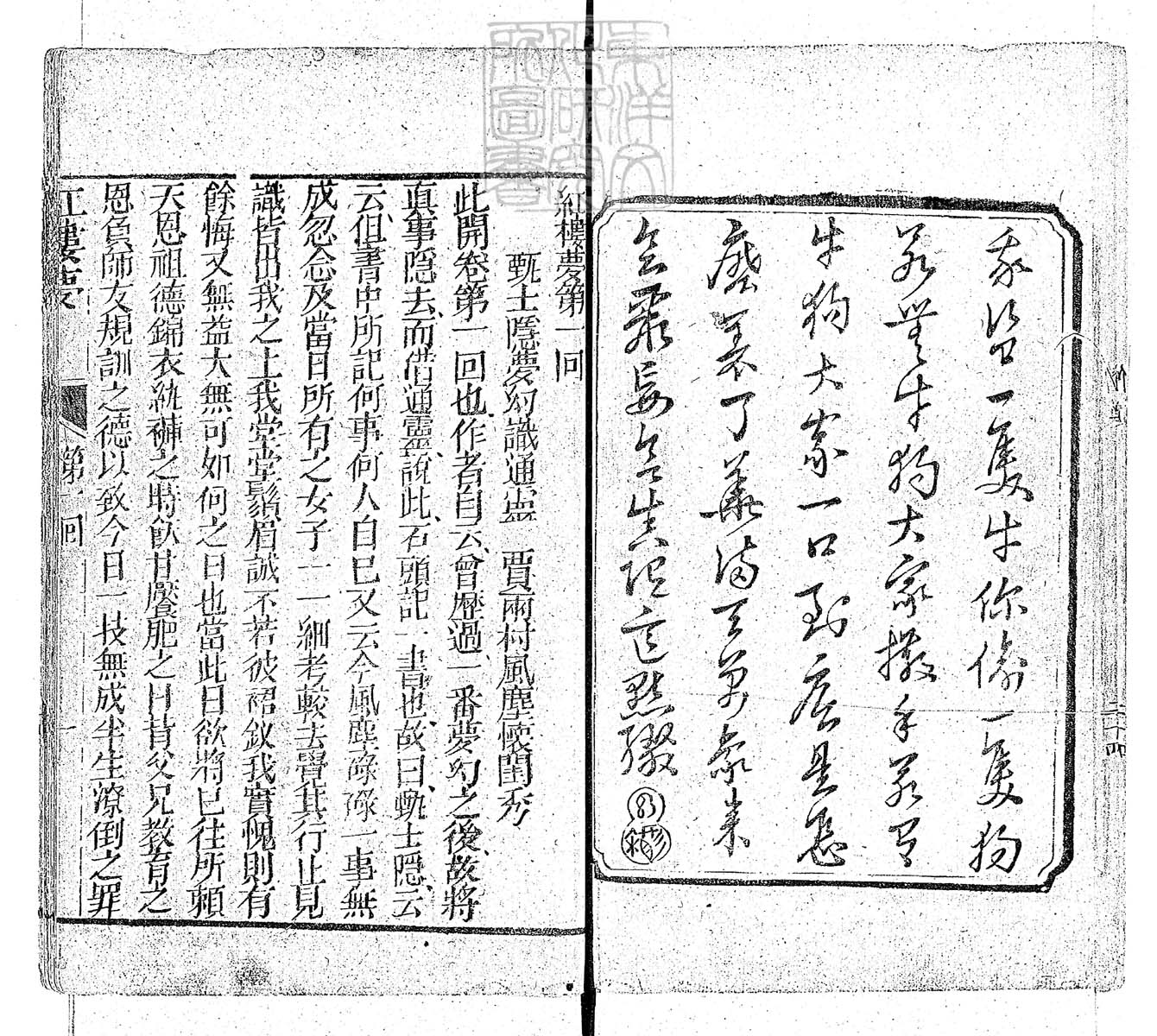
Image context: the cover image is a real archival scan of the first page of a Chengjia edition of Dream of the Red Chamber held through the Institute for Advanced Studies on Asia, University of Tokyo, and available on Wikimedia Commons. Its printed columns make a useful visual threshold: this is a novel obsessed with how memory becomes text, how text becomes inheritance, and how inheritance never stops being contested.[7]
1. The stone is origin, witness, and failed usefulness
The University of Minnesota's introduction to the text notes that the novel begins, in David Hawkes's translation, by asking about "the origin of this book."[3] That opening question matters because it makes the book suspicious of ordinary beginnings. The story does not simply start with a family, a house, or a protagonist. It begins by making narrative origin into an object problem: where did this account come from, who handled it, what sort of thing was it before it became a book?[1][3]
That is why the stone is more than a mythic ornament. It is material origin and rejected instrument at once. The stone belongs to a cosmic repair story, but its literary power comes from having been left over. It carries the wound of not becoming useful in the way the larger order expected. Then it becomes record-bearing matter. A failed material object turns into a witness, and that witness eventually becomes story.[1][6]
This structure gives the whole novel a peculiar ethical shape. The stone does not stand outside the human world as a pure metaphysical truth. It enters human life precisely through insufficiency, longing, and belated narration. The result is a book in which prestige is never secure. A family can look magnificent and be collapsing. A jewel can look like blessing and behave like burden. A poem can look like elegance and preserve grief. A memory can look private and already be on its way to becoming public text.[1][2][4]
2. Jade turns identity into an object other people can read
Baoyu's jade is the stone motif made social. It comes attached to him so closely that it helps define how others read him before he can fully define himself.[1] That is the first trap. A token that seems to promise singularity also makes him legible to a household hungry for signs, predictions, and family continuity. The jade does not merely express identity. It puts identity into circulation.
Britannica's short account of Cao Xueqin is helpful here because it frames the novel through family decline and the "ill-fated love" between Baoyu and Daiyu while also noting its partly autobiographical relation to the Cao family's loss of power.[2] In that world, identity is never merely inward. It is interpreted through lineage, money, office, marriage value, omen, and reputation.[2][4] The jade condenses that social pressure into one portable object.
This is why the jade can feel both intimate and impersonal. It belongs to Baoyu's body story, yet it also belongs to the household's interpretive economy. People look at him through it. They imagine futures through it. They read deviation and destiny into it. The novel's emotional intelligence lies in showing how exhausting that can be. Baoyu's tenderness, resistance to examination culture, attachment to girls' company, and refusal to become the expected family instrument are all sharpened by the fact that he has already been made symbolic.[1][2]
3. The garden is freedom with gates around it
The Prospect Garden is one of the novel's great inventions because it offers an alternate social climate without pretending to abolish the climate outside it. Within its walls, young women compose, joke, compete, mourn, and form a culture of attention that feels more responsive than the senior household's formal authority.[1][3] The garden gives feeling a roomier grammar.
Yet the garden never becomes simple escape. It is built by wealth, authorized by family hierarchy, and vulnerable to inspection. Its beauty depends on the same social machine that eventually threatens it.[1][4] That is what makes it so moving. A weaker novel might turn the garden into Eden and the outer household into corruption. Dream of the Red Chamber does something sharper. It lets the garden become a temporary arrangement where poetry, friendship, rivalry, illness, and desire can breathe, then keeps reminding the reader that temporary arrangements are still arrangements.
The University of Minnesota material on authorship and the social world emphasizes how scholarship keeps returning to the Cao family's fall and to the novel's dense domestic world.[4] The garden is where those scales meet. It is intimate enough to hold poems and glances; it is institutional enough to reveal who receives space, who serves, who watches, who is watched, and who can be moved when the family's needs change.[1][4]
4. Dream is not escape from reality; it is reality's x-ray
The word "dream" in the title can tempt readers toward a soft interpretation: life is illusion, beauty passes, desire deceives. The novel certainly contains Buddhist and Daoist pressure, and Penguin's description of the Hawkes translation points to a work infused with Buddhist belief.[5] But dream in this book is not a mist laid over reality. It is a device for seeing how reality is already theatrical, scripted, and fragile.[1][5]
Dream reveals pattern. It shows that the family's rituals, romantic gestures, poems, apartments, visits, illnesses, and quarrels are not random domestic episodes. They are part of a world moving toward record and loss. Anthony C. Yu's Rereading the Stone is useful even at the title level because it foregrounds desire and fiction-making together: the stone is not merely a symbol inside the fiction, but a way of thinking about how fiction itself gets made from longing, repetition, and narrated memory.[6]
That is why the dream motif does not cancel the social novel. It intensifies it. If everything were only illusion, the household's economics, gender hierarchy, marriage arrangements, and servant labor would lose force. Cao's point is subtler: institutions themselves can be dreamlike because they depend on shared fictions, ritualized language, inherited expectations, and controlled appearances. Dream is not the opposite of social reality. It is the form social reality takes when everyone is acting inside a script they did not write.[1][3][5]
5. The motifs work because they correct one another
The stone without the garden would be too abstract. The garden without the jade would be too pastoral. The jade without the dream would look like destiny rather than interpretation. The dream without the stone would dissolve the book's material stubbornness. Cao's symbolic system works because each motif limits and sharpens the others.[1][5][6]
Stone gives the book a problem of origin and record. Jade brings that problem into the body and the household. Garden gives the social world a temporary lyric interior. Dream keeps revealing that even the most vivid interior is already shadowed by time, narration, and loss. Together they make Dream of the Red Chamber feel unusually alive: a family chronicle that knows it is also a metaphysical document, a love story that knows it is also a study of signs, and a novel of rooms that keeps asking what survives once rooms become pages.[1][2][6]
That is the real use of a motif map here. It should not reduce the novel to symbols. It should show why the symbols refuse reduction. In Dream of the Red Chamber, objects and spaces are never merely meaningful. They are contested ways of living. A stone wants to be read. A jade makes a person readable before he is ready. A garden lets feeling speak under permission. A dream turns beauty into evidence after beauty has begun to vanish. The novel's greatness lies in how patiently it lets those systems touch, fail, and remember one another.[1][3][5]
Sources
- Cao Xueqin, Hung Lou Meng, or, the Dream of the Red Chamber, a Chinese Novel, Book I, translated by H. Bencraft Joly, Project Gutenberg ebook 9603.
- Encyclopaedia Britannica, "Cao Zhan" - biographical context, Cao Xueqin identification, family decline, and the novel's central relationship.
- Ann Waltner, Dream of the Red Chamber: Afterlives, "Introduction to the Text," University of Minnesota Libraries Publishing.
- Ann Waltner, Dream of the Red Chamber: Afterlives, "Authorship," University of Minnesota Libraries Publishing.
- Penguin Random House, The Story of the Stone, Volume I by Cao Xueqin, translated with an introduction by David Hawkes.
- Anthony C. Yu, Rereading the Stone: Desire and the Making of Fiction in Dream of the Red Chamber, Princeton University Press / De Gruyter front matter.
- Wikimedia Commons, "File:紅樓夢(程甲本)第一頁-乾隆五十六年序 刊本.jpg" - source page for the archival Chengjia-edition page image.