The Souls of Black Folk is usually remembered through its great conceptual phrases: the color-line, the veil, double-consciousness. That memory is deserved, but it can make the book sound more abstract than it is. Du Bois's 1903 collection does not simply state an argument about Black life in the United States. It builds a literary machine in which sociology, autobiography, political indictment, lyric meditation, spirituals, and short fiction press on one another until the argument has texture, rhythm, and voice.[1][2][4]
The book's afterlife depends on that mixed form. A thinner version of the same claims might have survived as political theory. The Souls of Black Folk survived as literature because Du Bois made political analysis pass through scenes, songs, thresholds, remembered classrooms, family loss, and narrative experiment. The famous sentence about the twentieth century's "color-line" is not a detachable slogan. It is a gate into a book that keeps asking how a social fact becomes inner weather, public law, school policy, religious memory, and art.[1][2][3]
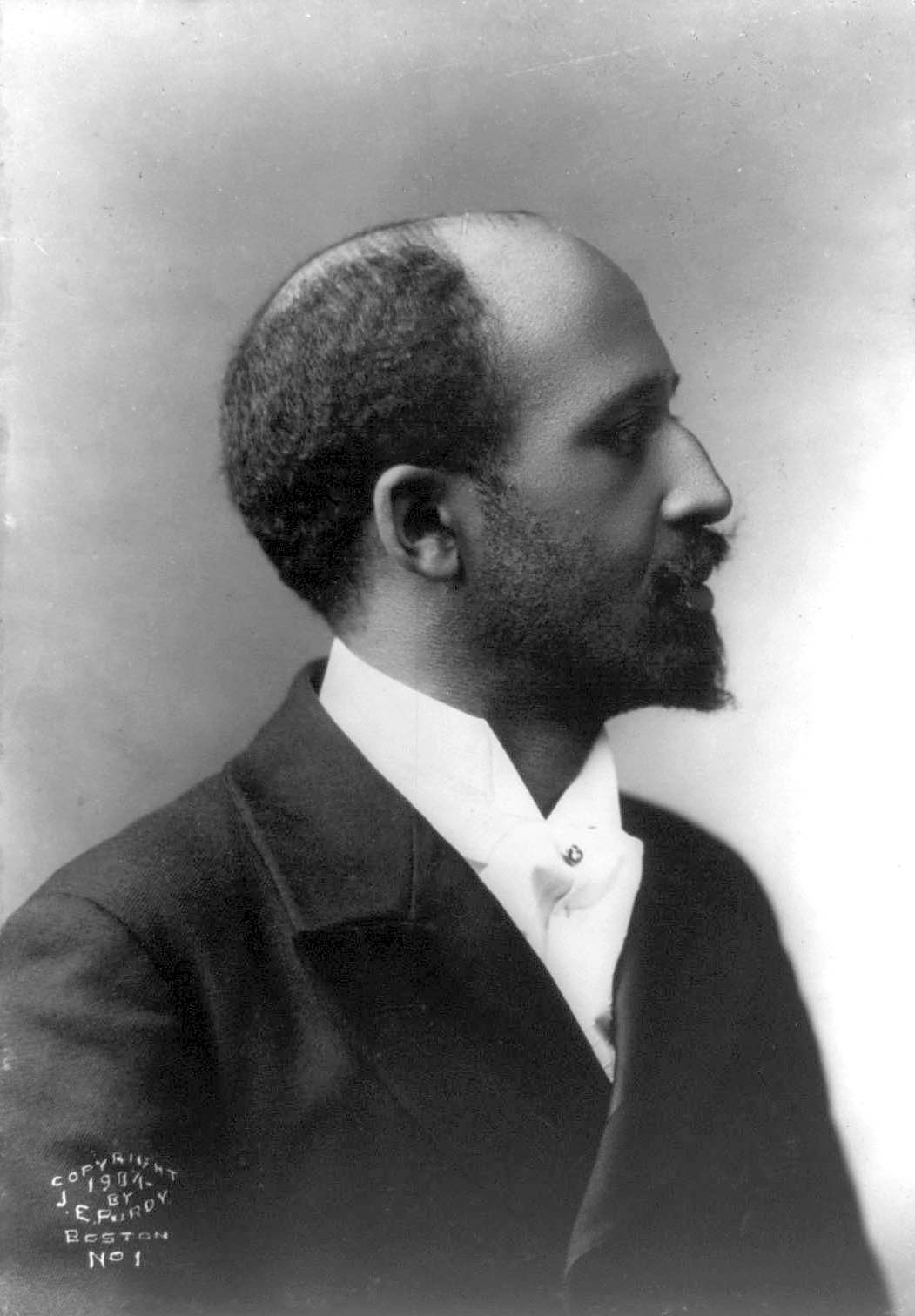
Image context: the cover uses James E. Purdy's 1904 photographic portrait of Du Bois, available through Wikimedia Commons and linked there to the Library of Congress Prints and Photographs Division. The date matters. The image is almost contemporary with the 1903 book, and it shows Du Bois not as a later monument but as a young public intellectual whose literary and political authority was still taking shape.[6]
1. The book arrived as argument, but it moved like a composed sequence
Project Gutenberg identifies The Souls of Black Folk as a 1903 collection of essays by W. E. B. Du Bois, and its catalog placement already shows the book's generic spread: African American writers, essays and speeches, American history, sociology, and politics.[1] Those labels are all accurate, and none is sufficient alone. The book keeps crossing borders because Du Bois understood that the subject itself crossed borders. Race was law, labor, schooling, memory, feeling, music, and vision at once.[1][2]
That is why the sequence matters. The opening chapters define the central pressure: how Black Americans are forced to live within a national promise that names them and refuses them at the same time. The later chapters test that pressure in education, labor, rural Georgia, religion, and cultural memory.[1][3] Du Bois's movement is cumulative rather than merely topical. Each chapter adds a different instrument to the same score.
Britannica's biographical account helps place the book's immediate public force. It notes Du Bois's empirical social-science work before 1903, including The Philadelphia Negro, and then frames The Souls of Black Folk as the book in which his opposition to Booker T. Washington's accommodationist program crystallized.[3] That conflict matters, but reducing the book to a Washington debate shrinks it. Du Bois is doing something broader: turning the conditions of Black citizenship into a theory of perception and a literary form.
2. The veil is a social image before it is a metaphor
The veil remains one of the book's strongest inventions because it is at once visible and interpretive. It marks separation, but it also marks distorted sight. One can look through a veil, be looked at through one, and be misread because the surface between people has become a social structure.[1][2]
The Stanford Encyclopedia of Philosophy's entry on double-consciousness is useful here because it refuses to treat Du Bois's key language as a simple psychological catchphrase. It locates double-consciousness in a larger account of racialized oppression, public disvaluation, and the inward "twoness" produced by that social world.[2] In the book, the veil names the condition that makes this twoness more than private mood. It is not just how a person feels. It is how a world has been arranged so that self-knowledge is forced to pass through another group's contempt, curiosity, law, and measurement.[1][2]
This is where Du Bois's prose becomes literary in the strongest sense. He does not define the veil once and file it away. He lets it recur as atmosphere. It covers schoolrooms, churches, labor systems, and the encounter between Black striving and white interpretation.[1] The image has enough flexibility to hold pain, irony, anger, and analytic clarity without collapsing them into one flat doctrine.
3. Double-consciousness became canonical because the sentence has pressure inside it
Du Bois's phrase "two souls, two thoughts" has lasted partly because it is conceptually precise, and partly because it sounds like divided music.[1] The line turns political injury into a rhythm of doubleness. The problem is not merely that Black Americans must understand white judgment. The problem is that this judgment enters the conditions under which the self becomes legible at all.[1][2]
That is why later reception has never left the phrase alone. The Stanford Encyclopedia of Philosophy emphasizes that the term appeared in Du Bois's 1897 Atlantic article and again in The Souls of Black Folk, then disappeared from his later published writing even as its interpretive afterlife expanded.[2] The concept became larger in reception than its literal recurrence in Du Bois's own vocabulary. That imbalance is telling. Readers kept returning to it because the book had given a name to a structure of experience that outlived the exact page on which it appeared.
Still, the best reading keeps double-consciousness inside the book's formal system. It is tied to the veil, to the education chapters, to the critique of narrow industrial training, to the chapter on Alexander Crummell, and to "Of the Coming of John," where fiction carries an argument about aspiration, return, violence, and impossible recognition.[1][2][3] Double-consciousness is not a standalone aphorism. It is a pressure that the whole book keeps staging.
4. The chapter epigraphs and spirituals make argument audible
One reason the book feels unlike ordinary political prose is that each chapter begins with paired epigraphs: literary quotation and musical notation from the spiritual tradition.[1][4] This device is not ornament. It changes the reader's ear before the argument begins. Du Bois makes the chapter threshold into a meeting place between European literary inheritance and Black song, then asks the prose to carry both.
Library of America describes the book as a collection of fourteen essays that are lyrical, historical, and autobiographical, and stresses its attention to the paradox of double-consciousness.[4] That description is exact because the book's lyricism is structural. The spirituals do not merely decorate the chapters with cultural authenticity. They insist that Black expressive life is a source of knowledge. Song becomes archive, philosophy, and evidence.[1][4]
This is especially important because Du Bois is arguing against several kinds of reduction at once. He resists the reduction of Black people to labor force, to social problem, to sentimental object, to statistical case, and to someone else's political compromise.[1][3] The spirituals keep opening another register. They say that the group being analyzed also speaks, remembers, worships, mourns, and composes. Form becomes a rebuttal.
5. Reception has kept widening the book, not simplifying it
The book's institutional afterlife shows how far its mixed form traveled. The National Archives page on the papers of W. E. B. Du Bois calls The Souls of Black Folk his most famous book and notes its lasting impact on Black and white consciousness.[5] Library of America keeps it in print as a classic of American letters.[4] Stanford treats double-consciousness as a major philosophical concept with a long scholarly career.[2] Project Gutenberg makes the primary text freely available as public-domain literature.[1]
Those different homes matter: archive, literary canon, philosophy, digital public-domain library. They confirm that the book was never only one thing. It can be read as political intervention, American prose, Africana philosophy, cultural history, educational argument, and literary experiment.[1][2][4][5] The danger in reception is to choose one of those identities and let it silence the rest.
A better reception history sees the book's power in its refusal to flatten. Du Bois writes with a sociologist's appetite for structure, a polemicist's urgency, a memoirist's memory, a critic's ear, and a fiction writer's sense of scene.[1][3][4] That is why the book still feels alive. It does not ask the reader merely to agree with a claim. It asks the reader to inhabit a form of divided perception long enough to understand why policy, schooling, labor, religion, and art cannot be separated cleanly.
6. Why the book still teaches form
The cleanest way to read The Souls of Black Folk now is to treat its form as the argument's first evidence. If the book had been only a list of propositions, it would have betrayed its own subject. Du Bois is writing about a life-world in which social pressure becomes inner division, public exclusion becomes private discipline, and song carries historical knowledge that official systems ignore.[1][2][4]
The book therefore has to be multiple. It has to think in concepts and in images. It has to cite social fact and make room for grief. It has to argue with Washington and with the nation, but also listen to the "Sorrow Songs" as an archive of what argument alone cannot hold.[1][3][4] Its literary achievement lies in that discipline of mixture. Du Bois does not use beauty to soften politics. He uses form to show that politics has already entered vision, sound, memory, and selfhood.
That is why the book remains more than a historical document from 1903. It is a lesson in how style can carry structural analysis without turning human life into abstraction. The veil gives separation an image. Double-consciousness gives divided perception a name. The spirituals give the book a collective voice before and beneath its essays. Together, they make The Souls of Black Folk one of the rare works whose reception has not exhausted its form. The book still asks to be read slowly because its deepest political claim is inseparable from the way it sounds.[1][2][4]
Sources
- W. E. B. Du Bois, The Souls of Black Folk (Project Gutenberg ebook 408).
- Stanford Encyclopedia of Philosophy, "Double Consciousness."
- Encyclopaedia Britannica, "W. E. B. Du Bois."
- Library of America, "W. E. B. Du Bois: The Souls of Black Folk (Paperback Classic)."
- National Archives, "Papers of W. E. B. DuBois."
- Wikimedia Commons, "File:WEB Du Bois.jpg" (1904 James E. Purdy portrait, Library of Congress source noted on file page).