Waiting for Godot begins by refusing the reader nearly everything that usually helps a play settle into place. The stage direction gives us "A country road. A tree. Evening." Estragon then struggles with his boot, gives up, rests, tries again, and says: "Nothing to be done."[1] That little beginning is so spare that it can be mistaken for emptiness. In practice, it is a complete grammar. Place, object, hour, effort, failure, repetition, speech: Beckett puts the play's whole machine onstage before Vladimir has even entered.
The Grove edition presents the work as a tragicomedy translated from French by Beckett himself, and the Nobel biographical note places Waiting for Godot among the late-1940s works in which war, exile, deprivation, and bilingual self-translation hardened into a new theatrical pressure.[1][2] The first English-language London production opened at the Arts Theatre in 1955, after the French premiere had already made the play a problem for audiences trained to expect plot as forward motion.[5] Yet the opening does not announce difficulty with a manifesto. It starts with a sore foot.
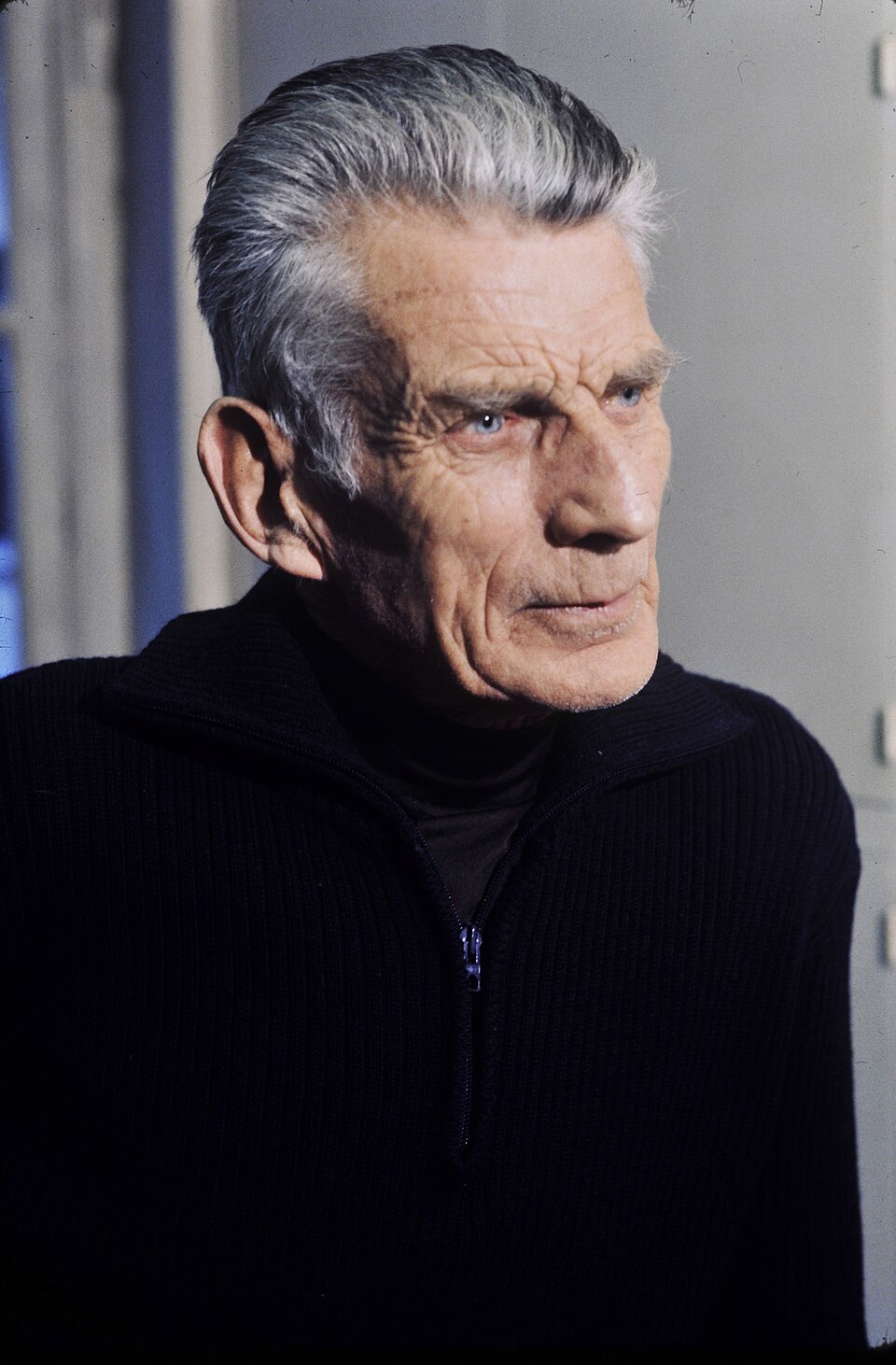
Image context: the cover uses Roger Pic's 1977 photograph of Beckett, preserved through the Bibliotheque nationale de France and Wikimedia Commons.[6] The image is not a substitute for the play's landscape, but it suits the article's scale: Beckett's theatrical austerity often feels less like blankness than like a face held still until every small movement becomes visible.
The road is a stage, not a destination
The road in the first line has no named country, no visible town, and no announced direction.[1] A road normally promises passage. Here it supplies the conditions for non-passage. Vladimir and Estragon will meet people on it, discuss leaving it, receive messages on it, and remain on it. The image is almost aggressively ordinary, but its ordinariness is what makes it theatrical. A road can hold arrival, departure, delay, and return without needing scenery to explain itself.
The tree does similar work. It is minimal enough to look symbolic and concrete enough to resist being solved. It marks the place where waiting gathers. It also gives the stage a vertical line against the horizontal road, a little architecture of expectation. By the time the Nobel ceremony speech later described Godot as a figure of "perpetual, uncertain expectation," it was naming something the opening had already built out of almost nothing: a place where waiting becomes the action rather than the interval before action.[3]
Evening matters because it arrives already late. The play does not begin at morning, with plans available, or at noon, with business underway. It begins in the hour when one takes stock, when fatigue has accumulated and departure must either happen soon or be postponed. That is why Estragon's boot is not comic business on the side. It is the first argument of the play. The body has its own schedule, and the body's schedule keeps interrupting metaphysics.
The boot makes thought physical
Estragon's boot turns abstraction into a practical problem. He cannot remove it easily; he tries, fails, rests, and tries again.[1] The audience watches exertion before it hears explanation. This is crucial because Godot is often summarized as a play about waiting, meaning, God, absence, or modern despair. Those abstractions are not wrong, but the opening insists that any such reading pass through feet, pain, clothes, hunger, sleeping outdoors, and the ridiculous dignity of someone wrestling with footwear.
"Nothing to be done" is therefore not a philosophical thesis first. It is a verdict on a task. Estragon cannot get the boot off. Only after Vladimir enters does the phrase begin to widen into habit, worldview, rhythm, and comic refrain.[1] The sentence grows because Beckett lets it start small. A failed gesture becomes a way of speaking; a way of speaking becomes a structure for the evening.
Vladimir's hat later answers Estragon's boot.[1] One man keeps checking the lower body, the other keeps inspecting the upper. Foot and head, pain and thought, earth and idea: Beckett turns the comic pair into a set of paired instruments. The movement is clownish, but the pattern is exact. What cannot be solved in the boot is repeated in the hat. The play's famous metaphysics arrives through routine maintenance.
Companionship begins as irritation
Vladimir's entrance changes the energy without changing the condition. Estragon is still there; the road is still there; the boot is still there. But the sentence can now be heard by someone else.[1] That is the first real development. Beckett makes companionship begin as repetition with an audience.
The relationship is tender because it is irritable. Vladimir is glad Estragon has returned, then almost immediately corrects, questions, remembers, lectures, and worries. Estragon resists, complains, and depends. Their bond has no clean sentimental surface. It is made from old habits, bad nights, bodily complaints, shared routines, and the fact that each man's speech needs the other's interruption to keep going. The opening establishes that pattern before the plot has had a chance to pretend to advance.
This is why Cambridge's critical description of the play as one of the most frequently discussed and influential works in theatre history still depends, at ground level, on the minute organization of stage business.[4] Influence did not come only from the idea that "nothing happens." It came from Beckett's discovery that almost nothing can happen with terrifying precision. A boot comes off, a hat is searched, a question returns, and time thickens.
The first sentence is a trapdoor
The danger in reading the opening is to make "Nothing to be done" too grand too quickly. Beckett's brilliance is that the line keeps changing its radius.[1] It begins as frustration, then becomes a greeting, then a comic rhythm, then a way to describe the whole theatrical world. The same words fit the boot, the road, the absent Godot, and the human desire for a structure that would turn delay into meaning.
The Nobel ceremony speech's account of the play's final uncertainty helps explain why the opening is so hard to exhaust.[3] At the end, the audience still receives no stable account of Godot. At the beginning, it receives no stable account of the road. Both absences are active. The play does not hide information so that a later revelation can release it. It arranges lack as a continuing condition, then watches how language, memory, jokes, theology, routine, and companionship try to live inside it.
That is why the first stage direction remains one of modern drama's most efficient doors. Road, tree, evening: three plain nouns and an hour. Add a boot that will not yield, a man who cannot stop trying, another man who cannot stop returning, and the stage has already become a world. Beckett's opening is small because the problem it stages is large. The less it gives us, the more exactly we have to watch.
Sources
- Grove Atlantic, Waiting for Godot by Samuel Beckett (publisher page with edition data and opening excerpt).
- NobelPrize.org, "Samuel Beckett - Facts" (1969 Nobel biographical and work context).
- NobelPrize.org, "Award ceremony speech" for the 1969 Nobel Prize in Literature (reception and interpretive framing of Waiting for Godot).
- Cambridge University Press, Lawrence Graver, Beckett: Waiting for Godot (critical study and influence context).
- Theatricalia, Waiting for Godot production record (Arts Theatre, London, 3 August 1955).
- Wikimedia Commons, "File:Samuel Beckett, f11.jpg" (Roger Pic 1977 archival photograph used for the lead image).