
A conservator lowers a handwritten page into liquid and then lifts away a translucent skin. The gesture looks alarmingly like damage until its history becomes clear: the silk gauze was not Charles Dickens's. It was an early-twentieth-century repair that had grown brittle, altered the paper's flexibility, and outlived its protective purpose.[1][2]
The object beneath that repair is the only surviving manuscript of A Christmas Carol. Dickens drafted its 66 numbered pages in about six weeks in autumn 1843, completed the story on December 2, and sent the folded leaves to the printer for a December 19 publication. The hundreds of cancellations and substitutions appear to belong largely to the same rush of composition, not to a separate, leisurely revision stage.[3][4]
That makes the Morgan Library & Museum's four-and-a-half-minute conservation film unusually valuable to a reader. It shows how an archive can intervene without pretending to return an object to an untouched state. It also makes a literary point that clean print conceals: A Christmas Carol did not arrive as a polished seasonal parable. Its speed is visible because its second thoughts are still on the page.
0:18 — Preservation has a history
The film's first close view turns the word original into a problem. Fine silk had been pasted to the blank side of every sheet, probably between 1910 and 1920. Silking was then a respected way to reinforce paper. A century later, the gauze was brittle and ineffective, while its adhesive had become another material the conservators had to manage.[2]
This is not a simple fable about foolish predecessors and enlightened modern experts. The old treatment helped the manuscript survive into a later conservation era; the new treatment depends on knowledge and materials that may themselves be reassessed. What changes is the archive's willingness to document an intervention as an intervention. The page has a biography after Dickens, and responsible access begins by refusing to hide it.
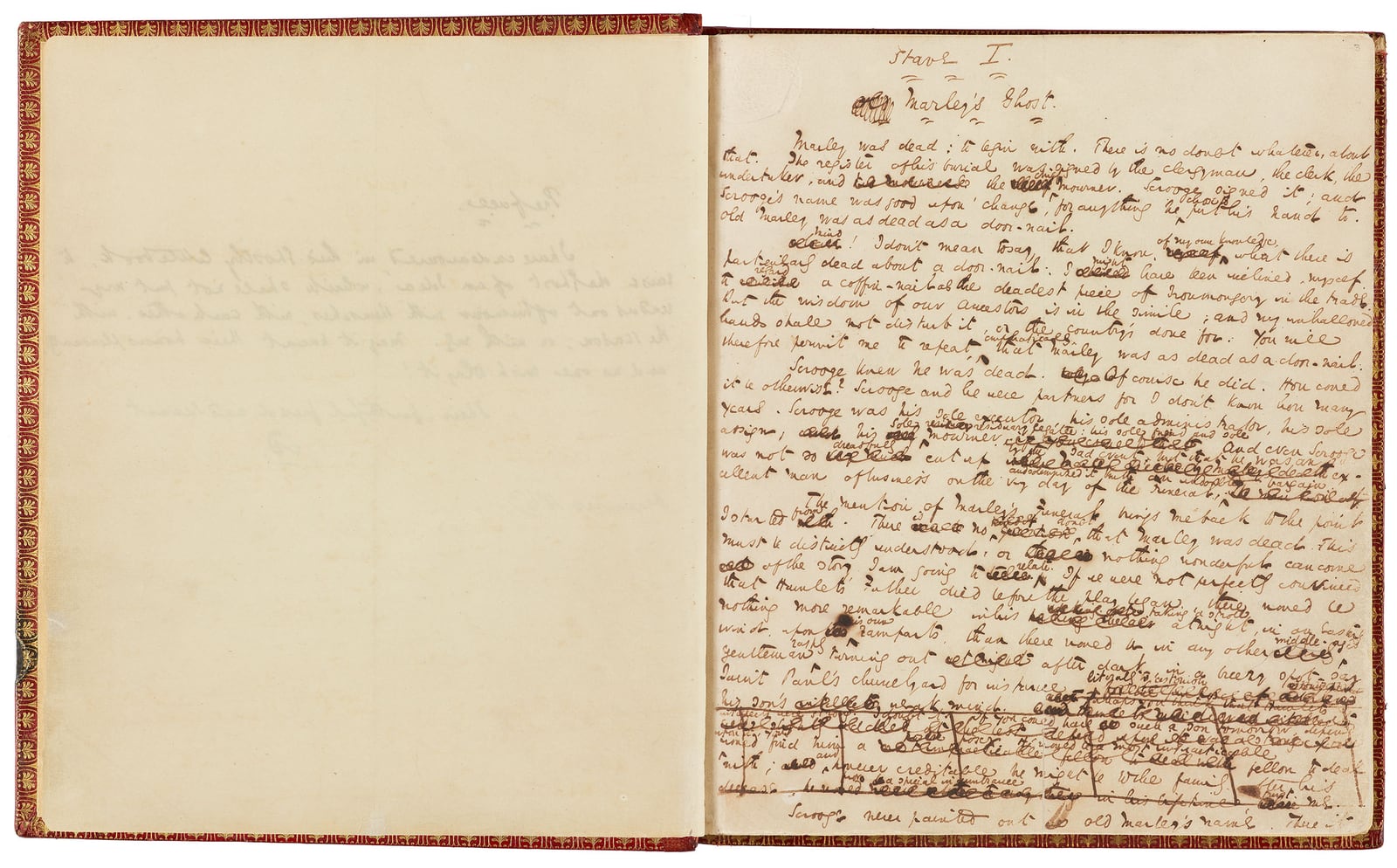
The cover image carries that layered history. It is a color photograph of the actual bound manuscript after treatment, not a typeset imitation or a before-and-after graphic. On the right, brown iron-gall ink crowds the opening leaf; on the left, writing from the preceding side shows faintly through the paper. The crimson binding frames both the text and the evidence of use.[5]
1:10 — Treatment begins with limits
Before washing anything, the Morgan team examined, tested, photographed, and documented the ink, rag paper, and binding. The manuscript was then disbound. Its sheets could tolerate a shallow water-and-alcohol bath because Dickens had written on strong paper made from cotton or linen rags, and because testing showed that his iron-gall ink was water-resistant.[2]
That sequence matters more than the apparent drama of submersion. Conservation is not a universal recipe called “wash the old paper.” The decision follows from this ink, this support, this adhesive, and this binding. Iron-gall ink adheres well but is acidic; another manuscript may have fugitive color, weakened fibers, or evidence in its sewing that should not be disturbed. The film's calm hands are the visible end of a chain of conditional judgments.
Reading a draft requires the same discipline. A deletion is evidence that Dickens rejected something, but not automatic proof of why. A replacement may be shorter or more active—patterns the Morgan identifies across the manuscript—without giving every individual change a single recoverable motive.[3][4] Material evidence narrows interpretation; it does not abolish uncertainty.
1:40 — Removing silk reveals literary editing
Around 1:40, the dissolved adhesive releases and the gauze is lifted from the wet sheet. Nothing spectacular is added. The gain is separation: silk becomes distinguishable from paper, later repair from 1843 artifact, conservation choice from authorial mark.[1][2]
Return from that scene to manuscript page 1. The famous opening, “Marley was dead: to begin with,” now sits amid crossings-out, insertions, and crowded lines.[5] Its repeated insistence that Marley is dead can sound inevitable in print. On the leaf, inevitability is something Dickens constructed. He tests the legal and commercial vocabulary around burial, inheritance, partnership, and Scrooge's signature; he tightens the narrator's comic overproof until disbelief itself becomes the joke.
The page does not disclose every abandoned phrase. Dickens often struck out wording with a continuous looping pen movement that was effective precisely because it made first thoughts hard to decipher.[4] Removing silk can improve access to the sheet, but it cannot reverse an author's deliberate cancellation. The film therefore restores evidence without manufacturing completeness.
This distinction protects the manuscript from two opposite myths. One is that genius produced the tale in a six-week trance with no craft between impulse and print. The other is that every blot can be decoded into a secret, superior version. What survives is more interesting: fast composition and revision happening together, with some alternatives legible and others permanently folded into the texture of refusal.
3:00 — A repaired page is not a reset page
After the silk comes off, the sheets receive a calcium-carbonate-enriched wash to reduce soluble acids and residual adhesive. They are air-dried, humidified, placed between blotters under weight, and locally mended with thin Japanese tissue and diluted wheat-starch paste where needed.[2] At about 3:00, drying and flattening replace the video's earlier liquid movement with patience.
Flattening here does not mean making the manuscript look newly manufactured. The brown ink, strikeouts, show-through, folds, and edge wear remain historical information. Nor does disbinding erase the bound object's history: the treatment record tells us what was separated and why. The digital facsimile is likewise not a view from nowhere. The Morgan photographed these pages after the 2011 treatment, so today's extraordinary online legibility is one outcome of conservation, imaging, transcription, and interface design.[3]
That mediation can enlarge scholarship when it stays visible. The Dickens Project's later collaboration with the Morgan and the Victoria and Albert Museum invited readers to help decipher deleted and revised manuscript material, treating difficult handwriting as a shared research problem rather than smoothing it away.[7] High-resolution access does not replace the object; it lets more readers test claims against marks on the page.
What the manuscript changes about Scrooge
The conservation film never argues about character, yet it changes the conditions of character reading. Scrooge's conversion is often summarized as a supernatural switch from miser to benefactor. The draft shows how strongly Dickens made that change grammatical. On manuscript page 64, the reformed Scrooge “watched,” “patted,” “questioned,” and “looked” as he moved through the city.[6] The old Scrooge's defining action had been refusal; the new one is a chain of outward-facing verbs.
The Morgan's overview observes a broad revision tendency toward more active verbs and fewer words.[3] That pattern suits the novella's moral design. Scrooge does not prove transformation by holding a better opinion in private. He gives, visits, raises a salary, tends a fire, and enters other people's rooms. Revision sharpens the prose toward the same test the plot imposes on its protagonist: feeling must become action.
This is why desilking belongs in a literature article rather than only a conservation report. The treatment does not interpret Dickens for us. It returns distinctions on which interpretation depends—ink and gauze, draft and repair, visible substitution and unreadable cancellation. Once those layers are separate, the manuscript can be read neither as sacred relic nor as transparent transcript. It becomes what it has always been: a working page that kept changing, then survived because later hands changed how it was cared for.
Sources
- The Morgan Library & Museum, “Preserving a Masterpiece: ‘Desilking’ A Christmas Carol,” video with paper conservator Reba Fishman Snyder, YouTube.
- Reba Fishman Snyder and the Thaw Conservation Center, “Preserving the manuscript,” The Morgan Library & Museum, September 23, 2011.
- The Morgan Library & Museum, “Charles Dickens's Christmas Carol,” complete digital facsimile, object history, and composition overview.
- The Morgan Library & Museum, “Dickens at work,” manuscript materials, production chronology, and revision method.
- The Morgan Library & Museum, “004. STAVE I. Marley's Ghost. Page 1,” archival manuscript image, transcription, and object record.
- The Morgan Library & Museum, “067. MA 97, Page 64,” archival manuscript image and transcription of Scrooge's Christmas Day walk.
- The Dickens Project, “Deciphering Dickens with the V&A and the Morgan Library & Museum,” June 10, 2021.