Prosper Mérimée's Carmen does not begin with Carmen. It begins with a French antiquarian in Andalusia, looking for the site of a Roman battle and amusing himself with the idea that his research will settle a question for “the whole of learned Europe.” Only then does he announce, with mock modesty, “I desire to relate a little tale.”[1] The sentence establishes the novella's governing privilege: before Carmen can become a character, a traveling scholar gets to decide what kind of knowledge she will be.
When Carmen finally appears, she is caught inside another man's account. The scholar meets the outlaw Don José, later visits him in prison, and records José's long confession about the woman he murdered. Carmen speaks vividly inside that confession, but José chooses the scenes, supplies the descriptions, interprets her motives, and survives to narrate her death. The story's most durable assertion—“Carmen will always be free”—reaches the reader in the murderer's voice.[1]
Georges Bizet's 1875 opera changed more than medium. Its librettists, Henri Meilhac and Ludovic Halévy, removed the antiquarian, discarded the prison interview, and put the action into chronological, public view. Carmen no longer arrives as evidence in somebody else's retrospective case. She walks into a square, sings her own theory of love, and becomes a role a living performer must create in front of witnesses. That redistribution of narrative authority is the adaptation's great invention. It does not free Carmen from stereotype, surveillance, or her fatal ending. It gives her a present tense—and makes the struggle over who controls that present newly visible.
The novella reaches Carmen through two men
Mérimée's frame is not decorative. Chapter I teaches readers to share the scholar's appetite for dangerous local color. He meets José beside a stream, studies his accent and appearance, guesses that he is a wanted bandit, and enjoys the thrill of proximity. In Chapter II, he meets Carmen in Córdoba and treats fortune-telling, language, clothing, and attraction with the same collecting eye. People become specimens before they become moral claims.[1]
Chapter III replaces the traveler's gaze with José's confession, but not with an unfiltered Carmen. José explains his descent from soldier to smuggler and murderer as a sequence of provocations. He repeatedly calls Carmen deceitful, renders her independence as volatility, and converts his own jealousy into the weather of the story. Yet her reported speech keeps exceeding that account. When José tries to govern her movements, she tells him, “I won't be ordered about.” At the end, she identifies his intention without softening it: he wants to kill her because she no longer loves him.[1]
This creates the novella's central formal tension. José owns the narration, but he cannot make Carmen's refusal sound like consent. His version can prejudice the reader against her, exoticize her, and place every act inside his grievance; it still preserves sentences that expose possession as the grievance's real name.
The later standalone text intensifies the problem by adding a fourth chapter of purported scholarship about Romani history, bodies, customs, and language. The Metropolitan Opera's guide notes both the frame's structure and the added chapter's false, degrading generalizations.[2] After Carmen's burial, the antiquarian returns to classifying the people to whom she belonged. Her individual death slides into a taxonomy. The scholar and the killer use different forms of authority, but both turn her into material for a concluding explanation.
The opera abolishes the alibi of hindsight
Bizet proposed Carmen after receiving an 1872 commission from the Opéra-Comique. Meilhac and Halévy drew on Mérimée's novella, his other Spanish writings, and his French translation of Pushkin's The Gypsies; neither librettists nor composer had visited Spain.[2][3] The adaptation was already a layered act of reading, borrowing, and imagined geography before a note reached the stage.
Its sharpest cut is the outer narrator. The opera begins outside the cigarette factory, where soldiers watch a crowd and wait for the women workers. The male gaze has not disappeared; it has been dramatized. Instead of quietly sharing a cultivated traveler's point of view, an audience sees watching happen as a social activity. Carmen enters a space already prepared to turn her into a spectacle, then takes control of the entrance.
The chronological structure changes José even more. Mérimée introduces him as a bandit and lets him reconstruct his own fall. The opera introduces him as a corporal, then makes the audience watch decision and constraint tighten around each other: he releases Carmen, initially refuses to desert, attacks Zuniga, and is left with little choice but to flee with the smugglers; later he threatens Carmen, pleads with her, and finally kills her.[2][3] No prison-cell confession can rearrange cause and blame after the fact. Music gives José extraordinary emotional force, but stage time denies him sole editorial control.
This is why the final confrontation lands differently even though the plot still ends in murder. In the novella, José reports Carmen's steady look and refusal. In the theater, two bodies remain before the audience while celebration sounds from inside the bullring. Public festivity and private coercion occupy the same present. Carmen's refusal cannot be reduced to a line José remembers; it is an action the performer sustains until the last moment.
A heroine assembled in rehearsal
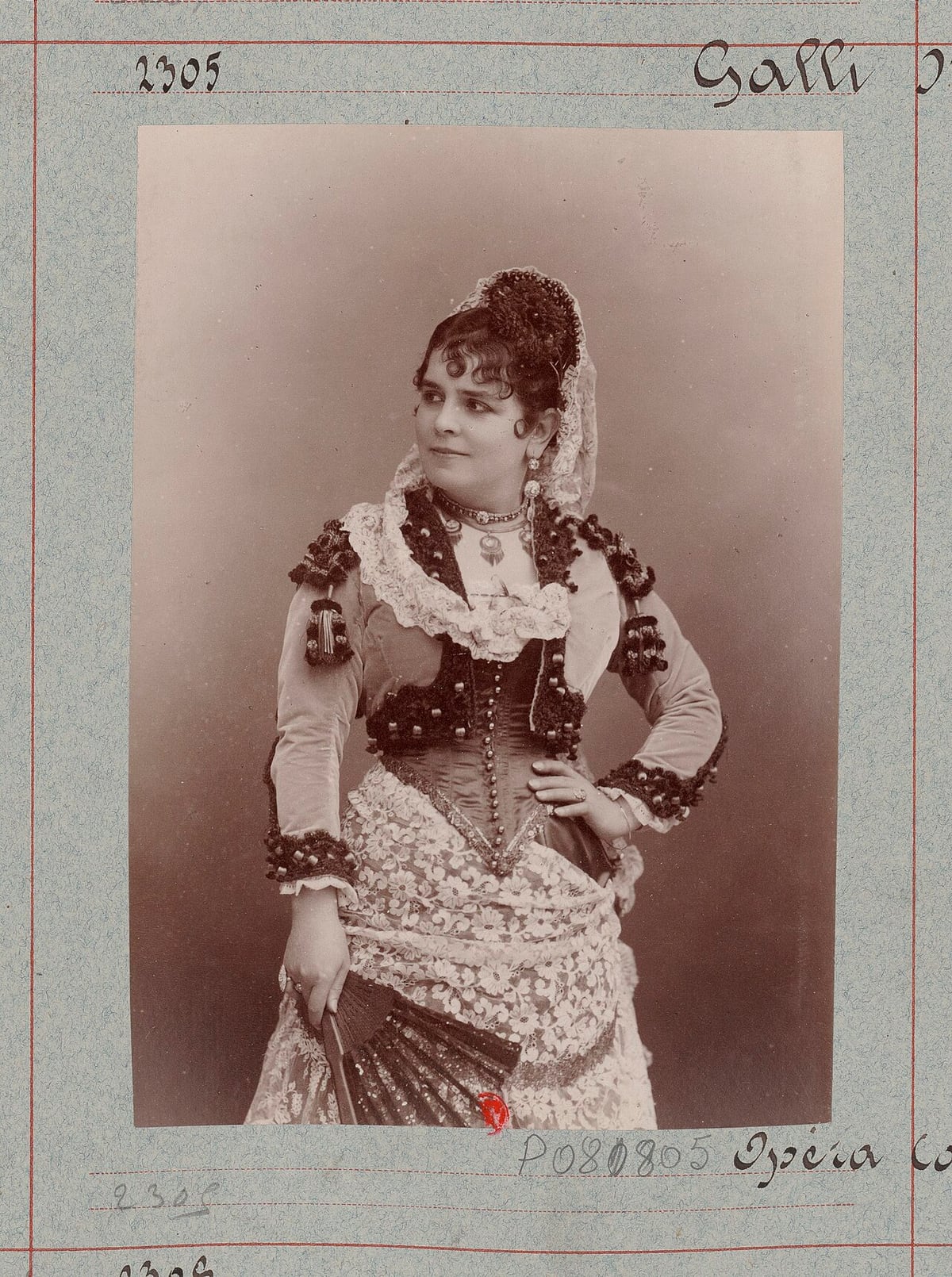
The move from page to stage was never a simple transfer of a finished character. Carmen's most famous entrance emerged through collaboration and resistance, especially from Célestine Galli-Marié, the mezzo-soprano who created the role.
Galli-Marié accepted the part in December 1873 and pressed for a vocal profile suited to the character she believed she could embody. Musicologist Hervé Lacombe traces how her dissatisfaction drove Bizet to replace Carmen's original entrance song during rehearsals. An early biographer, drawing on testimony from Bizet's friend Ernest Guiraud, claimed the number was remade thirteen times before the Habanera took its familiar form.[4] Whether every revision can be assigned cleanly is less important than the documented mechanism: the singer was not a container waiting to receive a finished character. Her range, experience, demands, and stage intelligence changed what audiences would understand Carmen to be.
The result is an entrance built as a proposition. “Love is a rebellious bird,” Carmen sings, describing desire as something that resists summons, law, and capture.[2][4] She does not tell the crowd where she came from or reveal a private psychology. She announces the rule by which she intends to move. The chorus repeats her phrases, so her language enters public circulation before José has answered her.
That authority has a cost. The Habanera's musical exoticism, adapted from a song by Sebastián Iradier, helps mark Carmen as sensually foreign to the Parisian audience. Read beside the source text's degrading taxonomy, the effect continues a racialized fantasy of the Romani woman as instinctive and dangerous.[2][4] Giving a character a spectacular voice is not the same as giving her an interior life. But Galli-Marié's intervention makes the spectacle less one-directional. The woman being watched also sets the tempo, addresses the watchers, and warns them how badly they misunderstand possession.
New characters redraw the moral room
Adaptation also works by invention. Micaëla, the dutiful village woman who carries a message from José's mother, has no counterpart in Mérimée's novella. Neither do Carmen's named companions Mercédès and Frasquita. The librettists transform the picador Lucas into the celebrated bullfighter Escamillo and remove Carmen's husband García from the central plot.[1][2][3]
These changes make the drama stageable, singable, and legible to the Opéra-Comique's family audience. Micaëla embodies the respectable future José abandons; Escamillo gives the crowd a charismatic rival to acclaim; the two friends let Carmen's life extend beyond her relation to José. The simplification is double-edged. Micaëla's virtue can make Carmen seem like its dark opposite, while Escamillo can turn her changing desire into a neat romantic switch. Yet the new ensemble also breaks José's monopoly. Other voices know Carmen, answer her, and continue to exist outside his confession.
The first Paris audience in March 1875 encountered a more disruptive work than those adjustments promised. Galli-Marié's realism, the onstage smoking and fighting, Carmen's sexual autonomy, and her death challenged the venue's conventions. The response was mixed, and Bizet died three months later, before the opera's international success.[3] Later that year, Guiraud supplied recitatives for Vienna, replacing spoken dialogue and helping the work travel through grand-opera houses. Even the canonical Carmen therefore began as competing performance versions, not a single sealed object.[3]
Carmen Jones changes the frame again
Once Carmen existed as a score, a role, and a repeatable sequence of confrontations, later artists could relocate her without returning first to Mérimée's Andalusia. Oscar Hammerstein II's 1943 stage musical Carmen Jones moved Bizet's music into a Black American wartime setting; Otto Preminger's 1954 film adapted that musical, with Dorothy Dandridge as a factory worker and Harry Belafonte as the soldier Joe.[5]
The transposition removes the opera's Romani identity and faux-Spanish setting, but it does not make race disappear. It puts a Black woman's autonomy at the center of a Hollywood production made within an industry that sharply limited Black performers. Dandridge embodies the role onscreen while mezzo-soprano Marilyn Horne supplies the singing voice. Their close collaboration makes the split sound seamless, while Dandridge's physical performance keeps the character from becoming merely an operatic symbol.[5] Their Carmen is neither Mérimée's ethnographic specimen nor simply Galli-Marié's stage descendant. She is a 1950s screen presence negotiating another apparatus of looking.
The fatal structure remains. Carmen Jones does not rescue its heroine by rewriting the ending. What changes is the pressure carried by her claim to self-possession. In a film centered on Black workers, soldiers, ambition, and mobility, Carmen's refusal to belong to Joe speaks beyond a private love plot even as the story punishes it.[5] Jennifer M. Wilks's study of Carmen's African diasporic afterlives follows this portability through novels, films, and stage works across North America, Africa, Europe, and the Caribbean, arguing that transposition lets artists interrogate gender, race, and sexuality rather than merely impose a European original unchanged.[6]
That afterlife helps explain how removing the novella's narrator worked together with music and repertory repetition. A written frame remains fixed each time readers return to it; a role must be embodied again. Every singer, actor, director, translator, and audience reopens the question of whether freedom is a trait assigned to an exotic “type,” a dangerous temptation seen by José, or a claim a woman makes about herself.
The freedom is real, and bounded
It would be too easy to call the opera an emancipation. Carmen is still written by men, framed through borrowed ideas of Spain and Romani life, desired by a crowd, and killed when she refuses possession. The music that amplifies her also makes her endlessly consumable. Adaptation does not remove the cage; it changes its materials.
But form determines where resistance can occur. Mérimée gives Carmen some of her strongest words and then encloses them inside José's confession and the scholar's classification. Bizet, Meilhac, Halévy, and Galli-Marié move those words' underlying claim into performance. José can no longer be the only person who tells us how she looked when she refused him. We have to watch her refuse.
That is the durable change. Carmen did not escape her ending. She escaped a single narrator. In the space that opened, performers could make her entrance sharper, her silence heavier, her fatalism colder, or her appetite for life more vivid. The story became more contestable because the woman at its center had to enter the room again.
Sources
- Prosper Mérimée, Carmen, translated by Lady Mary Loyd — complete novella, including the antiquarian frame, Don José's confession, and Chapter IV (Project Gutenberg).
- Metropolitan Opera, “The Opera's Plot and Creation” — comparison of Mérimée's frame, the added Romani ethnography, Pushkin's influence, and the opera's invented characters.
- Opéra-Comique, “À lire avant le spectacle — Carmen” — commission, adaptation process, 1875 premiere, reception, recitative version, and early international afterlife.
- Hervé Lacombe, “La Habanera de Carmen et Célestine Galli-Marié,” Opéra-Comique — archival account of Galli-Marié's role in reshaping Carmen's entrance aria.
- Alex Ramon, “Finest hours: Dorothy Dandridge's sultry temptress in Carmen Jones,” BFI, July 11, 2025 — adaptation chain, wartime transposition, and Dandridge-Horne performance.
- Jennifer M. Wilks, Carmen in Diaspora: Adaptation, Race, and Opera's Most Famous Character, Oxford University Press, 2024 — study overview and map of African diasporic afterlives.
- Wikimedia Commons, “Atelier Nadar — Galli-Marié in Bizet's Carmen — Original” — archival photograph from Gallica, dated between 1875 and 1883.