The most arresting thing about the opening of Daniel Deronda is how quickly George Eliot makes glamour feel unstable.[1] The novel starts in a resort casino at Leubronn, under gaslight, amid coins, hired leisure, and social display.[1][4] A young woman is winning at roulette, beautifully dressed, watched by others, and perfectly placed for a conventional nineteenth-century entrance. Yet Eliot refuses to let the scene settle into charm. Before she gives Gwendolen Harleth a backstory, a moral program, or a love plot, she puts her under a look she cannot manage. The result is one of the sharpest openings in Victorian fiction: a first encounter staged less as attraction than as exposure.[1][2]
That technical choice matters for the whole novel. Daniel Deronda, Eliot's final novel, is often discussed for its double plot, its treatment of Jewish identity and nationalism, and its unusual distribution of sympathy between Gwendolen and Deronda.[2][3][5] All of that is real. But the opening earns those larger ambitions by beginning at body scale. A glance across a roulette table becomes the first site where Eliot asks what it feels like to be judged, what kind of self survives social theater, and how moral pressure can enter consciousness before it has the dignity of a fully articulated idea.[1][5]
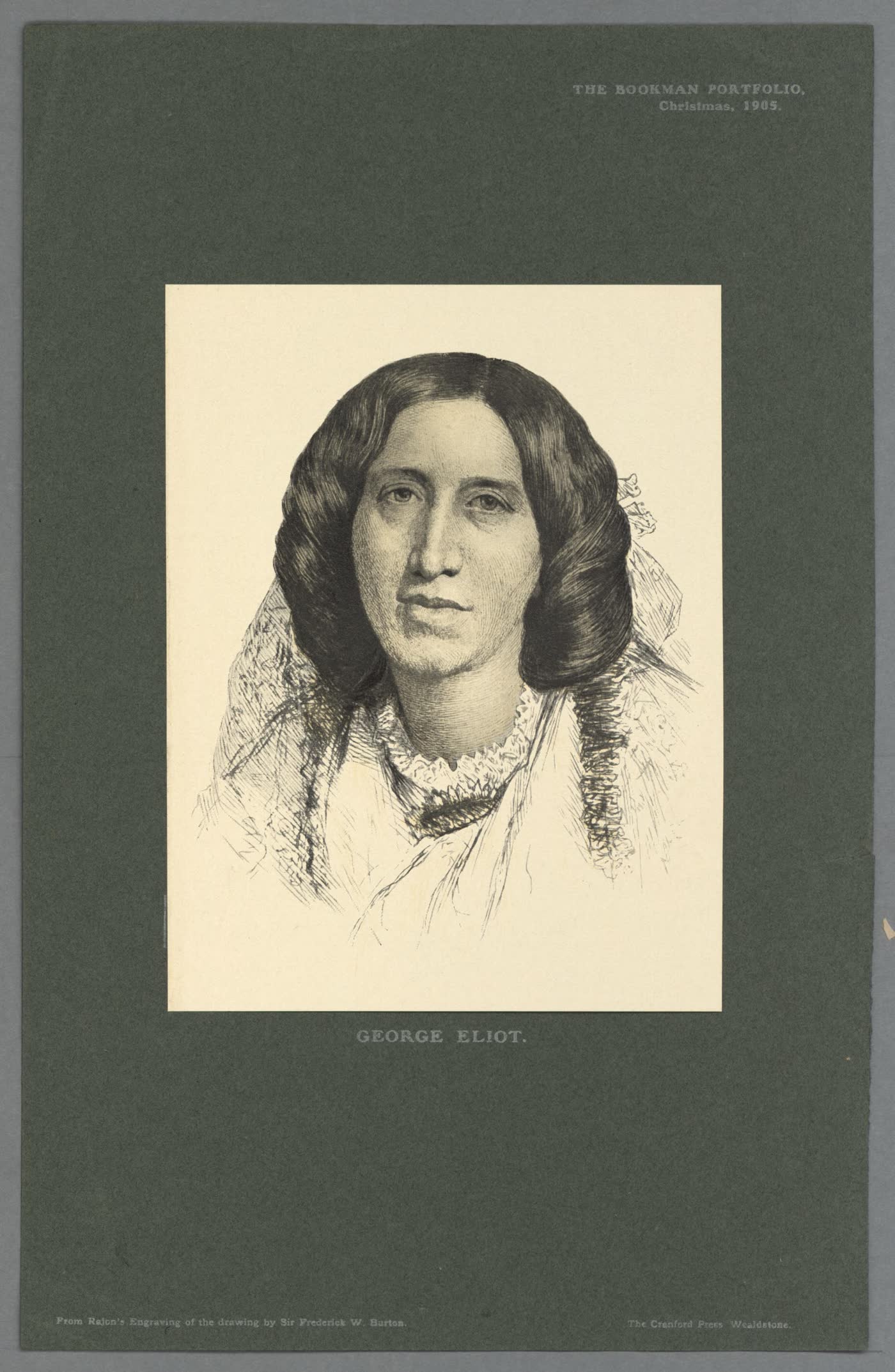
Image context: the cover uses a real archival photographic portrait of George Eliot from Wikimedia Commons. That choice suits the article because this opening is built on acts of reading and being read. A documentary portrait of Eliot keeps the emphasis on composure, observation, and authored scrutiny rather than on decorative period atmosphere.[6]
1) Eliot opens with a question that unsettles beauty itself
The first sentence does not simply present Gwendolen as beautiful. It asks, "Was she beautiful or not beautiful?"[1] That is a brilliant act of refusal. Eliot withholds the clean category that would turn Gwendolen into one more dazzling heroine. Instead, she makes beauty a problem of movement, force, and interpretation. The paragraph keeps worrying at the "secret" of the face and glance, wondering whether good or evil predominates there and why the impulse to look again feels coercive rather than easy.[1]
That opening question is already a method. Eliot does not separate physical appearance from moral atmosphere. Gwendolen's face is not described as a static possession. It is rendered as a field of effects: energy, unrest, command, opacity.[1] The reader therefore enters the novel in the same position that Deronda soon occupies. To look at Gwendolen is to interpret pressure, not merely admire surface.
This is one reason the opening still feels modern. A weaker novel would let beauty authorize innocence or romantic centrality. Eliot does something harder. She makes charisma feel ethically indeterminate. Gwendolen has magnetism, but the magnetism comes mixed with theatrical self-command and inward volatility.[1][5] Long before the novel has to explain her choices, it teaches the reader to register her as a person whose surface has already become labor.
2) The casino is not background scenery; it is a machine for degraded attention
Eliot's Leubronn is one of those spaces where social distinctions remain visible while moral distinctions blur. The room is full of titled people, stale appetites, mechanical habits, and what Deronda sees as "dull, gas-poisoned absorption."[1] The roulette table flattens everyone into the same posture of fixation. That is why the room feels both fashionable and sordid. Elegance survives there only as a surface film over appetite.
Victorian Web's discussion of the later frontispiece illustration gets at an important part of this opening: the gaming table is already a scene of distorted spectatorship.[4] The adults watch the wheel. The child in costume becomes a mute advertisement. Status is present everywhere, and human attention is misdirected everywhere.[1][4] Eliot is not merely decorating the chapter with continental vice. She is building a miniature social world in which seeing has been narrowed, monetized, and made slightly vulgar.
That setting sharpens Gwendolen's self-presentation. She is not merely playing to win money. Eliot lets us feel that she wants the additional thrill of visible mastery, the fantasy of becoming a figure others follow and read for signs.[1] The roulette table offers her a public stage with immediate feedback: coins move, faces turn, luck appears to certify a self. In that sense, gambling is less a subplot here than a technology of self-display. The room lets Gwendolen imagine that poise can be converted into sovereignty.
3) Deronda's gaze turns display into moral discomfort
The scene changes the moment Gwendolen becomes aware that someone is not watching her as part of the spectacle but reading her against it.[1] Eliot is precise about the transition. Deronda's scrutiny moves away from simple admiration toward evaluation; Gwendolen senses that he is measuring her, placing her below him, examining her as if she were a specimen of coarser moral material.[1] Whatever the exact justice of that impression, Eliot makes the bodily effect undeniable. Gwendolen's lips go pale, the orbits of her eyes grow hot, and the certainty of being watched becomes a physical pressure.[1]
This is the scene's great technical achievement. Eliot does not insert a lecture on conscience. She makes conscience arrive as sensation. Gwendolen has not yet accepted any moral verdict. She is still defiant, still doubling down, still trying to preserve command. But the body has already registered what the will cannot contain. Shame enters before self-knowledge has found its argument.[1][5]
The famous detail that Deronda's gaze seems to have acted as an "evil eye" is part of that logic.[1] The phrase matters because it captures Gwendolen's resistance to ethical recognition. She experiences the interruption as hostile magic, as if the problem were not the life she is enacting but the look that exposed its vulgarity. So she continues to play, each lost stake answered by a larger one.[1] The doubling is financial, but it is also theatrical. She is trying to outstare the fact of being seen.
What Eliot captures here is more humiliating than losing money. Gwendolen loses control over the meaning of her own appearance. The glamour she had been inhabiting gets reclassified, almost in real time, as strain. That is why the opening does not read like flirtation. Deronda does not complete her self-image; he destabilizes it.
4) The opening teaches the novel's larger moral scale
Because this chapter is so vivid, it is easy to treat it as a brilliant set piece and move on. But the Leubronn scene quietly installs the novel's larger structure. Gwendolen's later story will keep returning to the same problem: she wants forms of mastery available through surface, status, and tactical choice, yet she repeatedly discovers that those forms exact inward costs she cannot stay indifferent to.[1][2] The roulette table condenses that whole pattern. It gives her a stage, then exposes the stage as a trap.
Deronda's role is also clarified at once. Burdett's discussion of sympathy and antipathy in the novel is useful here because it shows how Eliot keeps making moral feeling unstable rather than automatic.[5] Deronda is not valuable simply because he is good in the abstract. In the opening, he functions as a witness whose attention refuses the room's degraded terms. He looks across the glamour of play and asks, implicitly, what kind of life is being formed there.[1][5] That does not make him omniscient or uncomplicated. It does explain why his presence matters before the novel gives him any programmatic speech.
Britannica's summary of Daniel Deronda emphasizes the novel's exposure of Victorian antisemitism and the scale of Eliot's final ambitions.[2] Eliot's own career, as Britannica notes, had long been marked by psychological analysis and by fiction that made inward consequence central to narrative form.[3] The opening scene is where those two strengths meet. A broad ethical novel begins from a tiny crisis in a gaming room. Eliot trusts that if she gets the pressure inside one gaze right, the larger questions of obligation, identity, and moral reach can grow from that exactness.
5) Why the Leubronn chapter still rewards rereading
The pleasure of this opening lies in how much it makes happen without overexplaining itself. It gives us a public room, a young woman with formidable surface command, a young man whose look carries judgment before intimacy, and a moral disturbance that first appears as nothing more elevated than heat in the eyes and blood leaving the lips.[1] Eliot lets the scene remain dramatic while making every gesture double as diagnosis.
That doubleness is why the chapter endures in the novel's afterlife. Readers return to it for atmosphere and theatricality, but what keeps it alive is the exact calibration of moral weather. The roulette wheel promises chance. Eliot uses it to reveal character under scrutiny. Gwendolen enters the book hoping to convert display into power. She leaves the opening chapter having learned that being seen can break the spell of self-display before any sermon begins. In that conversion from spectacle to inward disturbance, Daniel Deronda announces the seriousness of everything that follows.[1][2][5]
Sources
- George Eliot, Daniel Deronda. Project Gutenberg ebook 7469.
- Encyclopaedia Britannica, "Daniel Deronda."
- Encyclopaedia Britannica, "George Eliot."
- Jacqueline Banerjee, "Gwendolen at the Gaming Table." Victorian Web.
- Carolyn Burdett, "Sympathy–Antipathy in Daniel Deronda." 19 via DOAJ / Open Library of Humanities.
- Wikimedia Commons, "File: George Eliot (5227611).jpg" (lead-image source page).