Many first-time readers approach The Magic Mountain as if it were a mountain in the bad sense: a prestige climb, a test of stamina, a book one is supposed to finish with a notebook full of philosophy terms and a slightly improved posture. That expectation is the wrong burden to carry uphill. Even the Goethe-Institut's recent advice for Thomas Mann novices starts by pushing against the book's intimidating reputation.[2] The novel is large, but its intelligence is not locked behind ceremonial difficulty. It wants to change your tempo before it asks for your conclusions.
So the cleanest way in is not plot-first and not thesis-first. Hans Castorp arrives at a Swiss tuberculosis sanatorium for what is meant to be a three-week visit to his cousin Joachim and winds up staying seven years.[1][3] If you read only for "what happens," the early pages can feel perversely slow; if you read only for ideas, the long debates can harden into homework. The better route is to read the novel as a system of acclimatization. It keeps retraining the reader through three linked pressures: the measured body of the sanatorium, the long weather of conversation, and the growing sense that private delay on the mountain belongs to a larger European crisis below.[3][4][6]
That approach also respects where the book came from. Graubunden's Thomas-Mann-Weg page ties Mann's Davos impressions to his 1912 visit to his wife Katia at the Waldsanatorium, while Thomas Mann International notes that the writer later folded those experiences into the work he composed during his Bad Tolz years.[4][5] Place matters here. The Magic Mountain is not a free-floating allegory. It is a novel built from balconies, measured temperatures, dining-room ritual, snowlight, and the strange social intimacy of a place organized around illness.
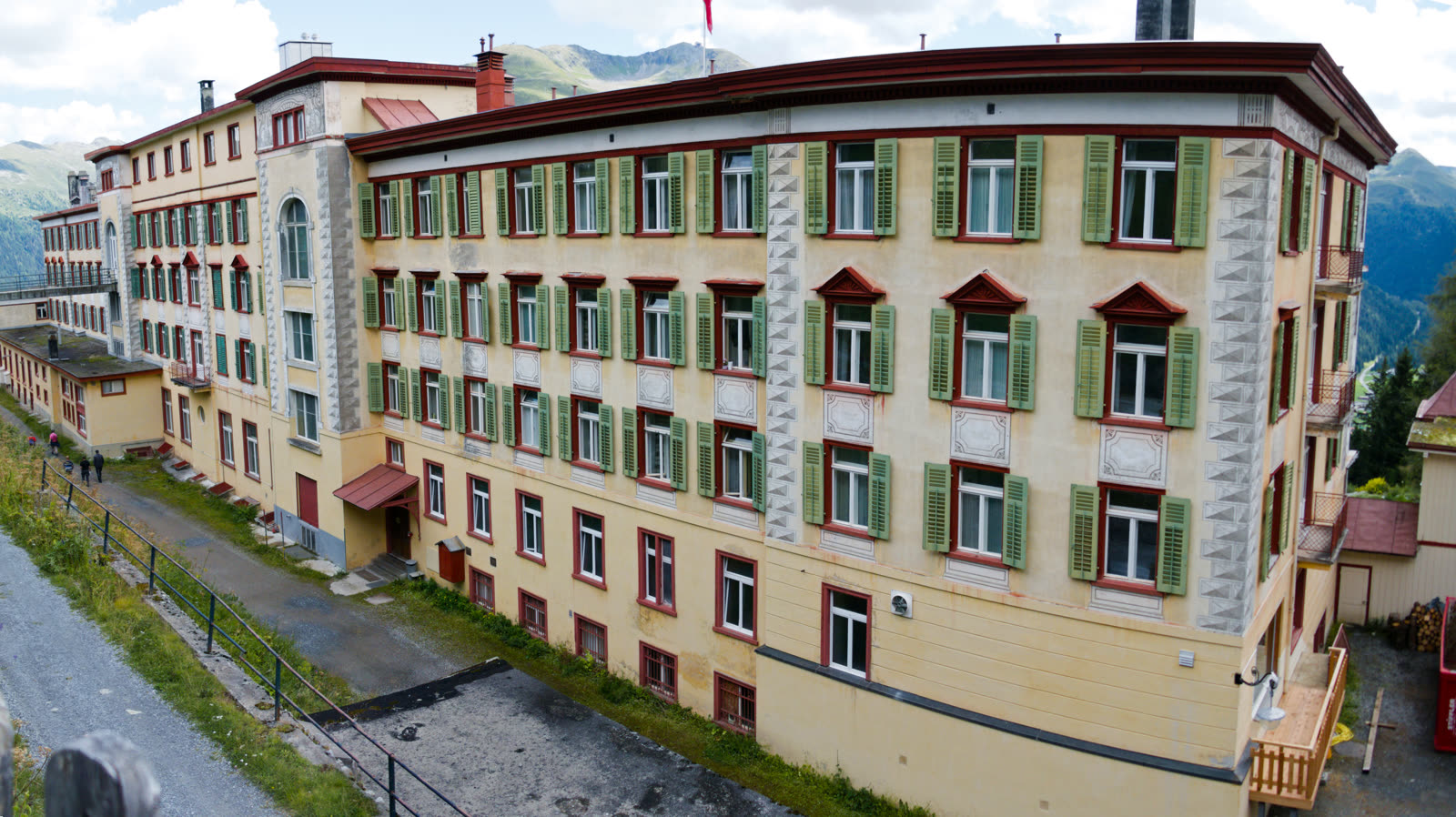
Image context: the lead image uses a real Wikimedia Commons photograph of Berghotel Schatzalp in Davos. A concrete mountain building is the right visual here because this novel works through architecture, altitude, and cure routine before it works as abstract "European ideas" fiction.[7]
1) Start by surrendering to the institution
The first hundred pages go better if you stop asking when the real plot will begin. The real plot has already begun: a healthy visitor enters a place where categories loosen, routines thicken, and time stops behaving like ordinary bourgeois time. Penguin's edition copy is concise on the basic frame: the sanatorium functions as a microcosm of Europe in the years before the First World War.[3] That phrase is useful, but only if you do not make it too schematic too soon. Before the book becomes a map of Europe, it becomes a map of climate, appetite, posture, and duration.
Read the opening stretch as environmental conversion. Castorp is being taught how to sit, rest, eat, listen, wait, and notice. The mountain teaches him that delay can feel luxurious before it becomes dangerous. Graubunden's Thomas-Mann-Weg description makes this spatial logic vivid even outside the novel: a 2.8-kilometer path from the former Waldsanatorium up toward Schatzalp, with ten literary stations tied to the book and Mann's Davos walks above the cure world.[4] That is the right scale to imagine while reading. The novel is always moving between room routine and mountain air, between enclosure and outlook.
If the early chapters feel uneventful, do not fight them. Let the daily pattern accumulate. Mann is training the reader to feel why life on the mountain can become seductive before it becomes morally confusing.
2) Pick one entry route and keep it for a while
You do not need to read all of The Magic Mountain with equal attention to every layer at once. Choose a route and stay with it long enough to build momentum.
- Route A: the body-and-measurement route. Track thermometers, rest cures, meals, coughs, x-rays, and every small ceremony that turns the body into a timetable. This route makes the sanatorium feel less like backdrop and more like a machine for reorganizing desire and self-perception.[1][4]
- Route B: the talk-and-argument route. Follow Settembrini, later Naphta, and the novel's great habit of turning conversation into weather. Read the debates for pressure, tone, and seduction, not only for abstract doctrine. Who expands Castorp's horizon, who tightens it, who flatters him, who exhausts him: those questions matter more than keeping score in a philosophy tournament.[2][6]
- Route C: the weather-and-temptation route. Stay close to Clavdia Chauchat, the snow chapter, music, dreams, and the way illness keeps shading into erotic and metaphysical suggestion. This route helps if the book's essayistic passages start to feel too dry, because it keeps the sensory and fatal atmosphere in view.[3][8]
All three routes lead toward the same recognition. The mountain is not only a setting where people happen to speak. It is an altitude chamber that changes what speech, waiting, flirtation, and seriousness feel like.
3) What to annotate so the book opens instead of simply lengthening
Use a very small annotation system.
- Time words. Mark every place where time stretches, loops, stalls, or loses proportion. This novel keeps asking whether duration changes character or merely exposes it.[1][2]
- Vertical and horizontal life. Up, down, lying out, climbing, balconies, dining rooms, snowfields, plains below: Mann turns altitude into a moral and perceptual instrument.[4][5]
- Voices under pressure. Do not annotate arguments by topic only. Annotate them by temperature. Which speakers make the air feel brisk, stale, fevered, theatrical, humane, or cruel?[2][6]
- The return of the outside world. Letters, news, visitors, departures, and finally war matter because the novel never lets the mountain become a sealed fairy kingdom. History keeps pressing at the glass.[3][6]
That is enough. If you annotate every allusion, you may slow the book into paralysis. If you annotate these four signals, the long middle will usually begin to cohere on its own.
4) Where readers stall, and the reset that works
Most readers stall in one of two places. Either the sanatorium routines start to feel too repetitive, or the discussions become so extended that the book seems to turn into a seminar with blankets. Both experiences are normal. The reset is simple:
- Write down what the mountain is making easier for Castorp.
- Write down what it is making harder: decision, proportion, ordinary work, ordinary love, ordinary urgency.
- Resume reading with one question in mind: which kind of civilization is this mountain educating him toward?[1][3][6]
That question gives the big debates a dramatic use. Settembrini and Naphta cease to be names you are meant to master and become rival claims on Castorp's inner weather. Even the repetitions start to work differently once you see that Mann is measuring how comfort can slide into enthrallment.[6][8]
5) Keep the snow chapter in reserve
If you want one section to hold in mind as a promise, keep the snow chapter there. You do not have to rush to it, but it helps to know the book has a center of gravity waiting for you. In that episode, the mountain strips away some of its charm and reveals the moral stakes that have been gathering under the novel's luxurious slowness. What looked like delay becomes a test of whether thought can remain humane when fascination with death, spectacle, and abstraction grows too strong.[6][8]
That is why the novel still feels alive in 2026. The Nobel presentation speech for Mann treated The Magic Mountain as evidence of a struggle of ideas moving toward a more explicit humanist commitment.[6] You do not need to flatten the book into a thesis about Europe to feel that force. It is enough to notice how patiently Mann converts atmosphere into judgment. The mountain gives Castorp rest, temptation, rhetoric, and dream; it also teaches the reader how thin the line can be between cultivated delay and historical sleepwalking.
So the best way in is to accept the book on its own terms. Read for altitude first, argument second, and approaching weather all along. Once those three layers are in place, The Magic Mountain stops looking like a monument you must conquer and starts behaving like what it really is: a long, sly, sensuous education in time.
Sources
- Thomas Mann, Der Zauberberg. Erster Band (Project Gutenberg edition).
- Goethe-Institut, "Reading tips for the 'Magic Mountain'".
- Penguin Random House, The Magic Mountain by Thomas Mann, translated by John E. Woods.
- Graubunden Ferien, "Thomas-Mann-Weg".
- Thomas Mann International, "Bad Tolz: Summer Home of Thomas Mann and His Family, 1909-1917".
- NobelPrize.org, Presentation Speech for the 1929 Nobel Prize in Literature.
- Wikimedia Commons, "File:Davos - Berghotel Schatzalp.jpg".
- Thomas Mann, Der Zauberberg. Zweiter Band (Project Gutenberg edition).